


Agent Lightning
NexusAi Summary: Agent Lightning is a compact, Kubernetes-first framework for training and running production-grade AI agents with rollout-driven pipelines and native cluster orchestration.
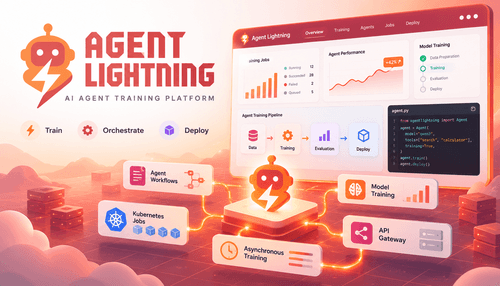
NexusAi Overview
The workflow centers on collecting rollouts from instrumented agents, aggregating traces, and using those structured trajectories for supervised or reward-based training. Agents interact via a model proxy so the same harness code works in research and production without structural changes.
Capabilities and technical scope
Agent Lightning targets ML engineers, research teams, and platform operators who need deterministic rollouts, reproducible training inputs, and Kubernetes-native deployment. It is suitable for building evaluable coding agents, reasoning agents, and retrieval-augmented systems that require controlled tool access and observable execution traces for debugging and auditing.
- Collect structured rollouts from instrumented agents with minimal code changes.
- Run agents as Kubernetes Jobs for reproducible, scalable executions.
- Proxy model calls to preserve tool integrations and execution context.
- Aggregate traces and trajectories for supervised or reward-driven training.
- Ship example pipelines for coding, reasoning, and multimodal QA workloads.

Why engineers choose Agent Lightning
Typical quote from documentation
Begin with the quick-start guide: install the Python package, run a local end-to-end rollout-driven job, and inspect collected traces. Move to controller configuration to run rollouts as Kubernetes Jobs and connect the API gateway to your model proxy. The documentation includes configuration for trainer integrations, examples for coding agents and multimodal QA, and notes on reward-hacking prevention. For production use, follow the Kubernetes Job templates, secure the API gateway, and adopt the provided trace aggregation formats to keep training inputs consistent across environments.
NexusAi: Run the same agent harness end-to-end: local debugging, rollout collection, then production-scale Kubernetes jobs.
Getting started and installation
Agent Lightning is a pragmatic foundation for teams building observable agent systems. Its strengths are minimal surface area, Kubernetes-first deployment, and preserved tool-context rollouts, which together reduce engineering friction when moving experiments into reproducible production jobs.
Open the tool and review its core product experience.
Create your account or access your existing workspace.
Use your own task to judge speed, quality, and fit.
Check similar AI tools before making a final decision.

Agent Lightning
Microsoft Research authors designed Agent Lightning as a concise framework for reproducible agent training and orchestration. Their work focuses on practical, auditable rollouts and enabling a smooth transition from experiments to cluster deployments.
Agent Lightning is a lightweight open-source framework for building, training, and deploying interactive AI agents. It couples rollout-driven training harnesses with a model proxy that preserves tool integrations, control flow, and environment interactions without modifying agent code. Designed for production workflows, the project emphasizes simplicity, predictable traces, and Kubernetes-native execution: agents run as Kubernetes Jobs with integrated API gateway and controller components. The codebase focuses on reproducible training, reward-hacking mitigation, and practical examples—coding agents, multistep reasoning, and multimodal QA—so teams can iterate from local end-to-end rollouts to cluster-scale training. Use it when you need transparent agent rollouts, traceable trajectories, and a direct path from research experiments to orchestrated production jobs.
Visit Agent Lightning
Comments (0)
No Comments Found