


Claude Haiku 5.5
NexusAi Summary: Claude Haiku 5.5 is a fast, low-cost small model tuned for high-volume, latency-sensitive tasks like summarization, classification, and subagents. It trades deep multi-step reasoning for throughput and consistent inference speed at scale.
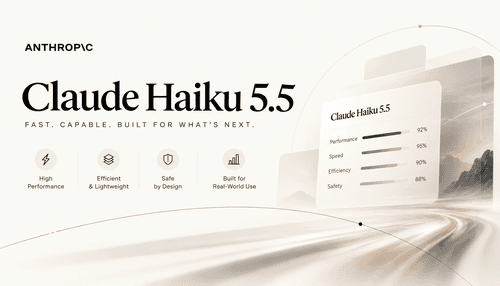
NexusAi Overview
In practice Haiku 5 5 is best placed where thousands or millions of compact requests are executed daily. Use it for document-level lookups, short summaries, classification pipelines, cache-backed retrieval, and real-time support routing. Teams commonly deploy Haiku 5 5 as a lightweight sidecar model that handles high-frequency chores while delegating complex reasoning to larger models.
Capabilities and trade-offs
Ideal adopters are platform engineers, product teams, and AI integrators who must run vast numbers of quick calls with tight latency and cost targets. It suits customer-support routing, high-frequency document question answering, routine summarization, and subagent workloads inside multi-model orchestration. Research teams and founders will also find it useful for prototyping scale-sensitive agents without committing heavy compute budgets.
- Runs very low-latency inference for high-frequency short requests.
- Adjustable effort setting lets teams trade cost for improved output quality.
- Pair as a subagent with larger Claude models for mixed compute pipelines.
- Optimised token pricing for prompts up to approximately one hundred thousand tokens.
- Safer default guardrails restrict hazardous cybersecurity and high-risk biology outputs.

Where Haiku 5 5 shines
User quote
Haiku 5 5 is available now on the Claude Platform and through cloud marketplaces on AWS, Google Cloud, and Azure. Developers can call the model via Anthropic’s API and use the Python or TypeScript SDKs for browser and computer-use integrations. The platform provides a migration guide, a monthly API credit for certain subscription tiers, and documentation covering the adjustable effort parameter, pricing nuances, and recommended subagent patterns. For production use, teams should test effort settings, instrument cache reads and writes, and combine Haiku 5 5 with larger models for multi-step or agentic tasks.
NexusAi: “Haiku 5.5 materially reduced latency on high-volume tasks while cutting inference cost, making large-scale subagents practical.”
How to get started
For teams that prioritise latency and volume over deep multi-step reasoning, Haiku 5 5 is a practical choice. Its combination of adjustable effort, markedly lower token costs, and modest safety tightening makes it a straightforward substitute for expensive calls in bulk pipelines. Use Haiku 5 5 when you need economical, consistent answers at scale and pair it with larger models only for tasks that require more sophisticated reasoning.
Open the tool and review its core product experience.
Create your account or access your existing workspace.
Use your own task to judge speed, quality, and fit.
Check similar AI tools before making a final decision.

Claude Haiku 5.5
Anthropic is a research-first AI company building safety-minded foundation models and developer tooling. Its work focuses on scalable model design, clearer guardrails, and APIs that let engineers integrate models into product and infrastructure safely.
Claude Haiku 5.5 is Anthropic’s purpose-built small model for high-volume, cost-conscious production workloads. It delivers the fastest inference of the Haiku family and is priced to make repetitive tasks economical: compaction, single-document question answering, classification, and short-form summarization. Haiku 5 5 includes an adjustable effort setting so teams can tune the cost–quality balance per request, and it integrates easily as a subagent alongside larger Claude models for mixed-compute pipelines. Benchmarks included in the launch show material gains in throughput and token-cost efficiency versus previous Haiku versions while preserving improved safety constraints. The model is available across major clouds and the Claude Platform, and it pairs with Anthropic’s Python and TypeScript SDKs for browser and computer-use integrations in beta.
Visit Claude Haiku 5.5
Comments (0)
No Comments Found