


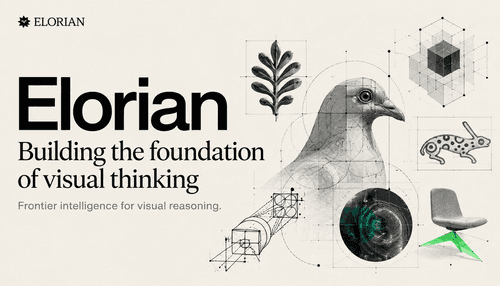
Elorian
NexusAi Summary: Elorian develops visual-thinking foundation models that reason about spatial relationships, design intent, and physical constraints to solve real-world visual problems where text-first approaches fail.
NexusAi Overview
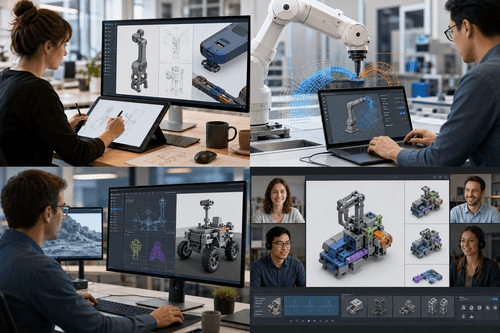
Workflows center on image-native inputs: sketches, photographs, and multi-view captures that the model ingests directly to produce structured hypotheses, constraints, and proposals. Outputs target actionable artifacts—annotated plans, constraint-aware edits, or symbolic descriptions suitable for downstream systems and human review.
Capabilities and technical approach
The platform is aimed at researchers, product teams, and practitioners who need robust image-native reasoning: designers validating form and function, robotics engineers requiring spatial constraints, and research labs studying grounded visual cognition. It is particularly relevant where concise textual descriptions are insufficient or error-prone.
- Ingests sketches, photos, and multi-view captures as primary inputs.
- Extracts spatial constraints, affordances, and structural relationships from images.
- Produces structured, verifiable outputs for downstream systems and human review.
- Prioritizes multi-view consistency and geometry-aware training to reduce hallucinations.
- Supports research collaborations and early-access programs for developer feedback.
Why visual-first models matter
A measured research posture
Elorian currently engages partners through research collaborations and an early-access program; documentation, papers, and demonstration assets are published on the company blog. Practitioners start by applying for access, reviewing evaluation notebooks, and testing sample pipelines with curated datasets. For teams accepted into the program, Elorian provides integration guidance, evaluation scripts, and technical support to validate model outputs against project-specific constraints.
NexusAi: Elorian treats images as primary reasoning substrate, prioritising geometric consistency and actionable structure over text-first shortcuts.
Getting started
Elorian’s core differentiator is its visual-first engineering: models designed to keep spatial structure and validate against physical priors. That reduces brittle language-mediated reasoning and makes outputs more actionable for design, robotics, and research settings where visual fidelity matters most.
Open the tool and review its core product experience.
Create your account or access your existing workspace.
Use your own task to judge speed, quality, and fit.
Check similar AI tools before making a final decision.

Elorian
Founded by researchers from major labs, Elorian combines expertise in visual representation learning, geometry, and systems research to build models that reason directly in images for real-world use.
Elorian builds foundation models designed to think natively in the visual modality rather than translating images into text first. The team focuses on spatial, structural, and relational reasoning — enabling models to infer geometry, constraints, and design intent from images and sketches. Research combines large-scale visual pretraining, multi-view geometry, and task-conditioned reasoning to reduce hallucination and improve grounded visual decision-making. Elorian positions these models for designers, roboticists, and researchers who need reliable image-native reasoning, with an emphasis on reproducible research, open evaluation, and developer access paths for early collaborators.
Visit Elorian
Comments (0)
No Comments Found