


FBR
NexusAi Summary: FBR builds stabilized long‑boom robots for uncontrolled environments, led by Hadrian bricklaying, Mantis welding, and Firehawk ladle lining. Powered by Dynamic Stabilisation Technology (DST), the systems deliver precision, speed, and reliability for construction and steelmaking operations at industrial scale.

NexusAi Overview
FBR platforms arrive as integrated machines with stabilization, motion control, and application tooling. After site setup and calibration, DST holds the working point steady while bricks, wire, or refractory are delivered. Operators supervise, stage materials, and manage work sequencing as the robot executes repeatable paths with continuous quality monitoring.
What it does
FBR serves contractors, fabricators, and operators responsible for repetitive, precision tasks in variable outdoor or heavy‑industrial conditions. Ideal users include general contractors and masonry specialists seeking schedule compression, steel shops chasing higher arc‑on time, and mills aiming to standardize ladle relines. Engineering managers and operations leaders evaluating cost, safety, and availability trade‑offs will benefit most when projects involve long reaches, inconsistent footing, or weather‑exposed workfaces.
- Stabilizes long-boom end effectors to maintain precise toolpaths in unstable environments.
- Automates high-throughput bricklaying with accurate course placement and continuous material delivery.
- Delivers large-scale welding productivity with controlled travel speed and consistent bead quality.
- Executes refractory ladle lining tasks with repeatable placement inside harsh foundry conditions.
- Reduces rework and exposure by moving workers off repetitive, hazardous access tasks.
Why it matters
Who it’s for
Getting started typically begins with a project discussion via FBR’s contact form, followed by scope definition and a site assessment. The team recommends the appropriate platform—Hadrian, Mantis, or Firehawk—and outlines mobilization, jobsite setup, safety procedures, and operator training. Commissioning includes calibration and trial runs to validate placement accuracy, weld quality, or refractory coverage against specifications. Many customers adopt a service-led approach, including Walls‑as‑a‑Service (WaaS) for brickwork, to de‑risk deployment before scaling. Ongoing support covers maintenance, spares, and process optimization as workloads ramp.
NexusAi: DST keeps the tool steady when the environment won’t—precision where fixed cells fail.
Getting started
Choose FBR when projects demand long reach, tight tolerances, and reliable output in unstable settings. DST keeps toolpaths accurate where scaffolds sway, trucks idle, or weather shifts. With category‑specific platforms and a service‑oriented adoption path, FBR helps teams compress schedules, improve safety, and achieve consistent quality at industrial scale without building fixed automation cells.
Open the tool and review its core product experience.
Create your account or access your existing workspace.
Use your own task to judge speed, quality, and fit.
Check similar AI tools before making a final decision.

FBR
Founded in Australia, FBR Ltd designs, prototypes, and deploys stabilized long‑boom robotics for uncontrolled environments. The ASX‑listed company (FBR) pioneered Dynamic Stabilisation Technology and productized it across construction and steelmaking applications, including the Hadrian bricklaying robot, Mantis welding platform, and Firehawk ladle‑lining system.
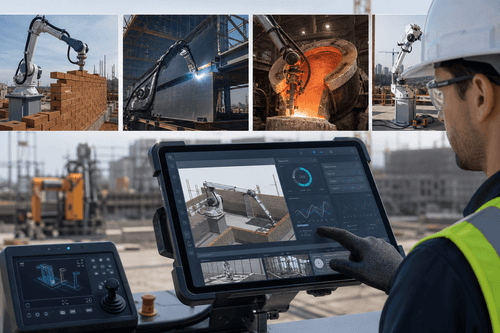
FBR is an industrial robotics company advancing autonomous work in real‑world, unstable environments. Its core innovation, Dynamic Stabilisation Technology (DST), fuses sensors, control software, and rapid mechanics to actively counteract motion and vibration along long‑reach booms. The portfolio includes Hadrian, a site‑deployable bricklaying robot; Mantis, a high‑reach welding platform targeting up to 4× productivity; and Firehawk, a ladle‑lining robot engineered for harsh steelmaking foundries. By stabilizing the tool center point despite environmental disturbance, FBR enables accurate placement, continuous material delivery, and consistent welds at scale. Teams use the systems to compress schedules, reduce rework, and improve safety where manual access is slow, repetitive, or hazardous.
Visit FBR
Comments (0)
No Comments Found