


Gemini Robotics 2
NexusAi Summary: Gemini Robotics 2 is Google DeepMind’s vision-language-action and embodied reasoning stack for real-world robots. It translates perception and language into motor control, plans multi-step tasks, enables whole-body dexterity, and coordinates multiple robots across dynamic, human-centered environments.
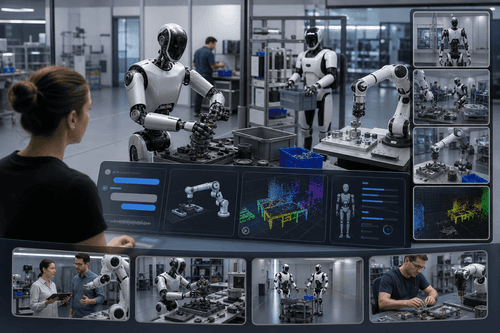
NexusAi Overview
Teams integrate Gemini Robotics 2 to perceive scenes, plan multi-step tasks, and execute robust motion across hands, arms, and legs. The system fuses visual context and plain-language goals to produce actionable control trajectories, adapting in real time as environments change, users intervene, or workloads are divided across multiple robots.
Capabilities
Designed for robotics teams building general-purpose manipulators and humanoids, enterprise automation groups, lab researchers exploring embodied AI, and startups piloting service, warehouse, or field deployments. It suits scenarios where tasks vary daily, environments shift, and collaboration with people or heterogeneous robots is required. Technical buyers seeking adaptable control, explainability during execution, and minimal retuning across hardware will benefit most, particularly when safety, accountability, and operational uptime are key constraints.
- Converts vision and language into precise, low-latency motor commands for robots.
- Generates long-horizon plans with spatial reasoning and dynamic constraint handling.
- Coordinates multi-robot workflows, enabling communication, task division, and re-planning flexibly.
- Delivers whole-body humanoid control for balance, reach, grasp, and locomotion.
- Adapts to new embodiments quickly, including efficient on-device execution options.
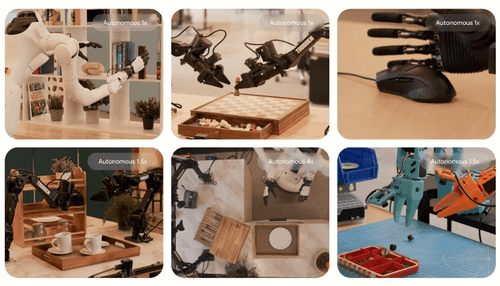
Key Capabilities
Who It’s For
Access currently runs through a growing trusted-tester program and research partnerships with robotics hardware providers. Teams define target embodiments and tasks, then collaborate on data collection, controller bring-up, and evaluation protocols. Natural-language interfaces enable operator-in-the-loop trials without extensive low-level programming. Documentation covers model capabilities, embodiment adaptation workflows, and recommended safety practices. On-device variants are considered where latency, privacy, or offline operation are priorities. Organizations pursuing early pilots should outline hardware specs, representative task suites, and facility constraints to accelerate scoping. As readiness increases, staged deployments validate reliability, recovery behaviors, and human-robot interaction under realistic throughput and downtime objectives.
NexusAi: Perceive, reason, and act—one integrated stack for robots that work safely with us.
Getting Started
Gemini Robotics 2 combines world-aware planning and high-precision control in a single, adaptable stack. It generalizes across embodiments, supports explainable, natural-language supervision, and scales from on-device edge execution to multi-robot collaboration. Backed by DeepMind’s safety work and partnerships, it targets practical reliability in unstructured spaces where brittle, single-task systems fail. For teams seeking fast bring-up, dexterous manipulation, and coordinated humanoid operation, it presents a credible path toward versatile, production-grade robotics.
Open the tool and review its core product experience.
Create your account or access your existing workspace.
Use your own task to judge speed, quality, and fit.
Check similar AI tools before making a final decision.

Gemini Robotics 2
Google DeepMind is an AI research and engineering organization advancing general intelligence for real-world impact. Its work spans foundational models, embodied AI, safety, and applied science. The Gemini family unifies multimodal perception, reasoning, and control, enabling developers and partners to translate cutting-edge research into robust systems for industry, science, and society.
Gemini Robotics 2 is DeepMind’s most advanced vision-language-action (VLA) model paired with an embodied reasoning (ER) model for world-aware planning. VLA converts multimodal inputs into low-latency motor commands for arms, hands, and full humanoid bodies. ER maps physical spaces, reasons over constraints, and generates long-horizon, multi-step plans that can be executed, monitored, and adapted on the fly. Together, they enable precise whole-body control, delicate manipulation, and multi-robot collaboration in shared, dynamic environments. The stack adapts to new embodiments, with reported hours-level bring-up for bi-arm platforms and efficient on-device variants for resource-constrained hardware. Interaction is natural: users can provide everyday instructions, redirect behavior mid-task, and receive explanations of intent and progress. Safety is addressed through layered safeguards and collaboration with external experts. Research partnerships with leading hardware companies demonstrate the system across diverse manipulators and humanoids, while a growing trusted-tester program evaluates reliability, usability, and deployment readiness in real-world operations.
Visit Gemini Robotics 2
Comments (0)
No Comments Found