


GPT-SoVITS
NexusAi Summary: GPT-SoVITS is an open-source WebUI for few-shot voice cloning and cross-lingual TTS. It delivers zero-shot synthesis from 5-second samples or higher fidelity with one-minute fine-tuning, GPU or CPU inference, dataset tooling, ASR-assisted labeling, and Docker or Conda deployments.

NexusAi Overview
Start with a short reference clip, clean it using built-in separation, segment long recordings automatically, and create transcripts with multilingual ASR. Then fine-tune for roughly a minute of data, select checkpoints, and synthesize natural, cross-lingual speech locally on GPU or CPU.
Capabilities and Architecture
Ideal for speech researchers, ML practitioners, audio engineers, localization teams, VTubers and creators, product teams prototyping voice features, and educators exploring modern TTS. It especially benefits teams with limited voice data, multilingual requirements, or on-prem constraints. Use it to prototype brand voices, produce character dialog, localize content across languages, or stand up internal voice services without sending data to external providers.
- Generate zero-shot speech from a five-second reference sample across supported languages.
- Fine-tune with about one minute of audio for stronger timbre similarity.
- Separate vocals and remove reverb to clean data using integrated UVR5.
- Auto-segment, transcribe, and proofread datasets with multilingual ASR backends built-in.
- Run locally via Conda or Docker with GPU or CPU-optimized inference.
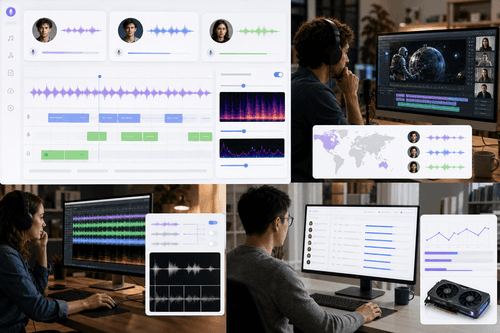
Why It Matters
Who It's For
Choose the Windows integrated package for the simplest launch, or install via Conda on Linux, macOS, or Windows. A Docker Compose setup provides reproducible environments with GPU or CPU options. Download the required pretrained checkpoints, then open the WebUI to prepare data: separate vocals, segment long recordings, and auto-transcribe for labels. For few-shot, curate approximately one minute of clean clips, start fine-tuning, and monitor checkpoints. Use the inference interface to select a reference, enter text, pick language, and render audio. Versioned model families allow selecting trade-offs across stability, fidelity, and speed.
NexusAi: One-minute fine-tuning makes high-quality, cross-lingual voice cloning attainable on everyday hardware.
Getting Started
GPT-SoVITS stands out by combining minimal-data cloning, cross-lingual synthesis, and fully integrated dataset tooling in a single, local-first workflow. With sub-real-time performance on mainstream GPUs and a CPU option when needed, teams can prototype, evaluate, and iterate voices quickly while keeping assets and training data under their control.
Open the tool and review its core product experience.
Create your account or access your existing workspace.
Use your own task to judge speed, quality, and fit.
Check similar AI tools before making a final decision.

GPT-SoVITS
RVC-Boss and contributors maintain GPT-SoVITS, a community-driven project focused on practical speech synthesis and voice conversion. The team emphasizes reproducible pipelines, multilingual text frontends, efficient inference, and accessible tooling that lowers data requirements for high-quality cloning and TTS experimentation across consumer and research hardware.
GPT-SoVITS is a production-ready, open-source system for voice conversion and text-to-speech that works with minimal data. A GPT-style acoustic model paired with a SoVITS/vocoder stack enables zero-shot synthesis from a 5-second sample or stronger similarity via about one minute of fine-tuning. The WebUI bundles practical tools for dataset creation: vocal/accompaniment separation (UVR5), automatic segmentation, and multilingual ASR (FunASR-Nano, SenseVoice, classic FunASR, or Faster-Whisper) for labeling and proofreading. Cross-lingual inference spans English, Japanese, Korean, Cantonese, and Chinese. Optimized pipelines achieve sub-real-time inference on common GPUs, with a CPU-optimized path available when acceleration is not. Versioned releases (including v2, v3, v4, and v2Pro) emphasize stability, timbre fidelity, and, in newer builds, native 48 kHz output. Deploy with a Windows integrated package, Conda environments, or Docker Compose for reproducible setups.
Visit GPT-SoVITS
Comments (0)
No Comments Found