


Graphify
NexusAi Summary: Graphify is an on-device engine that turns codebases, documents, meetings, and browsing history into a single, incrementally maintained knowledge graph. It patches only affected nodes on change, delivers path-aware answers with sources, and preserves privacy with zero telemetry.

NexusAi Overview
Point Graphify at a repository or workspace to decode entities and relationships in one pass. Next, run the watcher to patch only what changed. Query across files, notes, and transcripts to follow connections, inspect blast radius, and export evidence—without re-indexing the rest of the corpus.
Capabilities and Architecture
Graphify fits engineers onboarding to large codebases, product and platform teams tracing architectural choices, researchers mapping literature and notes, and operators connecting meetings, drafts, and decisions. Legal and regulated environments gain private, on-device processing; enterprise deployments support teams with role controls and audit trails. Use it to uncover ownership, understand blast radius before changes, and reconstruct why something shipped the way it did—without paging colleagues or re-running brittle indexing jobs.
- Build a unified, AST-native knowledge graph from polyglot codebases, documents, images, and transcripts to centralize technical, operational, and research context in a single traversable structure.
- Continuously patch only affected nodes and edges on file change, avoiding expensive re-embeddings, stale clusters, and full index rebuilds across large, evolving repositories.
- Query relationships with path explanations, sources, and confidence, tracing dependencies, decisions, and authorship across code, specs, meetings, and browser activity in seconds.
- Surface hidden communities and high-betweenness god nodes via Leiden clustering to understand coupling, ownership, and change risk before refactors or policy updates.
- Run fully on-device with zero telemetry; adopt enterprise options for team graphs, role-based access, SSO, audit logging, and air-gapped or managed deployments.
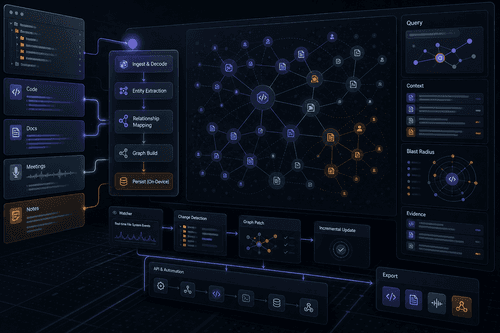
What You Can Do with Graphify
Who Uses It
Installation is straightforward: use uv or pip to install the package (for example, uv tool install graphifyy), then run graphify . to build the initial corpus. Start graphify watch to track changes and patch only affected nodes and edges. Use graphify query to follow relationships with path explanations, and export HTML and JSON reports for review. Open source runs fully on-device with zero telemetry. Enterprise adds team graphs, role-based access, SSO, audit logging, and deployment options spanning local, air-gapped, or managed environments for million-file corpora.
NexusAi: Finally, a knowledge graph that keeps up with change: incremental updates, path-aware answers, and zero cloud dependency.
Getting Started and Deployment
Graphify’s edge is simple: a living, on-device graph that patches incrementally, reasons over relationships, and scales without rebuilds. It turns sprawling, multi-format work into structured context you can query and trust. Choose open-source for private, local operation, or enterprise for team graphs, governance, and deployment freedom.
Open the tool and review its core product experience.
Create your account or access your existing workspace.
Use your own task to judge speed, quality, and fit.
Check similar AI tools before making a final decision.
Graphify
Graphify Labs builds open-source knowledge infrastructure focused on privacy, determinism, and scale. The team blends compiler design, information retrieval, and graph theory to decode heterogeneous artifacts into dependable structures. They steward an active community and offer enterprise features for organizations requiring governance, support, and deployment flexibility.
Graphify builds a persistent, traversable knowledge graph from everything you work with—source code, PDFs, notes, transcripts, and browser activity—running entirely on your machine. Unlike RAG pipelines that re-embed corpora after each edit, Graphify performs AST-native extraction across 20+ languages and patches only impacted nodes and edges. The result is a living graph that scales from initial indexing to enterprise-sized corpora without full rebuilds. Queries traverse entities and relationships with path explanations and sources, so you can trace decisions, dependencies, and context in seconds. Leiden clustering surfaces communities and high-betweenness god nodes to expose blast radius and hidden connectors. A live watcher keeps graphs fresh as files change; HTML exports and JSON reports support audits and sharing. Open source under MIT with on-device privacy; an enterprise edition adds team graphs, role-based access, SSO, audit logs, and deployment options from air-gapped environments to managed cloud.
Visit Graphify
Comments (0)
No Comments Found