


Hume
NexusAi Summary: Hume’s Audio Decision API is an audio-native judgment engine that converts raw speech and sound into structured, probabilistic decisions for evaluation and deployment workflows. It measures tone, timing, interruptions, and background context without relying on transcripts.
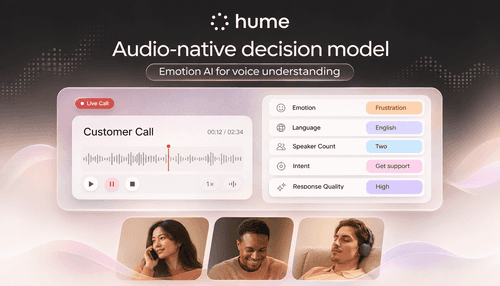
NexusAi Overview
Hume replaces multi-step pipelines with one model that reasons over speech, sound, and conversational context. Instead of separate STT, diarization, and classifier outputs, the API produces aligned probabilistic answers suitable for automated rules and human review, reducing orchestration and timestamp reconciliation.
Capabilities and outputs
Hume targets ML engineers, evaluation researchers, and product teams building voice agents, contact-center automation, and voice UX. It is particularly useful where timing, interruption, and affect matter—customer support, healthcare calls, and voice assistants—because it captures attributes transcripts miss and produces metrics for both automated checks and human judgment workflows.
- Returns calibrated probabilities for categorical and binary audio judgments.
- Detects speaker counts and alignable timestamps for conversational analysis.
- Measures tone, expression, interruption, and background intrusion directly from audio.
- Integrates with human rater pipelines for hybrid automated and subjective evaluation.
- Supports stress tests across accents, noise levels, and conversational perturbations.

Why it matters
A measured workflow
Begin with Hume’s API by provisioning an API key, selecting evaluation questions, and uploading sample recordings or live agent streams. Use the User Testing API to recruit participants and the Human Feedback API to manage trained rater tasks. Documentation includes request/response examples, schema for custom questions, examples for timestamp alignment, and guidance for interpreting probabilistic outputs and setting pass/fail thresholds.
NexusAi: We evaluate voice systems on timing, tone, and interruption—not just words—so teams can fix the precise failure modes that matter to users.
Getting started
Hume’s core differentiator is an audio-first decision model that preserves timing and expression while returning actionable, probabilistic outputs. It streamlines evaluation, reduces engineering overhead, and connects automated signals to human judgment so teams can prioritize fixes that improve real-user voice experiences.
Open the tool and review its core product experience.
Create your account or access your existing workspace.
Use your own task to judge speed, quality, and fit.
Check similar AI tools before making a final decision.

Hume
Hume AI is a research-led company focused on measuring human expressive behavior in voice and face. Their teams combine academic emotion science with applied ML to build evaluation tooling and APIs for product and research use.
Hume Audio Decision API is a single audio-native model that returns structured, probabilistic judgments about speech and sound without intermediate transcripts. It integrates acoustic signal processing with expression models and contextual signals to answer use-case questions—such as tone, number of speakers, background noise intrusion, and agent empathy—in one API call. The system supports automated stress tests, trained human rater workflows, and benchmark comparisons for voice models and deployed agents. It is designed for engineers and evaluation teams who need reproducible metrics for model selection, iterative development, and production monitoring across accents, noise environments, and agent types.
Visit Hume
Comments (0)
No Comments Found