


LeRobot
NexusAi Summary: LeRobot is Hugging Face’s open-source PyTorch library for end-to-end robot learning, combining robot control interfaces, dataset standards, training scripts, and deployable policies. It matters because it gives researchers and builders a shared foundation for collecting robotics data, training models, and evaluating policies across hardware and simulation.

NexusAi Overview
A typical LeRobot workflow starts with connecting a supported or custom robot through the library’s Robot interface, recording synchronized observations and actions, and saving the results in the LeRobotDataset format. Teams can then train policies with configuration-driven commands, evaluate them in simulation or on real hardware, and publish reusable datasets or checkpoints. This matters because robot learning projects often fail at the infrastructure layer before model quality becomes the limiting factor. LeRobot reduces that friction by standardizing the pieces that sit between hardware, data, training, and deployment.
Unified tooling for data, policies, and robot control
LeRobot is best suited to engineers and researchers who already understand Python-based machine learning and need practical robotics infrastructure. Academic labs can use it to make datasets and experiments easier to reproduce. Robotics startups can prototype policies on affordable arms before moving to more specialized platforms. Hardware teams can implement the Robot interface for new devices while reusing the library’s recording, training, and evaluation tools. AI researchers can experiment with real-world policy learning without building every data pipeline from scratch. It is less appropriate for users looking for a no-code robot programming tool or a complete commercial fleet management system.
- Developers can use the Robot interface to standardize connection, observation, and action commands across supported hardware while preserving the option to add custom robots.
- The LeRobotDataset format combines synchronized visual data with structured state and action records, helping teams store, stream, edit, and share robotics demonstrations more consistently.
- Policy training is configuration driven, allowing teams to run imitation learning, reinforcement learning, and vision-language-action experiments without rebuilding the orchestration layer each time.
- Evaluation workflows support both simulation benchmarks and physical robots, giving researchers a path to compare model behavior before committing to real-world deployment.
- Hugging Face Hub integration makes datasets and pretrained policies discoverable, reusable, and easier to distribute across labs, open-source contributors, and applied robotics teams.
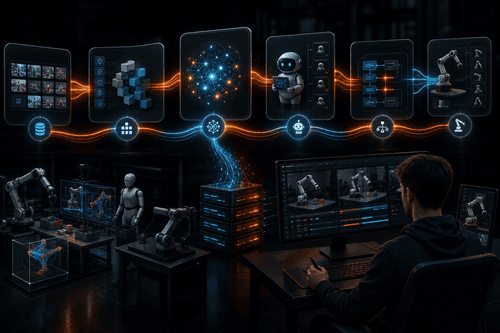
Where LeRobot fits in real robotics workflows
A serious open-source base for physical AI
The fastest starting point is installing the package from PyPI and checking the available command-line utilities and documentation. From there, users typically identify whether their target hardware is already supported, configure the relevant robot or teleoperation device, and run a small connection test before collecting data. For custom hardware, the recommended path is to implement the Robot interface so the rest of the stack can handle recording, training, visualization, and evaluation. Teams working with existing datasets can load LeRobotDataset repositories from the Hugging Face Hub and inspect observations, actions, and episode structure before launching training jobs. Because the project is Python-native and PyTorch-based, most advanced users will integrate it into existing experiment tracking, GPU training, and model evaluation workflows rather than treating it as a closed application.
NexusAi: LeRobot is valuable because it treats robotics AI as a full stack problem: hardware access, data quality, policy learning, evaluation, and distribution all need to work together.
Getting started with LeRobot
LeRobot stands out because it focuses on the unglamorous but essential infrastructure that real robot learning depends on. Rather than offering only model code or hardware demos, it connects devices, datasets, policies, benchmarks, and distribution into a coherent workflow. Its open license and Hub integration make it well positioned for collaborative robotics research, while its extensible interfaces make it practical for teams with their own hardware. The tradeoff is that users still need meaningful engineering and robotics knowledge, but for technical teams building end-to-end learning systems, LeRobot provides a strong foundation.
Open the tool and review its core product experience.
Create your account or access your existing workspace.
Use your own task to judge speed, quality, and fit.
Check similar AI tools before making a final decision.
LeRobot
Hugging Face is a major open-source AI company known for model hosting, datasets, transformers, tooling, and community infrastructure around machine learning. With LeRobot, the organization extends that ecosystem into robotics by combining research-oriented PyTorch implementations with Hub-based distribution for datasets and policies. The project reflects Hugging Face’s broader focus on reproducible AI workflows, collaborative development, and lowering barriers to applied machine learning research.
LeRobot is an open-source robotics AI framework designed to make real-world robot learning more reproducible, portable, and accessible. Built in Python and PyTorch, it gives teams a common stack for connecting robots, recording demonstrations, storing multimodal datasets, training policies, and evaluating models in simulation or on physical hardware. The project is maintained by Hugging Face and aligns closely with the Hugging Face Hub, where users can publish and consume robotics datasets and pretrained policies. The library addresses a persistent robotics problem: fragmented tooling across hardware, data formats, and learning methods. Its unified Robot interface separates control logic from device-specific implementation, making it easier to adapt workflows across low-cost robot arms, teleoperation devices, humanoids, mobile platforms, keyboards, gamepads, and custom robots. For data, LeRobot standardizes synchronized video or image streams with structured state and action data using a scalable dataset format based on media files and Parquet records. LeRobot also includes implementations of modern policy families used in robot learning, including imitation learning, reinforcement learning, vision-language-action models, world models, and reward models. Users can train models through configuration-driven scripts, inspect training behavior, evaluate against benchmarks such as LIBERO and MetaWorld, and share artifacts through the Hugging Face ecosystem. It is most useful for robotics researchers, academic labs, startups, hardware builders, and advanced developers who need practical infrastructure rather than isolated example code. Its strongest differentiator is the combination of open-source licensing, hardware extensibility, Hub-native dataset distribution, and a production-oriented workflow that spans data collection through deployment. LeRobot is not a turnkey robotics product for nontechnical users, but it provides a serious foundation for teams building physical AI systems.
Visit LeRobot
Comments (0)
No Comments Found