


Microsoft Mage
NexusAi Summary: A compact, research-focused family of multimodal models that combine codec-native video understanding, native‑resolution image generation and hybrid GUI+code policies for practical desktop and vision–language workflows.

NexusAi Overview
Mage workflows centre on compact checkpoints and modular recipes: stream video as codec frames, run a codec-aligned encoder for understanding, and invoke a native-resolution generator for pixel-accurate edits. The tooling encourages iterative research without large-scale infrastructure.
Capabilities and architecture
Mage is aimed at ML researchers, systems engineers, and teams building prototypical multimodal features or desktop automation proofs of concept. It is particularly useful where native-pixel fidelity, streaming video understanding, and hybrid interaction policies matter—for example, human–computer interaction research, rapid image-editing iterations, and experimental automation agents that must interleave GUI actions with code.
- Codec-native video inputs let models stream and reason over compressed frames.
- Native-resolution generation supports editing and upsampling without expensive patching steps.
- Hybrid policies learn to combine GUI interaction with programmatic execution.
- Compact 4B-parameter stacks preserve efficiency while enabling editing and understanding.
- Open research orientation and modular recipes make experimentation straightforward and repeatable.
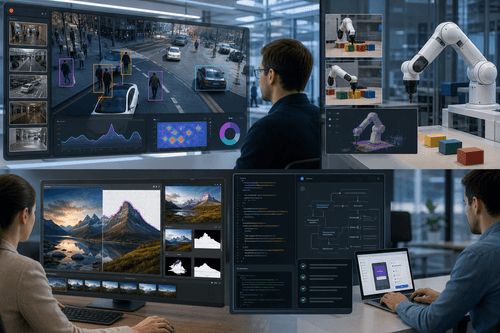
Key differentiators
Research focus
Begin with the published code, checkpoints, and training recipes: run small-scale finetuning on commodity GPUs, test Mage-VL on codec-framed inputs, and use Mage-Flow for native-resolution editing experiments. Project pages provide example harnesses and a progressive curriculum for reproducing hybrid training results; users will typically adapt the supplied harnesses to their dataset and validation pipeline before scaling up.
NexusAi: Mage pairs codec-native video understanding with compact native-resolution generation, enabling practical multimodal research at 4B scale.
Getting started
Mage’s strength is engineering that directs capacity to high-signal modalities: codec-native inputs for video, a native-resolution generator for pixel fidelity, and hybrid policies that blend GUI actions with code. For researchers wanting modular, reproducible stacks at modest scale, Mage lowers iteration cost while preserving practical capabilities for editing, streaming analysis, and desktop automation experiments.
Open the tool and review its core product experience.
Create your account or access your existing workspace.
Use your own task to judge speed, quality, and fit.
Check similar AI tools before making a final decision.

Microsoft Mage
Microsoft Research builds Mage to enable efficient multimodal experimentation. The team focuses on codec-aware modelling, compact generative stacks, and reproducible training recipes that support rapid iteration by researchers and engineering teams.
Microsoft Mage is a lightweight, research-oriented multimodal model family built around a 4B-parameter scale. It pairs codec-native vision–language encoders that stream compressed video with a native-resolution generative stack and hybrid GUI-code policies. The project emphasizes reproducible training recipes, compact inference stacks (Mage-VL, Mage-Flow, Mage-VL-Cowork), and engineering choices that allocate representation capacity to high-signal modalities. Practically, Mage aims to let researchers and engineers run multimodal experiments on modest compute, iterate on editing and understanding tasks at native pixels, and prototype hybrid automation policies that mix clicks and code. The release bundles model checkpoints, training harnesses, and curricula designed to accelerate reproducible research without presuming production deployment.
Visit Microsoft Mage
Comments (0)
No Comments Found