
Microsoft Phi
NexusAi Summary: Microsoft Phi is a family of compact language models optimized for cost, latency, and memory. They run through Azure in the cloud or locally via ONNX Runtime, enabling chat, summarization, and retrieval-augmented applications across devices and enterprise workloads.

NexusAi Overview
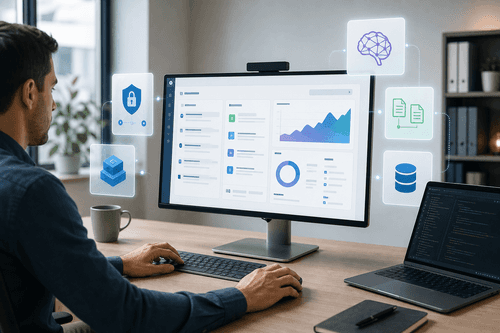
Teams prototype in Azure, then choose cloud endpoints for scale or export ONNX builds for local execution. The same model family powers chat, extraction, and summarization pipelines, with quantization options to keep tokens-per-second high and memory footprints small across laptops, edge boxes, and mobile-class hardware.
What It Delivers
Ideal for developers shipping assistants inside productivity apps, product teams embedding chat or summarization into workflows, and architects targeting Windows clients, kiosks, or edge gateways where bandwidth is limited. Research and operations groups can pair Phi with retrieval to answer domain-specific questions, while IT retains deployment choice for privacy-sensitive use cases and regional compliance.
- Serve models via Azure managed endpoints with enterprise scaling and observability.
- Export ONNX packages and run locally with hardware-accelerated inference support.
- Quantize models using Olive to reduce memory without major quality loss.
- Power chat, summarization, extraction, and lightweight reasoning across applications everywhere.
- Combine with retrieval to ground answers in private, governed data.
Why It Stands Out
Who Benefits
Start in Azure to evaluate model sizes against latency and quality needs. Create a managed inference endpoint, call it via REST or SDKs, and wire in retrieval over your data to validate grounding and guardrails. When on-device is preferred, export an ONNX package, apply Olive quantization, and benchmark with ONNX Runtime across your target hardware. Profile tokens-per-second, memory use, and prompt formats early, then choose a single configuration for cloud and edge to simplify operations. Documentation and quickstarts cover deployment patterns, environment setup, and security controls so teams can move from prototype to production with minimal custom infrastructure.
NexusAi: Small models that deliver practical accuracy where latency, privacy, and cost dominate.
Getting Started
Phi is for teams that want useful AI without heavyweight infrastructure. It delivers solid task-following, quick startup, and predictable costs, with a single family spanning cloud and device. Compared with larger LLMs, complex reasoning may require RAG or alternative models—but for embedded assistants and document workflows, Phi’s efficiency and deployment flexibility are persuasive.
Open the tool and review its core product experience.
Create your account or access your existing workspace.
Use your own task to judge speed, quality, and fit.
Check similar AI tools before making a final decision.

Microsoft Phi
Microsoft builds cloud, operating systems, and developer platforms used by millions of engineers. Its Azure AI portfolio spans foundation models, tooling, and managed inference services, with deep investment in performance, safety, and enterprise governance. Phi reflects Microsoft’s push toward practical, efficient AI that runs where products actually live.
Microsoft Phi is a production-ready family of small language models designed to deliver strong quality per parameter under tight latency and resource constraints. Available as managed endpoints in Azure and as portable ONNX packages, Phi enables responsive assistants, summarization, classification, and lightweight reasoning on client, edge, and server. Developers can call Phi over standard REST or SDKs and, when privacy or offline resilience matters, quantize and run models locally with ONNX Runtime and Olive. The portfolio includes instruction-tuned variants and, in select models, multimodal capabilities, allowing teams to match size and functionality to device and budget. Phi integrates cleanly with common RAG stacks in Azure, improving answer fidelity while keeping inference inexpensive. The result is a pragmatic path to ship useful AI where it counts—inside applications, at the edge, and across global cloud regions—without committing to heavyweight model footprints.
Visit Microsoft Phi
Comments (0)
No Comments Found