


Muse Code
NexusAi Summary: Muse Code is Meta’s code-focused generative model for AI-assisted software development. It helps developers draft functions, complete snippets, translate between languages, and explain code, with latency and quality tuned for practical IDE and CI workflows.

NexusAi Overview
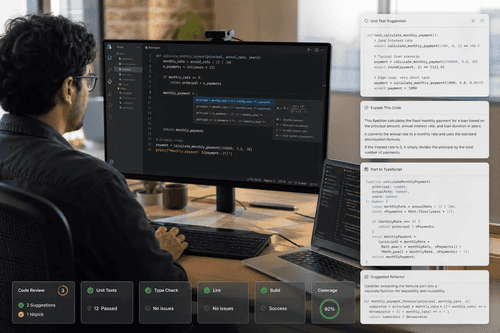
Developers describe intent in comments or prompts, highlight a region, and request suggestions. Muse Code returns candidate implementations or refactors tailored to the file, enabling quick accept, edit, or discard decisions. Outputs remain reviewable and testable within normal development gates.
How It Works
Muse Code suits software engineers, tech leads, and maintainers who want faster throughput without sacrificing review quality. It’s also useful for platform teams standardizing scaffolds, QA engineers authoring targeted tests, data and ML engineers translating utilities, and onboarding developers learning unfamiliar code paths. Organizations seeking measurable, incremental productivity gains—rather than disruptive tooling changes—will benefit most.
- Generates context-aware code completions aligned with local naming and imports.
- Translates functions between languages while preserving behavior and side effects.
- Proposes minimal edits to address failing tests or compiler errors quickly.
- Drafts docstrings, comments, and usage examples directly from code intent.
- Outlines multi-step refactors, then produces incremental patches for review safely.
Key Capabilities
Who It’s For
Visit the Muse Code page on Meta’s developer site, sign in with a developer account, and request access. Review the quickstart to understand authentication, request formats, usage guidelines, and limits. Experiment in a sandbox or console to validate prompts against a small repository. Integrate via documented endpoints from a service, CLI, or IDE extension, adding timeouts, retries, and logging. Start with read-only suggestions, measure acceptance and test outcomes, then expand coverage where signal-to-noise remains strong.
NexusAi: Purpose-built code generation that stays out of the way and speeds real work.
Getting Started
Muse Code concentrates on dependable, readable suggestions that integrate with existing engineering practices. Its code-first training, context awareness, and incremental integration path differentiate it from generic chat models. Teams can pilot in hours, evaluate acceptance and test outcomes, and scale usage where benefits persist—without abandoning established tools or governance.
Open the tool and review its core product experience.
Create your account or access your existing workspace.
Use your own task to judge speed, quality, and fit.
Check similar AI tools before making a final decision.

Muse Code
Meta develops large-scale AI systems spanning language, vision, and multimodal research, and ships production platforms used globally. The company emphasizes practical, responsible AI and open collaboration. Muse Code reflects Meta’s focus on developer workflows, measurable impact, and safe, incremental adoption in real engineering environments.
Muse Code is Meta’s code-centric generative model built to assist real software work across the edit-compile-test cycle. It accepts natural-language intent alongside partial code and returns context-aware suggestions that fit the surrounding style. Trained on a mixture of code and developer text, it aims to handle generation, completion, translation, and explanation tasks with balanced latency and accuracy. Teams can apply it inside IDEs, CLIs, code review bots, or CI pipelines to accelerate routine edits while keeping humans in control of merges and tests. The model emphasizes readable output and alignment with comments and docstrings so results are easier to verify. By slotting into existing developer tools via standard API patterns, Muse Code helps organizations pilot AI coding safely, measure impact, and scale where it proves reliable.
Visit Muse Code
Comments (0)
No Comments Found