


NanoBot
NexusAi Summary: NanoBot is an ultra-lightweight, open-source personal AI agent runtime for Python. It prioritizes compact code, predictable token budgets, and steady long-horizon execution to embed reliable agents in terminals, scripts, and services.

NexusAi Overview
Install from PyPI or via uv, launch a terminal or minimal web chat session, define tasks and lightweight tools in Python, then let the kernel coordinate steps while preserving context and guarding token budgets across extended runs.
Capabilities and Architecture
Engineers, operators, and technical founders who value reliability over novelty will appreciate NanoBot’s steady execution and budget control. It suits developers building personal assistants, task runners, or backend agents that must maintain context across extended sessions. Research and product teams can prototype quickly in the terminal, then embed the same kernel inside services without adopting heavyweight orchestration. It is a strong fit for budget-sensitive environments, small-footprint deployments, and pragmatic automation efforts that prioritize reproducible behavior and simple operations.
- Runs a standard agent kernel that cleanly separates planning, tool invocation, and context handling, enabling straightforward embedding in Python applications, services, and command-line workflows with minimal scaffolding.
- Supports long-horizon sequences—tens to hundreds of steps—while maintaining coherent context and execution state, allowing reliable multi-step automation without derailing midway through complex workflows.
- Provides predictable token budgeting and compact prompts, helping teams control spend from day one while preserving response quality across extended sessions and iterative task refinement.
- Ships with a terminal-first chat experience and a minimal online interface, making it easy to test, operate, and monitor agents locally or remotely with very low overhead.
- Released under the MIT License and distributed on PyPI, simplifying installation, versioning, and integration into existing CI pipelines, deployment scripts, and Python-based infrastructure.
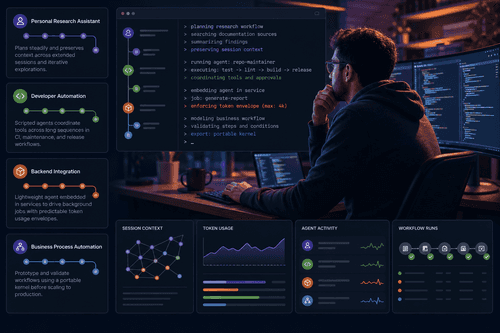
Why It Matters
Who Uses NanoBot
Install the package from PyPI using your preferred Python environment manager, or use uv for a fast path. You can also clone the repository and install in editable mode for development. After installation, start a terminal chat session to exercise the runtime, or import the kernel in Python to embed an agent inside your application or service. Define tasks and lightweight tools in code, then iterate as the agent executes steadily across steps. The documentation outlines setup, examples, and operational tips. Licensing under MIT keeps adoption straightforward.
NexusAi: A compact, steady agent kernel that favors coherence and budget control over flash—useful when reliability matters across long, multi-step tasks.
Getting Started
NanoBot stands out by delivering a portable agent kernel that keeps context coherent over long horizons while containing token spend. Its compact implementation, terminal-first workflow, and MIT-licensed, PyPI-based distribution reduce operational friction. If you need a dependable, low-overhead agent that embeds cleanly into Python services and scripts, NanoBot offers a focused, production-friendly foundation without heavy orchestration or unnecessary complexity.
Open the tool and review its core product experience.
Create your account or access your existing workspace.
Use your own task to judge speed, quality, and fit.
Check similar AI tools before making a final decision.

NanoBot
HKUDS maintains NanoBot as an MIT-licensed, open-source project focused on practical agent runtimes. The team emphasizes compact implementations, steady long-horizon behavior, and approachable operations that fit into everyday developer workflows.
NanoBot is an ultra-lightweight, open-source personal AI agent runtime for Python. It provides a standard kernel that embeds cleanly into scripts, terminals, and services, enabling steady long-horizon execution—tens to hundreds of steps—while keeping context coherent and spend predictable. With compact prompts and sensible token budgets, teams can operate agents confidently from day one. A terminal-first chat interface and minimal online view make operation straightforward, while the portable core integrates into existing applications without heavy orchestration layers. Distributed on PyPI and released under the MIT License, NanoBot favors simplicity, clarity, and operational reliability. It suits personal assistants, automation tasks, and backends that need consistent, controllable behavior. Designed to be steady, fast, and scalable, it emphasizes practical deployment paths and repeatable results rather than novelty, making it a dependable foundation for everyday agent-driven workflows.
Visit NanoBot
Comments (0)
No Comments Found