


NVIDIA Omniverse
NexusAi Summary: NVIDIA Omniverse provides OpenUSD-native libraries, APIs, and services to build simulation-ready 3D worlds for physical AI. Teams integrate RTX rendering, physics, sensors, and validation to create digital twins, robotics workflows, and scalable synthetic data pipelines inside existing applications.

NexusAi Overview
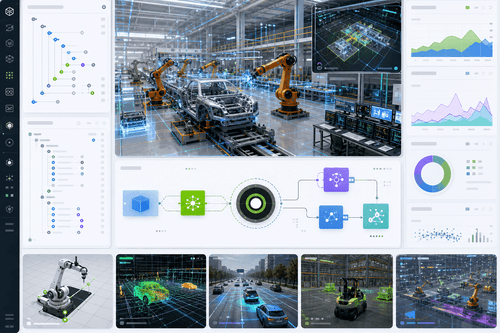
A typical workflow begins with OpenUSD scenes assembled from design and engineering sources. Agents or scripts check materials, colliders, and semantics, then call ovrtx for viewport renders or sensor output and ovphysx for dynamics. Validation gates flag readiness before downstream simulation, data generation, or deployment.
Capabilities and Architecture
Omniverse suits robotics teams preparing learning and evaluation environments, AV perception engineers validating sensor setups, and industrial engineers building digital twins for planning and optimization. It benefits MLEs constructing synthetic data pipelines, technical artists responsible for USD scene preparation, and software vendors integrating simulation features without replacing their applications. Choose Omniverse when durable scene structure, agent‑assisted preflight, and reproducible physics are prerequisites for safe deployment.
- Connect and organize OpenUSD scenes across DCC, simulation, and robotics pipelines.
- Trigger RTX renders and synthetic sensors to produce reviewable visual evidence.
- Run GPU physics for motion, contacts, and dynamics with agent oversight.
- Validate assets against SimReady requirements before training, testing, or deployment.
- Automate scene checks, routing issues and results through human-in-the-loop workflows.
Why Teams Choose Omniverse
Who It’s For
Start with Omniverse documentation and GitHub repositories to evaluate libraries like ovrtx and ovphysx. Use Agent Skills to script scene inspection, rendering, physics runs, and validation, then reference Blueprints and Labs to assemble production workflows. Develop locally on NVIDIA RTX workstations; scale to NVIDIA OVX for multi‑user visualization and simulation; or leverage NVIDIA DGX Cloud for bursty synthetic data generation and evaluation. Review each repository’s license and support level; pre‑release components may not be enterprise‑supported. For production deployments, NVIDIA Enterprise Support is available with an applicable entitlement.
NexusAi: OpenUSD-first libraries turn 3D assets into testable, sensor-ready worlds that physical AI can trust.
Getting Started
Omniverse differentiates with an OpenUSD‑first, agent‑ready architecture that upgrades existing tools instead of replacing them. Composable libraries provide rendering, sensors, physics, and validation with visual evidence and acceptance gates. Deployment spans RTX workstations to OVX and DGX Cloud, matching project scale. Use it to prepare trustworthy, simulation‑ready worlds—and pair with world‑model development platforms when photoreal, controllable synthetic data is required.
Open the tool and review its core product experience.
Create your account or access your existing workspace.
Use your own task to judge speed, quality, and fit.
Check similar AI tools before making a final decision.
NVIDIA Omniverse
NVIDIA is a leader in accelerated computing and AI platforms spanning GPUs, systems, and software. The company advances OpenUSD workflows, real‑time graphics, and simulation through Omniverse, enabling developers to build robotics, digital twins, and physical AI applications across workstations, data centers, and cloud.
NVIDIA Omniverse is an OpenUSD-native platform providing libraries, APIs, and services to design, simulate, and validate physical AI applications. Developers embed RTX rendering, GPU‑accelerated physics, sensor simulation, and asset validation directly into existing tools and pipelines. Omniverse libraries such as ovrtx and ovphysx add agent-ready capabilities so automated workflows can inspect scenes, trigger renders, run dynamics, and return evidence for human review. Used across robotics, industrial digital twins, autonomous vehicle scenarios, and synthetic data generation, Omniverse connects durable USD scene structures across design, engineering, and simulation. Teams move from static 3D content toward simulation‑ready worlds with physics materials, colliders, semantic labels, and sensor rigs. The result is faster iteration, better preflight coverage, and greater confidence before training, testing, or deployment.
Visit NVIDIA Omniverse
Comments (0)
No Comments Found