


OpenAI Rosalind
NexusAi Summary: OpenAI Rosalind combines a domain-tuned GPT‑Rosalind model with an orchestrated Workbench in Codex, letting life‑science teams interrogate sequencing data, synthesize evidence, prioritize targets, and plan experiments with governance controls, eligibility-gated access, and auditable workflows across research and enterprise settings.

NexusAi Overview
Typical workflows start by loading sequencing files and sample metadata, confirming an analysis plan, and monitoring QC during the run. Results, literature, and trusted databases are synthesized side‑by‑side, enabling target triage, protein and variant reasoning, and molecular comparisons before drafting an experiment plan to validate findings.
Life‑science reasoning with connected tools
Rosalind suits computational biologists, bioinformaticians, translational scientists, medicinal chemists, and lab leads who need governed, reviewable analysis. It also fits biotech and pharma R&D teams prioritizing targets, synthesizing cross‑evidence, and planning follow‑ups, plus public‑health and biodefense programs requiring audited workflows. Explore mode supports broad scientific inquiry; Research mode and API access serve eligible organizations with specialized workloads, tighter governance, and integration needs. Teams seeking transparent reasoning, artifact tracking, and operational controls will benefit most.
- Run guided NGS analysis with QC checks, saved outputs, and reviewable artifacts.
- Synthesize papers, trusted biology databases, and internal results into explicit evidence.
- Prioritize biological targets by scoring genetics, expression, pathways, and disease context.
- Interpret proteins and variants using sequences, alignments, structures, and functional reasoning.
- Build shareable research workflows in Codex, connecting tools, data sources, and validation.
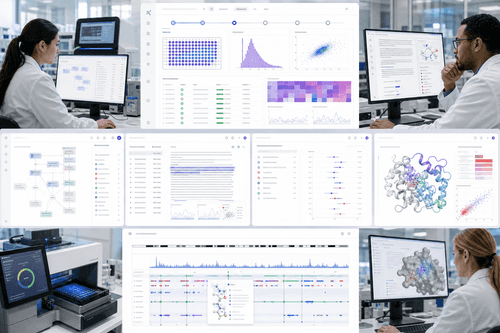
Key capabilities
Who it’s for
Start with Rosalind Workbench: download to get set up quickly, or open it directly in Codex if your organization already uses it. Load sequencing files and sample details, review the proposed plan, and monitor QC as runs progress. Explore mode is available for general scientific questions using the latest ChatGPT models. For complex biological workflows, apply for Research mode to access GPT‑Rosalind. Organizations can also request GPT‑Rosalind API access to integrate specialized reasoning into internal tools and governed pipelines. Rosalind Workbench is in research preview, and Research mode and API access are subject to eligibility review and enterprise governance.
NexusAi: Connect frontier AI with scientific evidence so researchers move faster with confidence.
Getting started and access
Rosalind stands out by pairing a life‑sciences‑tuned model with an orchestrated, auditable workspace that runs where teams already work. It joins sequencing, literature, and internal context into actionable rationale, supports shareable workflows in Codex, and offers eligibility‑gated API integration. Reported benchmark efficiency gains and enterprise governance make it a pragmatic choice for regulated research environments.
Open the tool and review its core product experience.
Create your account or access your existing workspace.
Use your own task to judge speed, quality, and fit.
Check similar AI tools before making a final decision.

OpenAI Rosalind
OpenAI builds general‑purpose AI systems and tooling for research, developers, and enterprises. Rosalind focuses on safe, beneficial life‑sciences applications, combining domain‑tuned models, governed deployment, and connected tools so scientists can interrogate data, synthesize evidence, and plan experiments with transparent, reviewable workflows.
OpenAI Rosalind connects a life‑science‑tuned GPT‑Rosalind model with Rosalind Workbench, an orchestrated environment that runs in Codex to unify tools, data, and evidence. Researchers can interrogate sequencing datasets, synthesize literature and trusted biology resources, compare molecular candidates, evaluate proteins and variants, and plan experiments in one governed workspace. Two modes accommodate varied needs: Explore mode uses the latest ChatGPT models for general scientific inquiry, while Research mode provides GPT‑Rosalind for deeper biological reasoning and specialized workflows, subject to eligibility. Organizations can also request API access to embed GPT‑Rosalind into internal applications with governance controls. Benchmarks report per‑token efficiency gains on representative life‑sciences tasks. The result is faster, reviewable research: inputs are checked, analysis plans approved, QC monitored, and outputs saved for inspection before deciding the next biological question or experiment.
Visit OpenAI Rosalind
Comments (0)
No Comments Found