


Pollen Robotics
NexusAi Summary: Pollen Robotics builds open-source, expressive robots that make embodied AI practical. Reachy Mini enables social interaction and creative coding; Microduck is a tiny biped for reinforcement learning. Designed for builders, researchers, and makers, with approachable hardware, developer tooling, and transparent documentation.

NexusAi Overview
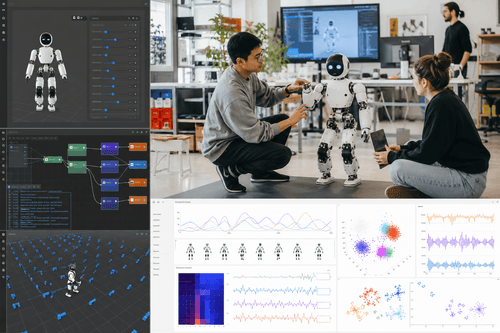
Workflows begin with designing behaviors in software, progress to scripted or learned policies, then deploy onto the robot for evaluation with people and real environments. Reachy Mini targets interactive scenarios; Microduck targets locomotion and recovery. Open documentation and community examples reduce setup time and speed iteration across sensing, control, and behavior layers.
Capabilities and platforms
Ideal users include AI researchers exploring RL and policy transfer, HRI teams validating social behaviors, educators teaching robotics concepts, and startups needing tangible demos. Reachy Mini suits conversational, assistive, or exhibit-like interactions where expression matters. Microduck fits locomotion, recovery, and compact manipulation experiments where repeated trials are required. Together, they provide a testbed spanning interaction-heavy tasks and movement-focused challenges without the operational overhead of larger lab robots.
- Prototype embodied AI quickly on approachable, open-source hardware with transparent documentation.
- Design expressive, social interactions and behaviors using example apps and modifiable control stacks.
- Train locomotion or skills, then evaluate robustness in real environments with people.
- Iterate from simulation or scripts to on-robot deployment with reproducible workflows.
- Leverage community resources, open repositories, and ongoing updates for faster development.
Highlights
Who it’s for
Getting started begins by selecting Reachy Mini or Microduck, then following the Get started guide and documentation. Unbox, assemble as directed, and run the provided examples to verify motion and communication. Explore downloadable resources, tutorials, and reference apps to script behaviors and connect your preferred ML stack. For learning-based projects, begin with baseline controllers or demonstrations, then iterate training and on-robot evaluation. Engage the community on Discord and browse GitHub for updates, troubleshooting, and contributed projects. When ready, extend hardware or behaviors while preserving reproducibility through documented configurations and versioned repositories.
NexusAi: Embodied AI should be hands-on—approachable robots you can program, modify, and learn from.
Onboarding and setup
Pollen Robotics pairs friendly, expressive form factors with open-source transparency and practical documentation. Reachy Mini lowers barriers for HRI and education, while Microduck compresses bipedal RL into a desk-friendly package with recovery and grasping. Community resources and collaboration with Hugging Face help teams move from ideas to evaluated, real-world behaviors faster—without surrendering control of their stack.
Open the tool and review its core product experience.
Create your account or access your existing workspace.
Use your own task to judge speed, quality, and fit.
Check similar AI tools before making a final decision.
Pollen Robotics
Pollen Robotics is a robotics team focused on open-source, expressive machines that make embodied AI accessible. Working with the Hugging Face community, they ship documented hardware and control stacks that favor reproducibility, fast iteration, and hands-on learning for builders, educators, and researchers.
Pollen Robotics builds open-source, expressive robots that let teams prototype, test, and ship embodied AI. The lineup centers on two approachable platforms: Reachy Mini, an interactive companion robot for social behaviors, creative coding, and AI experimentation; and Microduck, a 25 cm biped with 15 motors that walks, grasps with its beak, self-recovers, and learns new behaviors you train. Hardware, firmware, and control stacks are openly documented, encouraging modification and reproducibility. The company collaborates with Hugging Face and an active community, providing examples, apps, and references that shorten time-to-first demo. By packaging sensing, actuation, and expressive motion in accessible form factors, Pollen makes it easier for researchers, educators, and builders to evaluate models on real robots, iterate quickly, and move beyond simulation. The result is a pragmatic path to hands-on embodied intelligence.
Visit Pollen Robotics
Comments (0)
No Comments Found