


PyTorch
NexusAi Summary: PyTorch is an open-source deep learning framework for tensor computation, automatic differentiation, and neural network development in Python, with mature CPU, GPU, CUDA, ROCm, and Intel GPU support for research and production workloads.

NexusAi Overview
A typical PyTorch workflow starts with tensors, datasets, and model modules written directly in Python. Developers define network behavior imperatively, run training loops, inspect gradients through autograd, and use GPU-backed operations when available, making experimentation and debugging feel close to standard scientific Python.
Dynamic Autograd, Tensor Computation, and Hardware Acceleration
PyTorch is suited to machine learning researchers, applied AI engineers, platform teams, and technical founders who need control over model behavior and training infrastructure. It is particularly useful for experimental architectures, computer vision, language modeling, scientific computing, recommendation systems, and environments where fast iteration, clear stack traces, and access to lower-level tensor behavior matter.
- Developers can write imperative Python model code and inspect execution directly, reducing friction when debugging training behavior or architecture changes.
- The tensor library supports CPU and GPU placement with broad mathematical, indexing, linear algebra, and reduction operations for scientific workloads.
- Tape-based autograd records differentiable operations dynamically, enabling flexible neural network structures without rebuilding a fixed static graph.
- PyTorch integrates acceleration libraries and custom memory allocators to improve performance and memory efficiency during large model training.
- Extension APIs let teams implement custom layers or tensor integrations in Python or C++ while remaining close to the core framework.
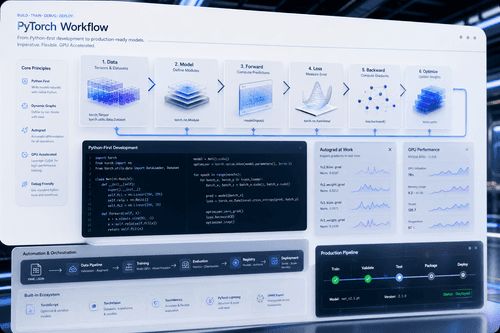
Where PyTorch Fits in AI Development
Technical Profile and Ecosystem
Most users begin with prebuilt binaries installed through package managers, selecting the configuration that matches their operating system, Python version, and hardware accelerator. Teams with specialized requirements can clone the source repository, initialize submodules, install development dependencies, and build editable installations with CMake-backed options. The project documents CPU-only, CUDA, ROCm, Intel GPU, Windows, macOS, Linux, Docker, and documentation build paths. Prebuilt Docker images are available for GPU-enabled environments, while source builds allow deeper control over compilers, acceleration libraries, and optional components such as distributed support or custom backend choices.
NexusAi: PyTorch is most compelling when teams need deep learning infrastructure that remains transparent, programmable, and close to the Python scientific stack.
Getting Started and Deployment Path
PyTorch stands out because it balances research flexibility with mature engineering foundations. Its dynamic execution model, strong GPU acceleration, Python-native design, and extension mechanisms make it a practical choice for teams that need to move from experimental model ideas to reliable training systems without losing visibility into how computations run.
Open the tool and review its core product experience.
Create your account or access your existing workspace.
Use your own task to judge speed, quality, and fit.
Check similar AI tools before making a final decision.

PyTorch
PyTorch is developed as a community-driven open-source project by engineers and researchers focused on practical deep learning infrastructure. The project emphasizes Python usability, high-performance tensor computation, flexible autograd, hardware acceleration, and transparent contribution workflows for the broader machine learning ecosystem.
PyTorch is a Python-first machine learning framework built around GPU-accelerated tensors, dynamic computation graphs, and a tape-based autograd system. It gives researchers and engineers a flexible environment for building neural networks while preserving the imperative feel of normal Python code. The framework includes core tensor operations, neural network modules, multiprocessing utilities, TorchScript compilation, and data loading tools, with performance backed by mature CPU and GPU libraries such as Intel MKL, cuDNN, and NCCL. PyTorch can be used as a NumPy-like tensor library, a research platform for rapidly changing model architectures, or a foundation for training and optimizing deep learning systems. Its practical value comes from combining interactive debugging, broad hardware support, extensibility in Python and C++, and a large ecosystem of tutorials, examples, models, documentation, and community support.
Visit PyTorch
Comments (0)
No Comments Found