

RAGFlow
NexusAi Summary: RAGFlow is an open-source RAG engine and agent platform that builds a dependable context layer for enterprise AI. It unifies ingestion, semantic indexing, hybrid retrieval, and agent orchestration with MCP and visual workflows to deliver traceable, high-precision answers.

NexusAi Overview
Teams ingest internal manuals, documents, and datasets through a built-in ETL pipeline, producing semantic indexes optimized for retrieval. At runtime, agents formulate queries, run hybrid search with re-ranking, pull authoritative snippets, and compose grounded responses—optionally augmenting with web results—so decisions remain explainable and verifiable.
Core Capabilities
RAGFlow suits engineering teams productizing retrieval-augmented applications, data/knowledge managers curating enterprise corpora, and domain specialists who require verifiable reasoning. Typical adopters include financial research groups, legal and compliance teams, manufacturing operations, and education providers building tutoring or knowledge assistants. It also benefits AI platform owners standardizing agent patterns across business units, and startups seeking open-source control with enterprise-ready guardrails.
- Built-in ETL cleans, chunks, and semantically indexes multi-format data, producing structured representations that significantly improve retrieval granularity, governance, and cross-document traceability for downstream agents and applications.
- Hybrid retrieval blends vector similarity, BM25, and custom scoring, then applies advanced re-ranking to prioritize passages that maximize factual grounding, task relevance, and overall answer precision.
- Visual agent orchestration connects RAG steps, tools, HTTP calls, and MCP-compatible components, enabling multi-agent plans with conditional routing and auditable execution graphs across complex workflows.
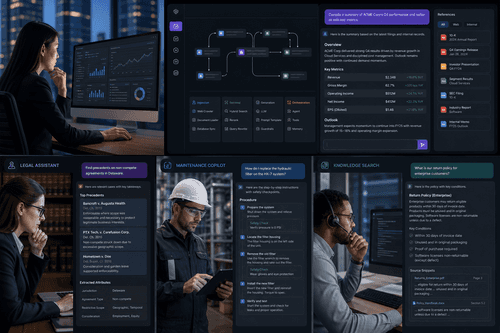
- Domain templates for equity research, legal precedent analysis, and maintenance support accelerate deployment with guided prompts, validation stages, and structured reporting aligned to industry workflows.
- Enterprise-focused operations include dataset management, selective web augmentation, and flexible deployment—covering BYOC and on-premises options—aligned with security constraints and compliance needs.
Why It Stands Out
Operational Considerations
Begin in the documentation, connect internal sources, and create datasets. Configure chunking and metadata, then build a retrieval pipeline using vector, BM25, and re-ranking. Design visual workflows that chain RAG steps, tools, and MCP-compatible components; optionally enable web search for coverage gaps. Test with sample agents, measure grounding quality, and iterate on chunking and scoring. Open-source distribution supports self-hosting, while paid tiers provide API key usage and higher limits. Enterprise teams can deploy BYOC or on-premises for tighter control and integration with existing governance.
NexusAi: Reliable retrieval beats larger models when answers must be explainable, grounded, and repeatable across regulated workflows.
Getting Started
RAGFlow distinguishes itself by pairing disciplined ingestion with a retrieval stack tuned for precision, then embedding that capability inside auditable agent workflows. The result is grounded output, faster implementation via domain patterns, and deployment choice that respects organizational constraints—strong reasons to prefer a purpose-built RAG platform over ad hoc pipelines.
Open the tool and review its core product experience.
Create your account or access your existing workspace.
Use your own task to judge speed, quality, and fit.
Check similar AI tools before making a final decision.

RAGFlow
InfiniFlow Inc. develops RAGFlow, an open-source RAG engine and agent platform. The team focuses on enterprise-grade retrieval, orchestration, and deployment flexibility, contributing tooling around MCP, hybrid search, and ingestion pipelines. Community channels and documentation support production adoption across regulated industries.
RAGFlow delivers a production-grade context layer for AI agents by pairing rigorous ETL for unstructured data with a high-precision retrieval stack. Its ingestion pipeline cleanses, chunks, and embeds multi-format sources—documents, images, datasets—into rich semantic representations. At query time, a hybrid search engine blends vector similarity with BM25 and custom scoring, then applies advanced re-ranking to surface trustworthy, grounded passages. An integrated agent platform coordinates RAG, tools, and Model Context Protocol (MCP) endpoints through visual workflows, enabling autonomous plans with auditable steps. Designed for enterprise, RAGFlow emphasizes reliability, transparency, and operational control across internal knowledge and selective web sources. Open-source foundations, API access, and deployment flexibility—including BYOC and on-premises options—fit regulated environments and existing MLOps stacks.
Visit RAGFlow
Comments (0)
No Comments Found