


Rime
NexusAi Summary: Rime’s Prism and TTS engines provide production-grade conversation AI for enterprise calls, combining real-time speech-to-speech, low-latency TTS, deterministic pronunciation controls, and on‑prem or VPC deployment for compliance-sensitive industries.
NexusAi Overview
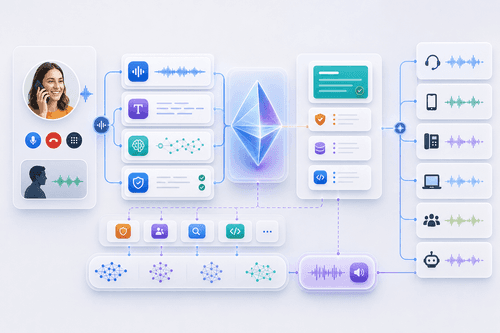
In a typical deployment Prism ingests phone audio, transcribes and reasons over the content, triggers guardrails or tools, and produces a vetted text checkpoint before sending synthesized audio. Teams use that checkpoint for compliance checks, entity resolution, or business-logic calls, then render voice via a tuned TTS model. The result is interactive, interruptible conversation that preserves safety and reduces costly mispronunciations.
Capabilities & technology
Rime is aimed at engineering teams and technical buyers building conversational systems where accuracy and compliance are non-negotiable: healthcare appointment systems, financial verification flows, travel and hospitality booking, and large contact centers. It fits teams that need deterministic pronunciation, low-latency live voice, and the option to run models inside their infrastructure to satisfy security or regulatory constraints.
- One-pass speech-to-speech with a text checkpoint before audio playback for safety.
- Low-latency TTS engines engineered for live calls and sub-100ms TTFB on endpoints.
- Deterministic pronunciation controls that lock brand and proper nouns consistently.
- Fine-tuning on customer calls to adapt voice and behavior to your use case.
- VPC and on-prem deployment options for compliance and data residency requirements.
Key differentiators
Who should evaluate Rime
Rime provides API-first integration, SDKs for common contact-center stacks, and documentation for on-prem/VPC deployment. Teams typically start with a hosted proof-of-concept, run a small call volume to fine-tune voices and pronunciation lists, then migrate inference to their environment if required. Rime offers demos, a trial tier, and support for engineering-led onboarding to shorten time-to-production.
NexusAi: Prism’s interactivity, interruption handling, and latency is terrific.
Getting started
Rime differentiates by treating voice as a craft: linguistically informed models, production latency engineering, and deployment options that meet compliance needs. For teams that must avoid mispronunciations, keep calls flowing, and maintain data residency, Rime pairs practical controls with APIs and fine-tuning to accelerate safe voice automation.
Open the tool and review its core product experience.
Create your account or access your existing workspace.
Use your own task to judge speed, quality, and fit.
Check similar AI tools before making a final decision.

Rime
Rime Labs is a voice-AI company founded by linguists and systems engineers. The team focuses on production-ready speech models that prioritize human rhythm, deterministic pronunciation, low latency, and enterprise deployment.
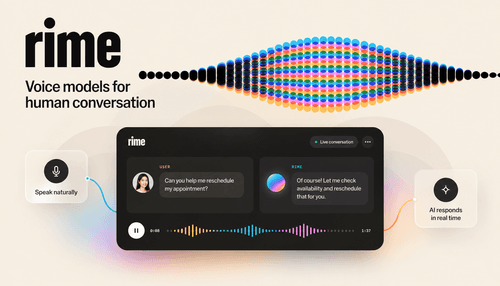
Rime builds voice models and a speech-to-speech engine engineered for live customer conversations. Prism is a one-pass conversational model that listens, reasons, and emits a text checkpoint before audio generation so teams can apply checks or tool calls in real time. Complementary TTS engines (Mist and Coda) deliver deterministic pronunciation, sub-100ms time-to-first-byte latency in production, and a large multilingual voice inventory. Rime supports self-hosted and VPC deployment paths and offers fine-tuning on customer calls, making it suitable where compliance, low latency, and reliable pronunciation matter.
Visit Rime
Comments (0)
No Comments Found