


Samsung Electronics
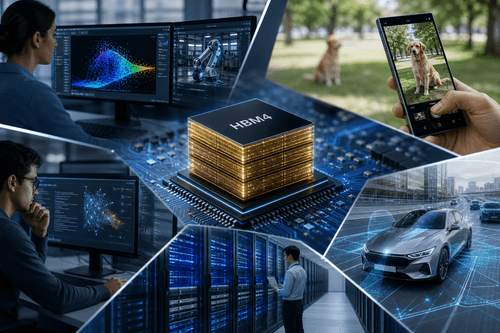
NexusAi Summary: Samsung Semiconductor supplies the memory, storage, processors, and image sensors that power modern AI systems across mobile, automotive, server, and edge. Its portfolio spans HBM4, LPDDR, DDR5, UFS, SSD, CXL memory, Exynos SoCs, and ISOCELL sensors.

NexusAi Overview
Architects combine HBM4 for GPU/accelerator bandwidth, LPDDR/DDR5 for system memory, and UFS or SSD for fast persistence, then integrate Exynos SoCs or external accelerators as needed. ISOCELL sensors capture high-fidelity data streams for perception. CXL memory expands capacity without major platform changes, easing model scaling and in-memory analytics.
Capabilities
Ideal for system architects, AI platform engineers, silicon procurement, and product leads building mobile devices, autonomous platforms, or AI servers. Teams needing reliable supply, thermally efficient footprints, and long-term roadmaps benefit most. Research groups exploring edge perception, in-vehicle compute, or private on-device AI gain strong performance-per-watt with consistent latency and robust operating envelopes.
- HBM4 stacks deliver extreme bandwidth for training and inference with improved efficiency.
- LPDDR and DDR5 provide scalable system memory footprints across mobile, automotive, and servers.
- UFS and enterprise SSD accelerate AI datasets with predictable latency and endurance.
- Exynos processors enable on-device AI, connectivity, and multimedia with efficient power.
- ISOCELL sensors capture HDR, global shutter, and ToF data for perception workloads.
Highlights
Who Uses It
Getting started typically begins with the product finder and technical resources for DRAM, storage, processors, sensors, and packaging. Engineers evaluate datasheets, reference designs, and qualification guides, then engage sales or the Global Network for sampling and lifecycle planning. Foundry and SAFE alliances provide process options, IP, EDA, cloud design enablement, and OSAT partners for turnkey manufacturing. Automotive and server programs align on compliance, reliability, and security requirements early, while on-device AI developers assess Exynos roadmaps and camera-sensor pipelines for target workloads.
NexusAi: A unified silicon portfolio—memory, storage, compute, and sensors—built to feed AI workloads efficiently from edge devices to hyperscale.
Getting Started
Samsung Semiconductor’s differentiator is breadth plus manufacturing depth: leading HBM4 and LPDDR, performant UFS and SSD, competitive Exynos roadmaps, advanced sensors, and mature packaging under one supplier. This reduces integration risk, eases validation, and sustains supply continuity across product generations, from handset inference to high-density training clusters.
Open the tool and review its core product experience.
Create your account or access your existing workspace.
Use your own task to judge speed, quality, and fit.
Check similar AI tools before making a final decision.

Samsung Electronics
Samsung Semiconductor, a division of Samsung Electronics, designs and manufactures memory, storage, processors, image sensors, and advanced packaging. Its engineering depth spans R&D through high-volume fabs and OSAT partners, supporting rigorous quality, reliability, and long-term supply across mobile, automotive, server, and network markets.
Samsung Semiconductor is the component and foundry arm of Samsung building foundational silicon for AI, data-intensive computing, and connected devices. The lineup covers high-bandwidth memory (HBM4) for training and inference, LPDDR and DDR5 DRAM, UFS and SSD storage, CXL memory expanders, multi-chip packages, Exynos mobile and automotive processors, and ISOCELL image sensors. Advanced packaging and multi-die integration improve bandwidth, power efficiency, and footprint for heterogeneous AI systems. SAFE alliances and manufacturing provide process technology, advanced packaging, and design enablement spanning logic nodes and specialty technologies. Solutions target servers, on-device AI, automotive ADAS, networks, and mobile, pairing bandwidth with low-latency memory hierarchies and reliable storage. The result is a vertically integrated supply path—from R&D through fabs and packaging—supporting performance, efficiency, and scale.
Visit Samsung Electronics
Comments (0)
No Comments Found