


Tesla Robotaxi
NexusAi Summary: Tesla Robotaxi is Tesla’s proposed autonomous ride-hailing platform, pairing self-driving Teslas with fleet orchestration, dispatch, and rider applications. The concept targets affordable, low-friction urban mobility once technical safety, operational readiness, and regulatory approvals are achieved across selected geographies.

NexusAi Overview
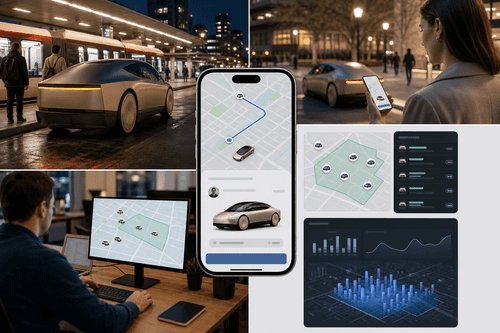
In the intended workflow, a rider requests a trip, the system dispatches the nearest eligible vehicle, and routing adapts to traffic and geofences. Charging and cleaning windows are scheduled between rides. Operations staff monitor health signals and handle exceptions, maintaining conservative policies for unusual scenarios and graceful service fallback.
System Overview
Robotaxi targets riders seeking affordable, reliable urban mobility; municipalities exploring safer, lower-emission transport options; campus and business park operators needing fixed-route circulators; and fleet partners interested in operating dedicated service areas. Early adopters likely include airport districts, university zones, and cities willing to host structured pilots with clear metrics and reporting.
- Dispatches an available Tesla to riders through a streamlined, mobile-first booking flow.
- Optimizes routing, pooling, and dwell time to improve cost, reliability, and throughput.
- Integrates charging windows and vehicle health to minimize downtime between paid trips.
- Applies layered safety policies, geofencing, and monitoring with conservative exception handling.
- Continuously updates onboard software to enhance perception, planning, and operations at scale.
Why It Matters
Who It’s For
Because service availability is region-dependent, prospective partners typically begin by assessing corridors, curb access, charging capacity, and data-sharing requirements. Organizations prepare operating rules, incident reporting pathways, and rider-safety policies aligned with local regulations. Pilot programs usually proceed in staged phases—closed testing, supervised trials, then limited public service—collecting evidence for expansion. Developers and integrators can evaluate mapping, curb and charging APIs, and telematics interfaces when available, ensuring compatibility with dispatch, compliance, and billing systems. Interested parties should monitor official announcements for pilot eligibility, service terms, and technical documentation.
NexusAi: Autonomy only matters when it moves people safely, affordably, and reliably.
Getting Started
Tesla Robotaxi’s differentiator is vertical integration: vehicle hardware, autonomy software, energy infrastructure, and fleet operations in one stack. That alignment aims to compress per-mile costs, speed iteration through telemetry, and simplify support. Timelines and scope remain dependent on safety validation and regulation, but the ambition is a scalable, practical autonomous mobility service. Success will hinge on disciplined rollouts, robust evidence, and transparent rider protections.
Open the tool and review its core product experience.
Create your account or access your existing workspace.
Use your own task to judge speed, quality, and fit.
Check similar AI tools before making a final decision.

Tesla Robotaxi
Tesla builds electric vehicles, energy storage, and charging infrastructure while investing heavily in vehicle autonomy and large-scale software operations. The company’s expertise spans manufacturing, powertrain, batteries, and over-the-air updates, informing an integrated approach to mobility, safety engineering, and fleet management.
Tesla Robotaxi is Tesla’s envisioned autonomous ride-hailing platform, combining purpose-built operations software with highly automated Tesla vehicles. The concept centers on end-to-end orchestration—rider booking, dispatch, routing, pricing, charging coordination, and safety oversight—to deliver low-cost, reliable trips in geofenced service areas. Vehicles would operate under conservative policies with continuous over-the-air software improvement, backed by data logging and operational monitoring. A cloud control plane would balance supply across demand peaks, limit deadhead miles, and schedule charging and maintenance between rides. The approach leverages Tesla’s EV manufacturing scale and energy infrastructure to reduce per-mile costs and improve uptime. Initial availability, operating domains, and feature scope are subject to technical validation and regulation. Rollout is expected to progress through limited pilots, expanding as safety evidence, local approvals, and infrastructure readiness mature.
Visit Tesla Robotaxi
Comments (0)
No Comments Found