


Transformers
NexusAi Summary: Transformers is Hugging Face’s open-source model-definition framework for running and training state-of-the-art text, vision, audio, video, and multimodal models through a consistent Python API and deep Hub ecosystem integration.

NexusAi Overview
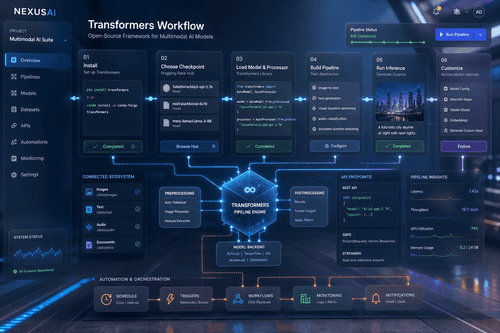
Teams typically start by installing the library, choosing a checkpoint from the Hugging Face Hub, and invoking a pipeline or model class for the task. Transformers handles common preprocessing and output formatting while still exposing lower-level model internals for customization.
Core capabilities and technical model
Transformers is best suited for machine learning engineers, applied researchers, AI product teams, and technical founders building with pretrained or fine-tuned models. It fits organizations that need rapid prototyping across modalities, reproducible access to current architectures, and enough control to inspect, adapt, or extend model behavior without starting from raw neural-network primitives.
- Run pretrained models through high-level pipelines that standardize preprocessing, inference calls, and returned outputs across multiple AI task types.
- Use shared model definitions that help training libraries, inference engines, and adjacent tooling agree on architecture behavior.
- Access Hub-hosted checkpoints for language, vision, speech, audio, video, and multimodal workloads without manually recreating model code.
- Fine-tune supported PyTorch models using library utilities, examples, and task-specific patterns that shorten experimental setup time.
- Inspect and customize model internals when research workflows require architecture changes, ablations, or task-specific adaptation.
Where Transformers is most useful
Editorial assessment
Getting started is straightforward for Python users. The project supports modern Python environments and PyTorch-based workflows, with installation available through common package managers or directly from source for contributors and users who need the latest changes. A typical onboarding path is to create a virtual environment, install the library with PyTorch support, select a Hub model, and call a pipeline for the target task. More advanced users can move beyond pipelines into model classes, processors, tokenizers, example scripts, and training utilities. Teams should still validate examples against their own data, hardware, and deployment constraints, because the repository’s sample scripts are starting points rather than guaranteed drop-in production systems.
NexusAi: Transformers remains one of the most important open-source foundations for teams that need current AI models, readable implementations, and ecosystem compatibility in one package.
Setup and adoption path
Transformers is strongest when a team needs both breadth and credibility: many model families, many modalities, and a mature open-source ecosystem around them. Its main tradeoff is scope; users seeking a small neural-network building-block library or fully managed deployment product may need complementary tools. For model experimentation and architecture compatibility, it is a default choice.
Open the tool and review its core product experience.
Create your account or access your existing workspace.
Use your own task to judge speed, quality, and fit.
Check similar AI tools before making a final decision.

Transformers
Hugging Face builds open-source machine learning infrastructure, model hosting, datasets, and collaboration tools for the AI community. Its work focuses on making modern models easier to share, evaluate, fine-tune, and deploy across research and applied engineering environments.
Transformers is the core open-source library behind much of the Hugging Face model ecosystem. It provides reusable model definitions, tokenizers, processors, pipelines, and training utilities for modern machine learning workloads across natural language processing, computer vision, speech, audio, video, and multimodal tasks. Rather than acting as a generic neural-network component toolbox, it standardizes how model architectures are implemented so researchers, engineers, and downstream infrastructure can share compatible definitions. The library works with Python and PyTorch, supports high-level inference through pipelines, and connects directly to the Hugging Face Hub, where more than one million compatible checkpoints are available. It is widely used for experimentation, fine-tuning, evaluation, and production handoff, especially when teams need access to current foundation models without rebuilding architecture code from scratch.
Visit Transformers
Comments (0)
No Comments Found