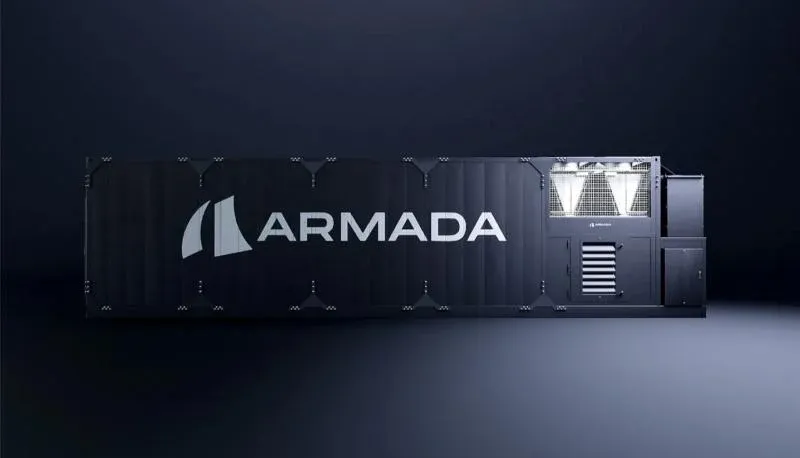
Armada combines ruggedized modular data centers, satellite connectivity, GPU orchestration and centralized fleet management to run AI where conventional cloud infrastructure cannot reliably reach.
Most enterprise AI platforms assume that data can be transmitted continuously to a large cloud region. That assumption becomes unreliable on mines, offshore facilities, isolated manufacturing sites, emergency-response deployments and other locations where bandwidth is constrained, connectivity is intermittent or operational data cannot leave the site.
Armada approaches this problem by moving usable computing infrastructure closer to where data is created. Its Galleon family packages compute, storage, networking, power management and cooling into modular ruggedized systems that can run AI workloads locally instead of waiting for a conventional data center to be built.
The important product is therefore not one container or server. It is the combined Armada Edge Platform: physical compute through Galleon, fleet visibility through Atlas, GPU management through Bridge, and application deployment through Marketplace. This full-stack approach makes Armada relevant to the wider shift from cloud-only AI toward distributed and sovereign infrastructure.
Why edge AI needs more than a smaller cloud server
Edge AI is valuable when decisions must be made near machines, sensors, cameras, vehicles or workers. Local processing can reduce latency, continue operating through network disruption and avoid transferring large volumes of raw video or industrial telemetry to the cloud.
However, placing a GPU at a remote site does not create a production-ready edge platform. Organizations also need cooling, storage, resilient networking, monitoring, application delivery, security and remote administration. Armada's central proposition is to package these requirements into deployable infrastructure rather than forcing each customer to assemble an edge environment independently.
Galleon turns modular infrastructure into a deployable AI site
Galleon is a family of portable and containerized edge computing systems designed for demanding environments. Configurations can include CPUs, GPUs, storage, networking, heating and cooling, allowing deployments to scale from compact installations to substantially larger computing capacity.
For AI workloads, the practical advantage is local processing. Computer-vision models can inspect equipment, sensor pipelines can identify anomalies and operational systems can generate alerts without continuously uploading raw data. Only important results, metadata or selected records need to move back to central systems.
Atlas manages connectivity and distributed assets
Atlas provides the management layer for connected assets, Galleon deployments and remote network operations. It brings fleet health, usage, alerts, permissions and historical performance into a centralized operational interface instead of requiring teams to monitor each remote installation separately.
Connectivity is especially important at the edge. Atlas can combine Starlink, 5G, LTE and other network paths using traffic steering, quality-of-service controls, bonding and link aggregation. This does not eliminate network failure, but it gives organizations more options for keeping critical applications connected when one link becomes unavailable.
Bridge and Marketplace complete the software layer
Bridge is Armada's GPU management and orchestration layer. It is intended to turn distributed GPU infrastructure into a managed AI cloud, giving organizations a common way to schedule capacity and operate compute resources that may be spread across different sites.
Marketplace provides a deployment channel for AI applications, industrial software, connected hardware and partner products. This is strategically important because edge infrastructure only creates value when teams can reliably install, update, monitor and secure the applications running on it. The combined platform reduces the gap between purchasing physical equipment and operating a repeatable edge AI workflow.
Who should consider Armada and what should be tested first
Armada is most relevant to mining, energy, manufacturing, telecommunications, defense, public safety and infrastructure operators with remote or bandwidth-constrained sites. It may also suit organizations that require local data processing, air-gapped operation or stronger control over where AI workloads and operational data reside.
Prospective customers should test workload performance, environmental durability, power availability, failover behavior, application compatibility, remote recovery and total operating cost. Modular infrastructure can reduce deployment time, but it does not remove the need for maintenance planning, cybersecurity, physical protection and staff capable of operating distributed systems.