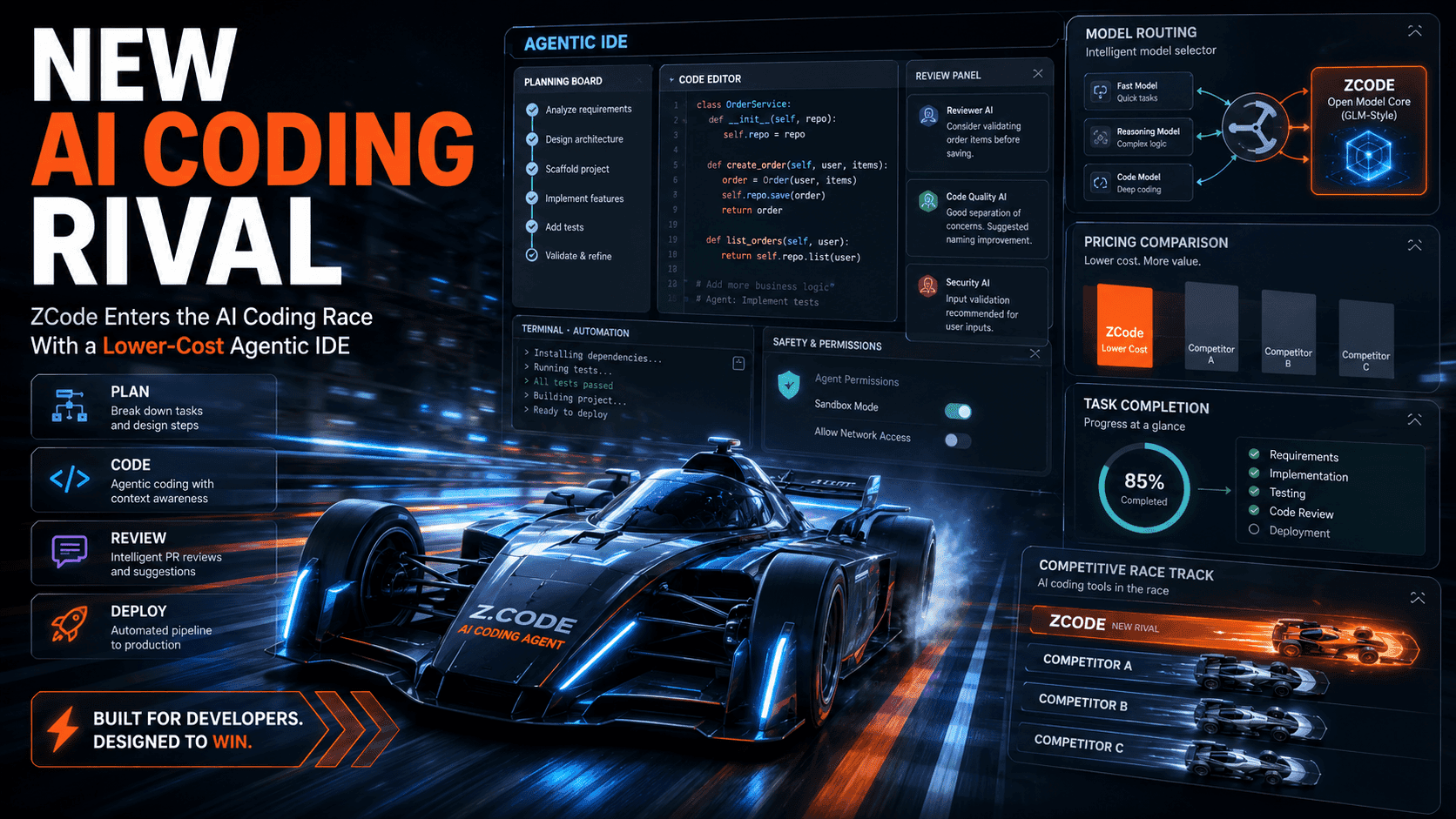
Z.ai’s ZCode launch puts new pressure on Cursor, Claude Code and GitHub Copilot by combining agentic coding workflows, model flexibility and aggressive pricing.
Z.ai’s ZCode launch adds another serious player to the crowded AI coding market. The product is being positioned as an AI coding harness that helps developers plan, code, review and deploy in one workflow, putting it directly into the competitive space occupied by Cursor, Claude Code, GitHub Copilot and Codex-style tools.
The timing matters because AI coding has become one of the most valuable battlegrounds in generative AI. Developers are no longer choosing tools only for autocomplete. They are comparing agentic workflows, repo understanding, model routing, terminal access, review quality, pricing, security and how much control they keep over the development process.
ZCode’s most important market signal may be cost pressure. If Z.ai can offer a capable coding environment at a lower monthly price while connecting to strong open models such as GLM 5.2, it could push the AI coding race toward cheaper subscriptions, more open model options and faster feature competition.
The product angle: coding harness, not only code chat
ZCode is described as a tool for planning, coding, reviewing and deploying. That is important because the most valuable AI coding tools are becoming workflow containers. They are not just chat windows beside an editor; they are systems that help developers move from task intent to implementation and validation.
This is where developer trust becomes critical. A coding harness needs to understand project structure, make safe edits, explain changes, avoid hidden side effects and fit into the developer’s existing tools. The stronger the automation, the more important review, rollback and permission controls become.
GLM 5.2 gives ZCode a model-platform story
ZCode is tied to Z.ai’s GLM 5.2 model, which gives the product a different strategic angle from tools that depend primarily on Western frontier-model ecosystems. If the model performs well for code, long context and security-oriented workflows, ZCode could become a showcase for Z.ai’s broader model platform.
At the same time, reported support for connecting to other models matters. Developer teams increasingly want model flexibility. They may use one model for planning, another for fast edits, another for security review, and another for harder reasoning. AI coding tools that support routing and switching may age better than tools locked to one model family.
Pricing pressure could reshape AI coding subscriptions
The biggest short-term market impact may come from pricing. Developers are already sensitive to rising AI coding subscription costs, usage caps and premium tiers. A lower-priced ZCode plan puts pressure on incumbents to justify their higher prices with better reliability, workflow depth and enterprise features.
For individuals and small teams, cheaper agentic coding tools can expand adoption. But cost alone will not win. The tool still has to prove that it reduces review time, improves code quality, avoids bad edits and completes real engineering work with less friction.
What developers should evaluate before switching
Developers should test ZCode against real projects rather than relying on launch claims. Good tests include repo navigation, bug fixing, refactoring, test generation, pull request review, terminal workflows, documentation updates and multi-file changes with clear acceptance criteria.
The key metrics are completed task rate, code-review burden, edit safety, context accuracy, latency, cost per accepted change, model selection options, privacy controls and whether the tool fits the developer’s current workflow. The right AI coding tool is not the loudest launch; it is the one that consistently helps ship better software.