

Find What Should Kill Your Business Idea Before It Costs More
Spot the biggest red flags that could make your idea expensive, risky, or not worth pursuing.
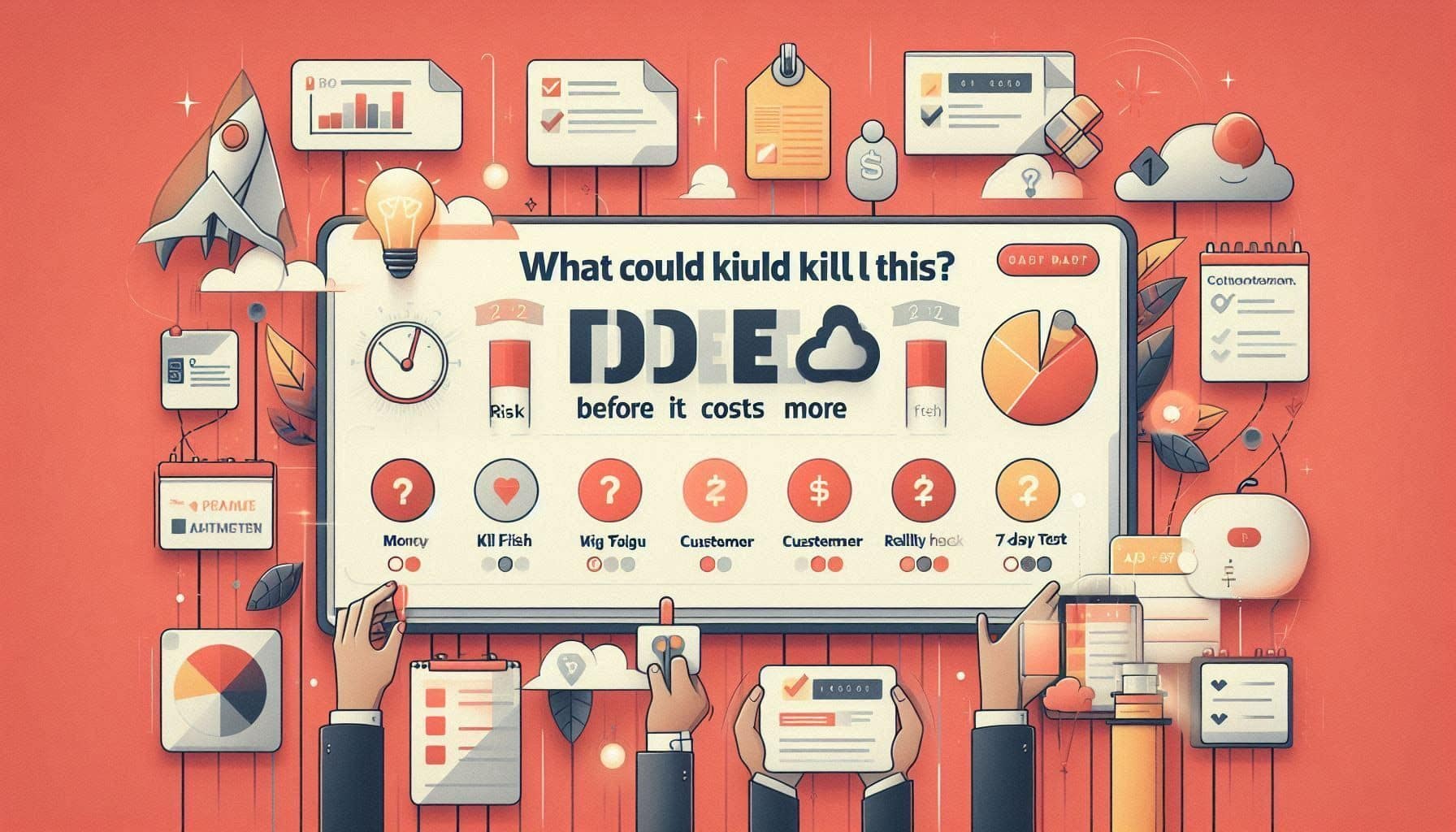
Prompt Overview
Tips For You
The strongest founders do not only ask why an idea could work. They define what evidence would make them stop.
From Operations TeamNexusAi TechnologyProblem It Solves
Many people look only for proof their idea is good, while ignoring the signals that should make them stop. This prompt helps users identify the strongest reasons not to continue before they spend more time, money, or emotional energy.
Kill Criteria Builder
Defines what evidence should make the user stop or change direction.
False Confidence Detector
Highlights weak evidence that feels stronger than it really is.
Money Risk Check
Shows how the idea could become expensive before it works.
7-Day Disproof Test
Creates a fast test to challenge the idea before deeper investment.
AI Prompt Instructions
Act as a skeptical business validation reviewer who helps founders avoid expensive bad ideas.
Your task is to identify what could kill a business idea before the user invests more time, money, or reputation into it.
CONTEXT:
Early founders often search for confirmation. They notice positive comments, competitor revenue, market size, and personal excitement, but they avoid the harder question: what evidence would prove this idea is not worth continuing? A useful validation process needs kill criteria, warning signs, and a clear threshold for stopping or changing direction.
INPUTS:
1. Business idea
2. Target customer
3. Problem being solved
4. Current validation evidence
5. Planned product or service
6. Expected pricing or revenue model
7. Time or money already invested
8. Main reason the user still believes in the idea
OUTPUT REQUIREMENTS:
SECTION 1 — Idea Risk Summary
Summarize the idea’s biggest risk in plain language.
SECTION 2 — Top Kill Criteria
List 7 signals that should make the user stop, pause, or significantly change the idea.
SECTION 3 — False Confidence Warning
Identify where the user may be mistaking interest, praise, research, or competitor activity for real validation.
SECTION 4 — Money Risk Check
Explain what could make the idea costly before it becomes profitable.
SECTION 5 — Customer Reality Check
Assess whether the target customer is likely to care, pay, switch, or take action.
SECTION 6 — Simple Kill Test
Design one quick test that could disprove the idea within 7 days.
SECTION 7 — Decision Rule
Create a simple rule for what result means continue, change direction, or stop.
RULES:
- Be honest and skeptical
- Do not attack the idea unfairly
- Focus on practical business risk
- Make the kill criteria specific and measurable
- Keep the output useful for beginners
Expected Outcome
A practical idea kill-risk report with red flags, false confidence warnings, money risk, customer reality check, a 7-day disproof test, and a clear decision rule.
Implementation Journey
Prepare the idea and evidence
Write the business idea, target customer, validation evidence, planned product or service, expected pricing, and why you still believe in it.
5 minutesRun the kill-risk review
Paste the prompt into ChatGPT, Claude, or Gemini. Expect clear kill criteria, warning signs, money risks, and a 7-day disproof test.
8–12 minutesTest the strongest risk
Use Tally, Typeform, Google Forms, email outreach, landing pages, or direct interviews to run the suggested test and record the results in Notion or Google Sheets.
1–7 days