

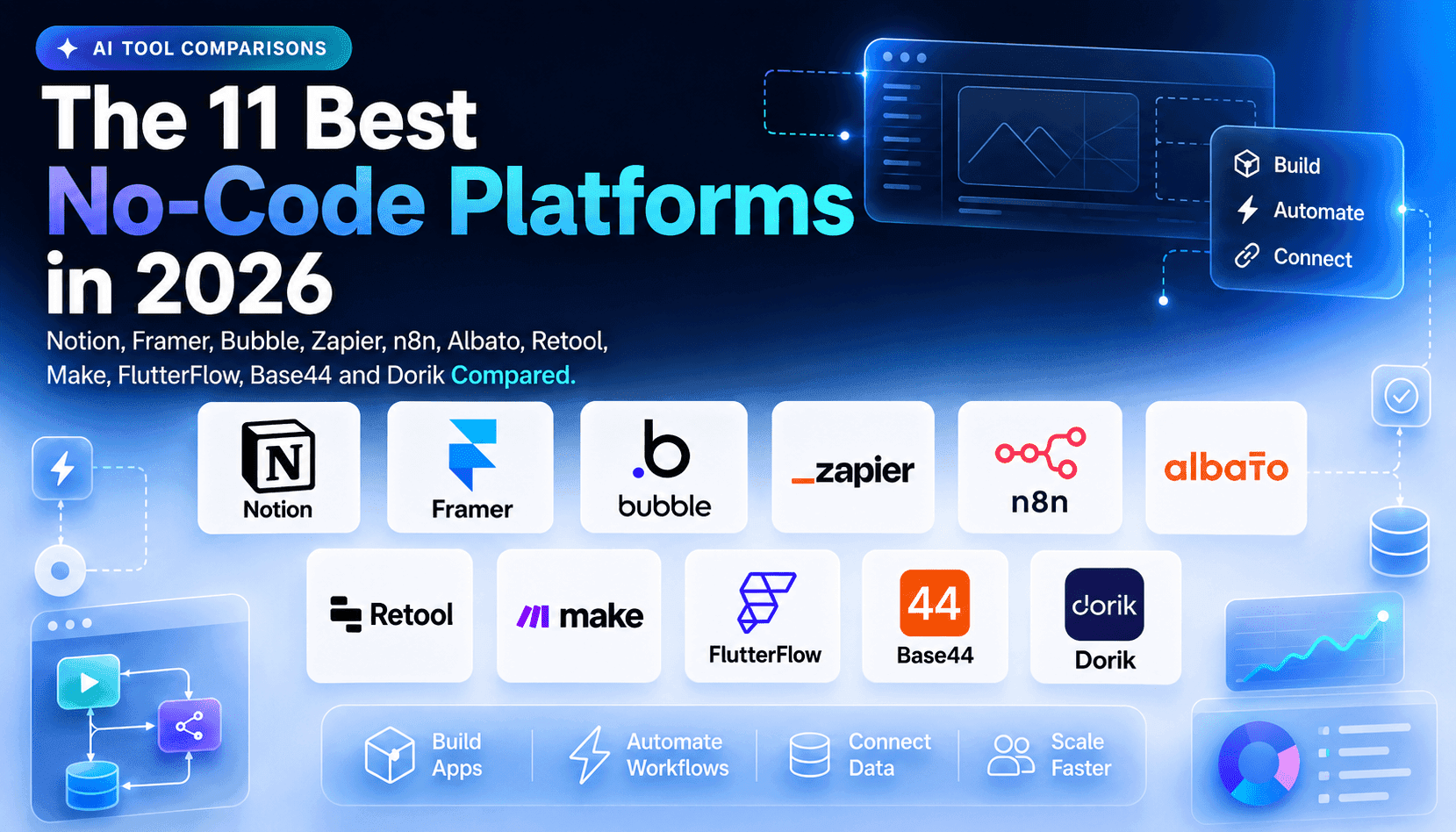
The no-code market now spans polished site builders, full‑stack app platforms, and powerful automation layers. Rather than declare a universal winner, the smart approach is to buy by job‑to‑be‑done. This guide compares eleven platforms—Notion, Framer, Bubble, Zapier, n8n, Albato, Retool, Make, FlutterFlow, Base44, and Dorik—against concrete outcomes: launch a marketing site, ship a data‑backed application, instrument internal tools, or orchestrate cross‑SaaS workflows with AI assistance. We focus on what determines success in production: data design, authentication and roles, extensibility, CI/CD options, auditability, and total cost over time, not just template speed during week one.
A practical map emerges. For collaborative workspaces, documentation, and lightweight business systems, Notion’s database‑plus‑page model remains a flexible hub. Framer wins for design‑led, fast, SEO‑sensitive websites with native hosting. Dorik is excellent for lean landing pages. For full‑stack web apps with complex logic, Bubble is the deepest no‑code runtime, while Retool shines for authenticated, data‑first internal tools built on top of your existing databases and APIs. FlutterFlow is the most direct path to cross‑platform mobile UI with logic and integrations. For automation: Zapier emphasizes approachability and breadth, n8n favors technical flexibility and self‑hosting, Albato offers budget‑friendly multi‑app automation, and Make excels at complex, visual orchestration and parallelism.
AI is now table stakes. Framer, Base44, and several automation platforms add AI‑assisted generation and agents to speed builds and maintain flows. Treat these as accelerants, not architecture. What matters is governance: role‑based approvals, audit logs, secrets management, versioning, and the ability to review and rollback changes. As your footprint grows, the hidden costs show up in environment management, API limits, and ops toil. Buyers should demand observability (metrics and logs at the flow, step, and request level), clear data export paths, and a migration story if you outgrow the platform—or want to split workloads between no‑code and low‑code services without stalling delivery.
Selecting a stack is ultimately portfolio management. For a startup landing/marketing presence, pair Framer for the site with Notion for knowledge and a simple CMS, and add Zapier or Albato for accessible automations; upgrade to Make or n8n when orchestration and parallelism increase. For a customer‑facing product MVP, Bubble handles end‑to‑end logic while Retool covers internal admin consoles. For mobile‑first, start in FlutterFlow and connect to your preferred backend and auth. Emerging Base44 is compelling for prompt‑driven prototypes; keep it in your lab to compress idea‑to‑demo cycles, then graduate stable modules into your longer‑term stack.