

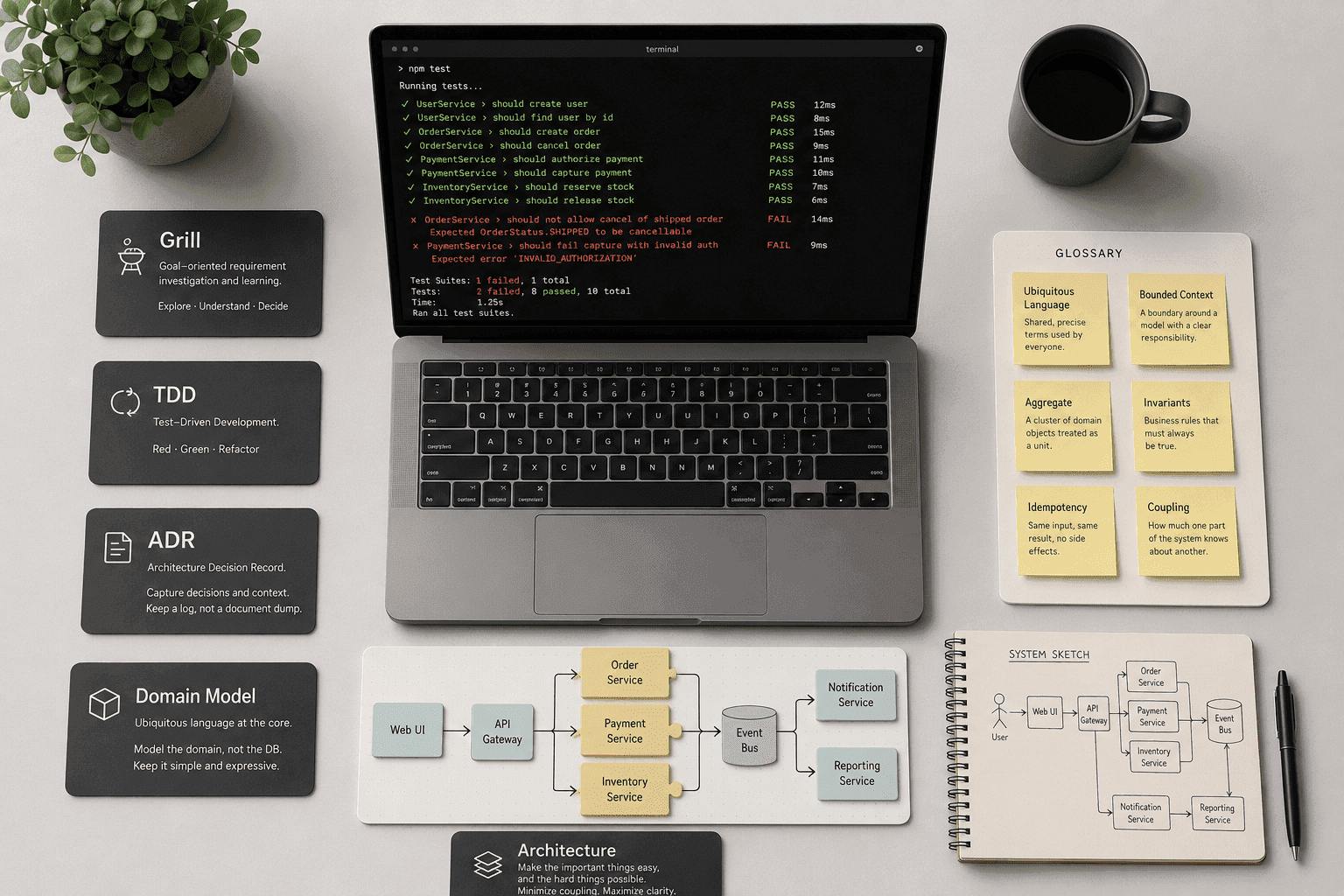
End‑to‑end agent frameworks promise a single pane of glass for planning, coding, and shipping. In practice, they often seize too much control: debugging becomes archaeology, iteration slows, and regressions hide inside the orchestration layer. A skills-first approach decomposes the work into small, composable behaviors—grill the requirements, capture a shared language, drive red‑green‑refactor, and periodically reshape the codebase. Each unit does one thing well, is trivial to swap or fork, and works with any model, editor, or CI. You get explicit control over feedback loops, clearer observability, and the freedom to tune process without breaking everything else.
The core stack looks like seasoned engineering practice packaged for agents: grilling sessions to align on scope and assumptions, domain modeling to compress project jargon into a precise shared language, TDD to force executable intent before implementation, and a disciplined bug diagnosis loop to reproduce, minimize, instrument, fix, and guard with regression tests. Around it sit helpers that synthesize specs from conversations, break work into tracer‑bullet tickets, and regularly improve architecture depth. Crucially, none of these skills require a specific vendor or model—they encode habits, not platforms—so teams keep leverage as tools evolve.
For CTOs and leads, the value is measurability and change control. Skills are individually observable: you can track grill-to-spec alignment defects, TDD pass/fail latency, and architecture improvement throughput. Adoption is incremental—pilot one repo, baseline defect escape rate and cycle time, then expand. If a model stutters or a plugin degrades, you replace a single skill, not the process. This pragmatism shortens feedback loops, reduces diff churn, and improves incident recovery because the system favors simple seams, deep modules, and tests that describe business intent rather than implementation trivia.