AI System 7-Layer Architecture: From Tokens to Skills
A strong AI system is not just a model or a prompt; it needs tokens, prompts, context, agents, harnesses, MCP connections and reusable skills working together.
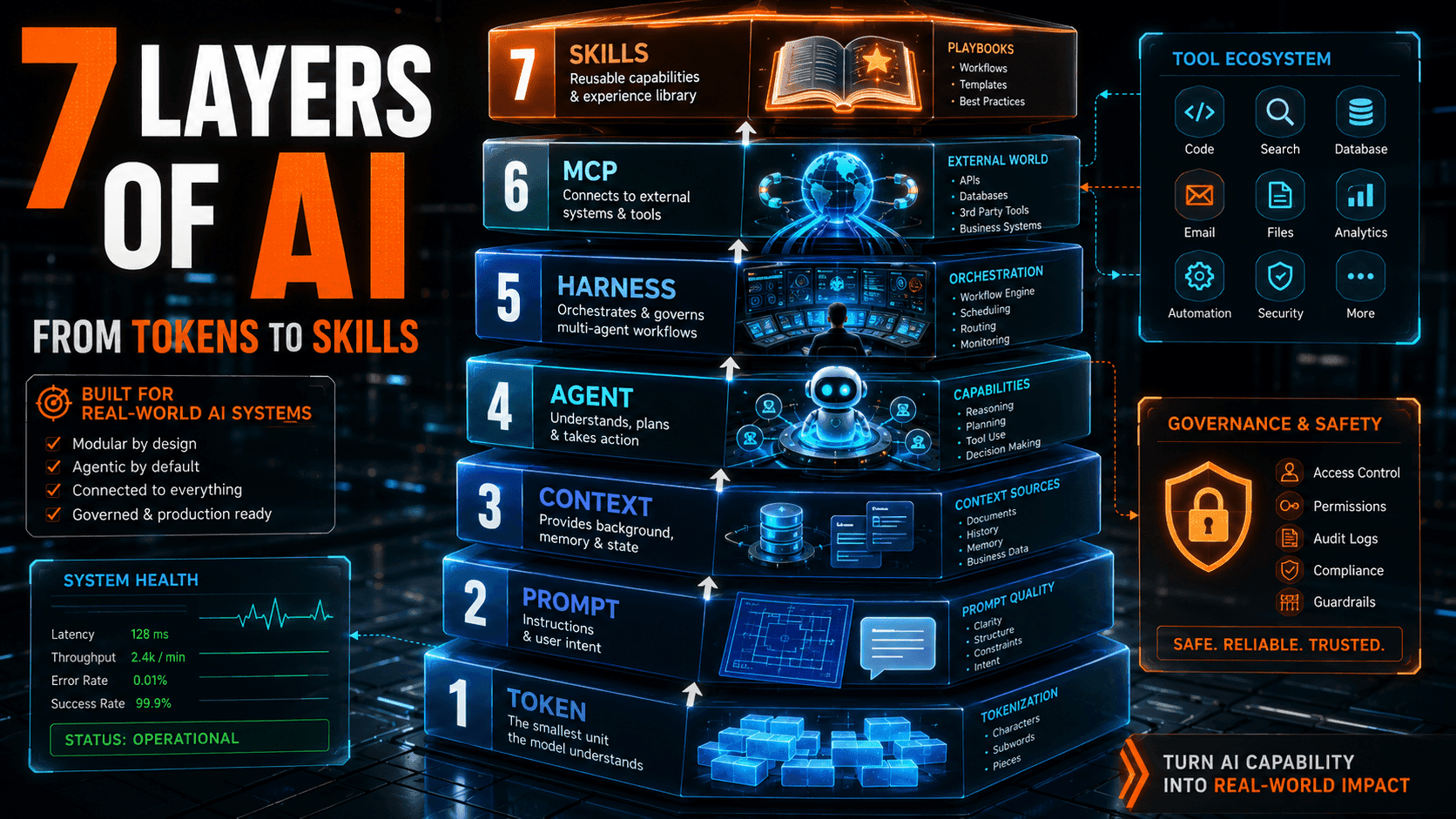
AI BriefModern AI systems are not built from prompts alone. They depend on a layered architecture where tokens define the smallest unit of understanding, prompts express intent, context grounds the answer, agents execute work, harnesses orchestrate workflows, MCP connects external systems and skills preserve reusable capability. For NexusAI users, this framework is useful because it explains why some AI products feel powerful and reliable while others remain generic chatbots.
Many people still think of AI as a single model responding to a single prompt. That view is too simple for today’s AI products. Real AI systems now combine model reasoning, user instructions, memory, tools, workflows, external software connections and reusable execution patterns.
The seven-layer architecture gives founders, developers, operators and business users a practical way to understand how AI systems are built. Each layer has a different job. Tokens are the bricks, prompts are the blueprint, context is the foundation, agents are workers, harnesses are project managers, MCP is the connector and skills are the playbook.
The main message is simple: a strong AI system is not only about having a powerful model. If any layer is weak, the whole system becomes unreliable. Weak prompts produce vague answers, missing context creates hallucinations, poor orchestration creates messy workflows, and missing skills force the AI to relearn the same task every time.
Key Takeaways
AI systems are layered, not flat
A reliable AI product needs tokens, prompts, context, agents, harnesses, MCP connections and reusable skills working together.
Agents need orchestration and external access
The agent layer becomes useful only when it is supported by context, workflow control, tools, MCP connections and safety boundaries.
Skills turn AI from reactive to reusable
Reusable skills let AI systems preserve experience, repeat successful workflows and improve execution across tasks without starting from zero.
1. Token: the smallest unit layer
The model does not read words exactly like humans do. It breaks text into smaller pieces called tokens, then predicts and reasons over those pieces. Tokens can be whole words, parts of words, punctuation or short fragments depending on the tokenizer.
This layer matters because tokens affect cost, context length, speed and output quality. A long document, a messy prompt or unnecessary repeated context can consume tokens quickly. In simple terms, tokens are the bricks that every AI output is built from.
2. Prompt: the instruction and intent layer
The prompt tells the AI what the user wants. It defines the task, direction, tone, constraints, output format and success criteria. A weak prompt can make a strong model produce generic results, while a clear prompt can turn the same model into a much more useful assistant.
The prompt is like a blueprint. It does not build the house by itself, but it guides the construction. In business workflows, prompt quality matters because it controls whether the AI produces a vague answer, a practical plan, a structured JSON object, a legal-style summary or a production-ready deliverable.
3. Context: the background information layer
Context gives the AI the information it needs to answer reliably. This can include previous conversation, uploaded files, business rules, customer data, project history, examples, database records, tool outputs or brand guidelines.
Without context, even a powerful model may produce a generic or incorrect answer. Context is the foundation. It tells the AI what world it is operating in, what facts matter, what has already happened and what constraints must be respected.
4. Agent: the intelligent execution layer
An agent is more than a chatbot response. It can understand a goal, break it into steps, choose tools, inspect results, correct mistakes and continue working until the task is complete. This is the layer where AI moves from answering questions to doing work.
The agent is like a worker who can act. In real products, this could be a coding agent fixing bugs, a research agent collecting evidence, a support agent resolving tickets, or a finance agent checking invoice records. The quality of the agent depends on planning ability, tool access, feedback loops and guardrails.
5. Harness: the workflow and orchestration layer
The harness organizes the whole AI workflow. It controls how prompts, agents, tools, memory, files, validations, retries, human review and output formats work together. Without a harness, multi-step AI systems can become messy and unpredictable.
The harness is like a project manager. It decides what happens first, what happens next, what must be checked, when to call another agent, when to stop, and when to ask a human for approval. This layer is essential for production AI apps because it turns model intelligence into repeatable workflows.
6. MCP: the connection to the outside world
MCP connects AI systems to external tools and resources such as databases, files, browsers, APIs, email, calendars, code repositories and business software. It helps agents move beyond the chat window and interact with real systems.
This layer matters because useful AI needs access to live context and operational tools. An AI agent that cannot access data or take controlled actions remains limited. MCP is like an external interface or connector that lets the AI system read, retrieve, operate and update resources through governed tool access.
7. Skills: the reusable capability and experience layer
Skills are reusable abilities, workflows or experience modules that an AI system can call across different tasks. A skill may contain instructions, code, templates, examples, validation rules, domain knowledge or a repeatable process.
Skills are like experience or a playbook. They make the system stronger over time because the AI does not need to rebuild the same workflow from scratch. In production AI systems, skills can turn one-off prompting into scalable capability.
Frequently Asked Questions
Why is a prompt alone not enough for a strong AI system?
A prompt only gives the instruction. A strong system also needs context, tools, orchestration, external connections and reusable skills to produce reliable, repeatable and useful results.
What is the difference between an agent and a harness?
An agent plans and acts on a task, while the harness controls the workflow around the agent. The harness manages steps, tools, retries, validations, human review and coordination between multiple agents.
Why does MCP matter in this architecture?
MCP matters because it connects AI agents to external systems such as databases, files, APIs and business tools. Without this connection layer, AI is often trapped inside the chat interface.