

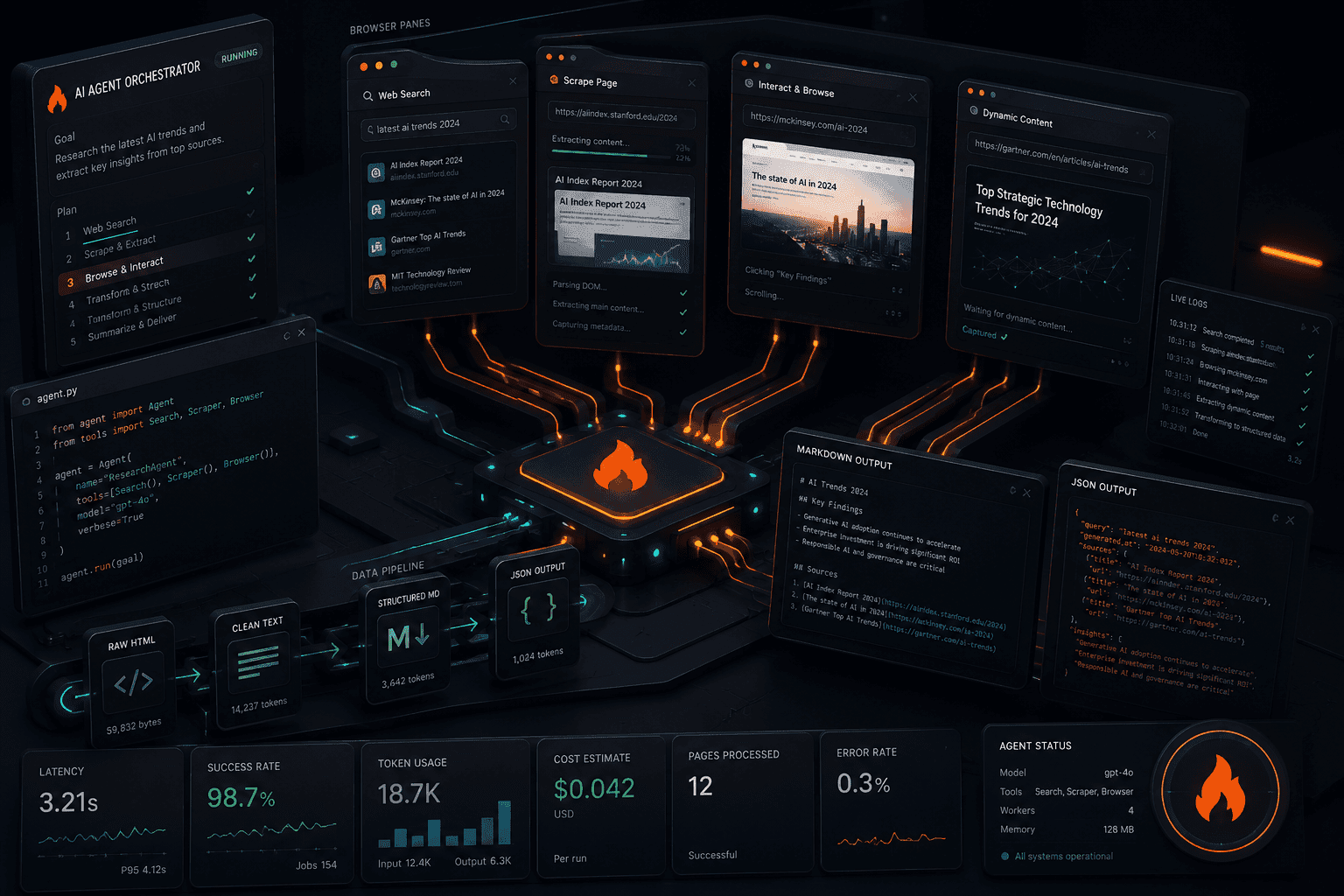
For teams shipping agents and research pipelines, the bottleneck is rarely modeling—it’s dependable web context. Firecrawl reframes the problem by offering a unified API to search, scrape, and interact with pages, returning Markdown, structured JSON, and screenshots that are directly LLM-ready. Instead of orchestrating proxies, headless browsers, anti-bot workarounds, and extraction heuristics, teams can externalize this layer and focus on task logic, memory, and evaluation. Because it’s open source with a hosted option, Firecrawl supports a pragmatic adoption path: prototype fast in the cloud, then harden with self-hosted or hybrid footprints as governance, cost sensitivity, or data residency needs grow.
The promise is performance with reliability: Firecrawl targets broad coverage (including JS-heavy pages) and production-grade latencies, while normalizing output for downstream LLMs. Search returns links plus full-page context, Scrape converts complex DOMs into clean, token-efficient Markdown or JSON, and Interact enables scripted or AI-driven clicks, form fills, and waits before extraction. This alignment with agent workflows reduces prompt size and error rates versus raw HTML, while the SDKs handle polling and job states for longer crawls. In practice, that means faster iteration cycles, fewer brittle per-site scrapers, and measurably lower ops drag.
The strategic question is not whether Firecrawl can scrape a page—it’s whether it can become your web data plane. Teams should benchmark on three axes: coverage and accuracy on representative targets; LLM token efficiency and schema fidelity for downstream tasks; and cost predictability under real concurrency. Used well, Search→Map→Crawl pipelines plus caching and schema validation enable trustworthy, repeatable retrieval. For buyers, the decision often comes down to time-to-value versus owning every edge case: many will start hosted for speed and move selective workloads in-house once usage patterns, guardrails, and KPIs are clear.
Operationally, success hinges on instrumentation and guardrails. Introduce input validation for URLs and prompts, apply robots and legal policies consistently, and log provenance with per-document metadata for audits. Add caching at URL and normalized-content levels, cap interaction steps to avoid runaway sessions, and enforce schema checks before persisting outputs. With those controls in place, Firecrawl can power agents for research, competitive monitoring, support retrieval, and QA—without rebuilding the web stack for each new task.