

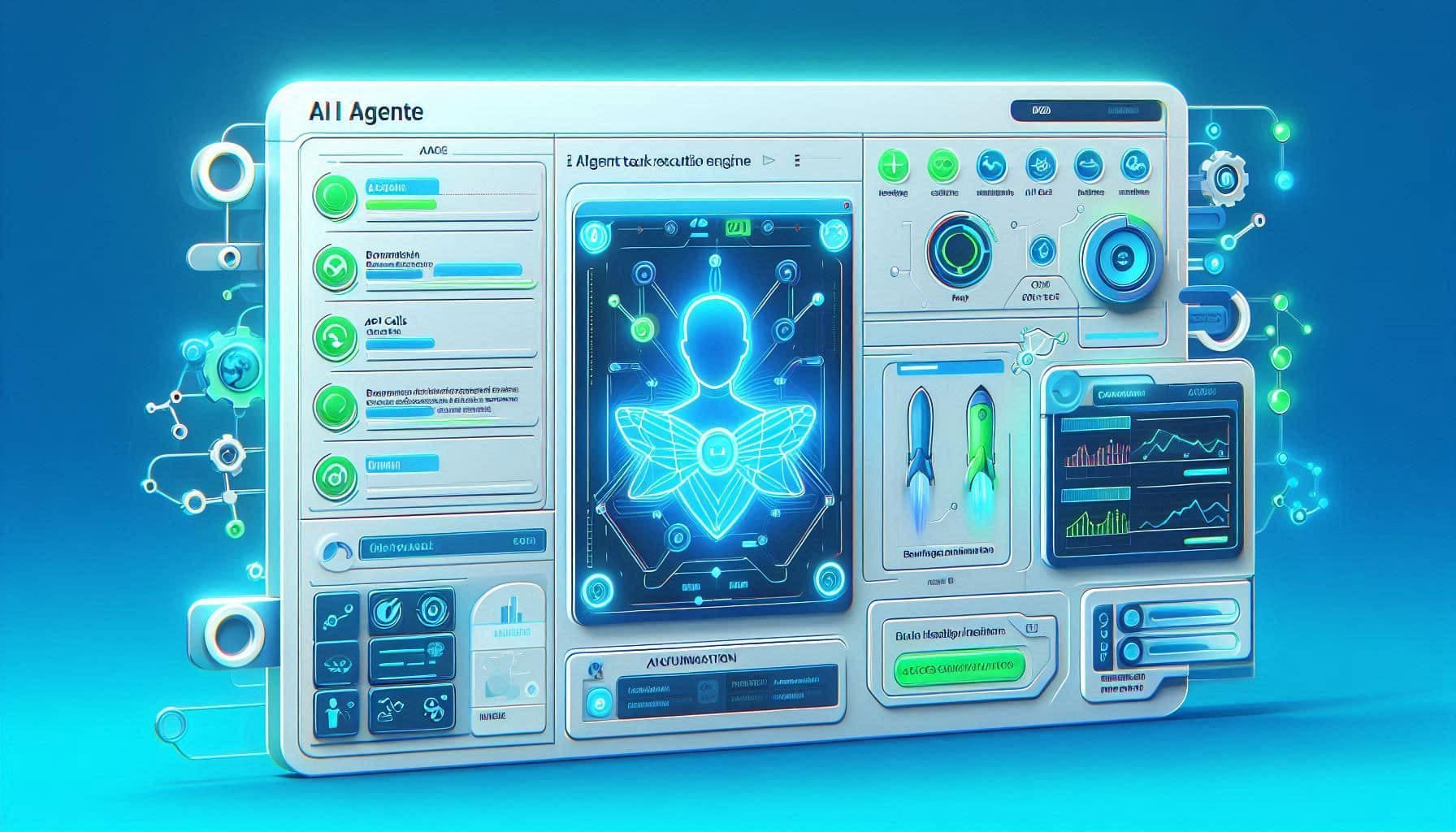
AI Agent Task Execution Engine (Action-Oriented Workflow & Tool Invocation System)
Design AI agents that execute real-world actions by calling tools, APIs, and browser workflows.
Prompt Overview
Tips For You
Reasoning is not enough. The biggest jump in business value happens when agents can reliably invoke tools, validate results, and recover from execution failure without constant human intervention.
From Operations TeamNexusAi TechnologyProblem It Solves
Many AI systems remain theoretical because they lack the ability to execute actions, resulting in no real business value.
Action-Oriented AI Design
Transforms AI outputs into real-world execution systems.
Tool Invocation Framework
Connects AI agents to APIs, tools, and platforms.
Execution Reliability System
Includes validation and error handling logic.
AI Prompt Instructions
Act as an AI execution systems engineer focused on building action-oriented AI agents.
Your task is to design a system where AI agents can execute real-world actions using tools, APIs, and browser automation.
CONTEXT:
AI becomes valuable only when it can act. Many systems fail because they generate outputs but do not execute tasks. This prompt focuses on transforming reasoning into execution.
INPUTS:
1. Task or workflow
2. Desired real-world outcome
3. Available tools (APIs, platforms, browser actions)
OUTPUT REQUIREMENTS:
SECTION 1 — TASK BREAKDOWN
Break the task into executable actions.
SECTION 2 — TOOL MAPPING
Map each action to specific tools, APIs, or automation layers.
SECTION 3 — EXECUTION LOGIC
Define how the agent selects tools and performs actions.
SECTION 4 — DECISION FLOW
Explain how the agent adapts based on results.
SECTION 5 — VALIDATION SYSTEM
Define checks to ensure actions succeed.
SECTION 6 — ERROR HANDLING
Include retries, fallbacks, and recovery logic.
SECTION 7 — FINAL EXECUTION ENGINE
Provide a structured system ready for deployment.
RULES:
- Focus on real-world execution
- Avoid theoretical outputs
- Ensure every step can be automated
Expected Outcome
A structured execution engine showing task breakdown, tool mappings, adaptive decision logic, validation rules, and failure-handling paths for real-world agent actions.
Implementation Journey
Step 1 — Define executable task in ChatGPT or Gemini
Paste prompt into ChatGPT or Gemini and input a real-world task (e.g., scrape leads, send emails, update database).
10 minutesStep 2 — Refine execution logic in Claude
Use Claude to improve execution reliability, validate tool mapping, and identify failure points.
10–15 minutesStep 3 — Implement agents in OpenClaw
Translate system into executable agents in OpenClaw, defining tool calls and execution logic.
20–40 minutesStep 4 — Connect APIs via Postman or LangChain
Use Postman or LangChain to connect APIs and define request-response flows.
20–30 minutesStep 5 — Execute browser actions using Playwright
Use Playwright to enable agents to interact with web applications and automate tasks.
15–25 minutesStep 6 — Monitor execution via Airtable or Supabase
Store execution logs, results, and system state for debugging and optimization.
10–20 minutes