The 8 AI Agent Architectures That Matter in 2026: From ReAct to Autonomous Loops
A practitioner’s map of eight mainstream AI agent architectures—ReAct, Plan-and-Execute, Multi-Agent, Reflective, Tool- and Memory-Augmented, RAG, and Autonomous Loops—explaining strengths, failure modes, and serving choices. Use it to pick the fastest, cheapest, and most reliable path from prototype to production.
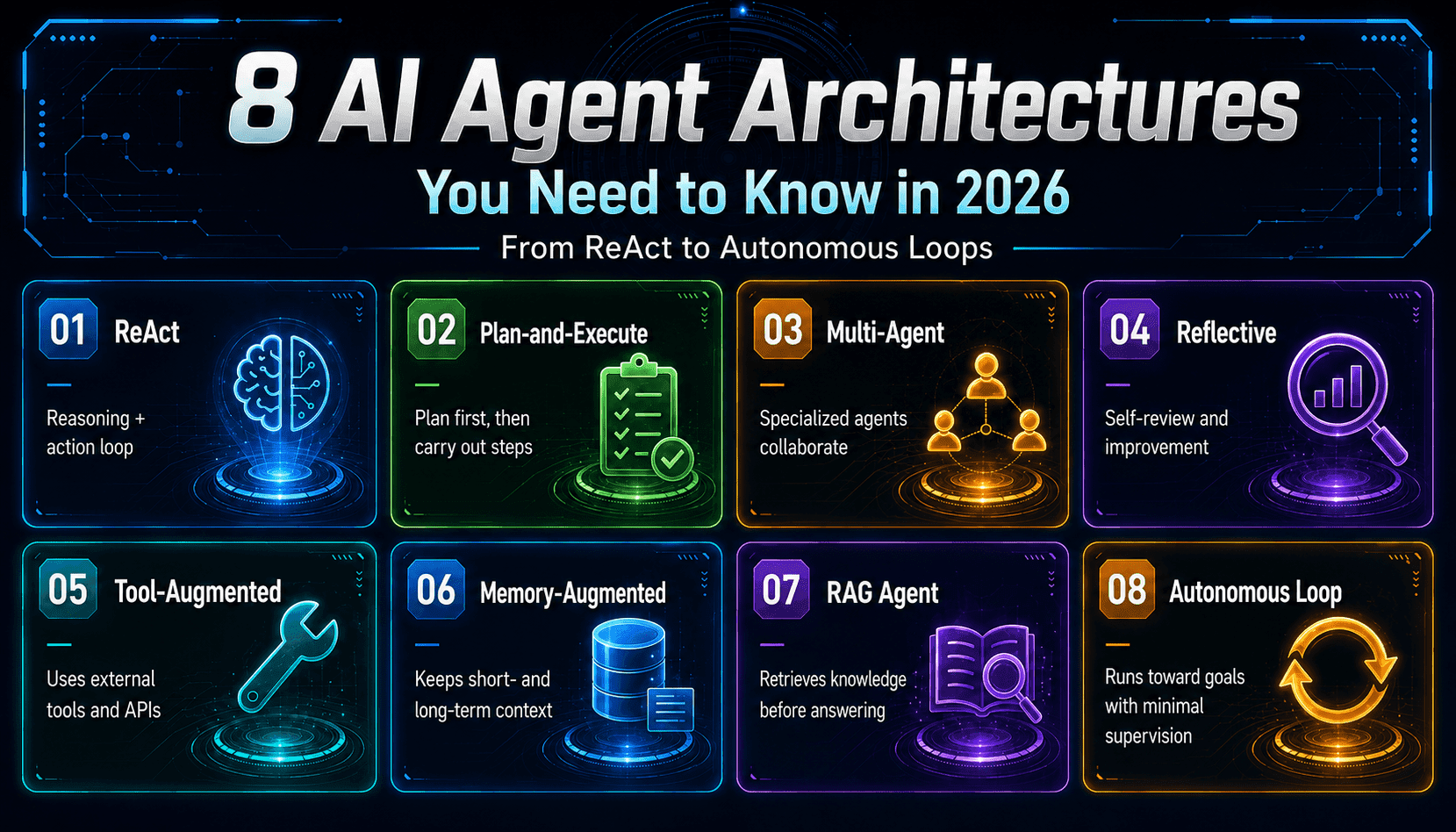
AI BriefAgent architecture is now the gating decision for reliability and unit economics. This guide breaks down eight patterns—ReAct, Plan-and-Execute, Multi-Agent, Reflective (self-critique), Tool-Augmented, Memory-Augmented, RAG, and Autonomous Loops—covering when each wins, why they fail, and how serving topology (sync vs async, event-driven, batching) shifts latency and cost. We translate architecture into operational decisions: debugging surface area, routing determinism, memory boundaries, and evaluation harnesses. The payoff: a decision framework you can use to start simple, scale deliberately, and avoid brittle orchestration that collapses under real workloads.
Most agent projects stall not on model capability, but on architecture choices that inflate latency, hide failure modes, and make debugging impossible. In 2026, eight patterns dominate real deployments: ReAct, Plan-and-Execute, Multi-Agent, Reflective, Tool-Augmented, Memory-Augmented, RAG, and Autonomous Loops. Each imposes distinct trade-offs in planning overhead, token usage, coordination complexity, and observability. Choosing well starts with a candid look at task shape: ambiguity of the path to a goal, accuracy tolerance, parallelism, and the need for persistent context.
ReAct remains the default for open-ended tool use because it is traceable and cheap to iterate, while Plan-and-Execute shines when subtasks are enumerable and parallelizable. Reflective agents buy accuracy with additional passes and evaluation criteria. Tool- and Memory-Augmented patterns harden production surfaces by formalizing APIs and state. RAG addresses knowledge freshness and grounding. Multi-Agent hierarchies extend horizon length but introduce coordination risk. Autonomous Loops bind it all into event-driven systems that survive timeouts and spikes.
The architecture decision only works when coupled to a serving choice. Synchronous REST can be fine for single-turn queries; it crumbles for long-running agents. Event-driven, asynchronous topologies with queues, idempotent steps, and explicit contracts between perception, reasoning, memory, and tools create the headroom to scale safely. Use this guide to start with the simplest workable pattern, add reflection where accuracy warrants it, and adopt hierarchy and autonomous orchestration only once telemetry proves a single loop is insufficient.
Key Takeaways
Start Simple, Prove Limits
Begin with ReAct plus explicit tools and scratchpads. Add reflection, RAG, and hierarchy only when telemetry shows accuracy gaps, freshness needs, or horizon limits that a single loop cannot meet.
Serving Topology Is Strategy
Adopt asynchronous, event-driven designs early for multi-step agents. Decouple stages, enforce idempotency, and monitor step-level metrics to avoid timeouts and runaway costs.
Governance Is a Layer
Version tool contracts, segment memory, and embed automated evaluations in CI. If you can’t trace decisions by step, you can’t operate the system safely in production.
The Eight Patterns—Strengths, Limits, and Fit
ReAct: tight thought–tool–observation loops for tasks with unknown paths (APIs, search, scraping). Best when traceability and quick iteration matter; watch token drift on long horizons.
Plan-and-Execute: front-load a plan, then run steps sequentially or in parallel. Great for deterministic workflows (reports, ETL), but plans can stale if upstream data shifts mid-run.
Reflective: self-critique against a success rubric to raise accuracy (code, math, summaries); trades latency and cost for quality.
Tool-Augmented: explicit tool contracts and routing; reduces hallucinated actions but requires robust error handling.
Memory-Augmented: short- and long-term stores (scratchpads, vector DBs); boosts continuity, but needs boundaries and eviction policies to prevent context poisoning.
RAG: retrieval grounds responses in current data and cuts hallucinations; retrieval quality and chunking outweigh model size.
Multi-Agent: supervisor–worker or peer collaboration for parallel specialization and longer tasks; failure isolation and coordination rules are mandatory.
Autonomous Loops: event-driven, stateful agents that run unattended across queues; outstanding for reliability and throughput, but demand strong observability and governance.
Selection Framework: Latency, Cost, Reliability, Complexity
Map your task on four axes. Latency: user-facing chat needs sub-second steps—favor ReAct or Plan-and-Execute with parallelism. Cost: high-traffic workloads reward batching, efficient retrieval, and minimal reflection passes. Reliability: if failure cost is high, prioritize Reflective or Plan-and-Execute with strict contracts and golden-path tests. Complexity: treat hierarchy and autonomous orchestration as liabilities until data proves single-agent limits.
Practical defaults: start ReAct with constrained tools and deterministic routing; add reflection when measured error exceeds tolerance; adopt Memory- and Tool-Augmentation to stabilize surfaces; insert RAG for freshness and auditability; reach for Multi-Agent only when context or specialization needs outgrow one loop; wrap mature workflows in Autonomous Loops to scale safely.
Serving Topologies That Make or Break Agents
Synchronous REST is fine for simple, single-turn calls. It collapses under long-running chains, parallel subtasks, or retries. Asynchronous queues and event-driven microservices decouple CPU preprocessing, GPU inference, and post-processing so spikes in one stage don’t starve others. Add idempotency keys, dead-letter queues, and backoff policies to prevent cascading failures.
Batching raises throughput and drops per-request cost but increases tail latency; reserve it for non-interactive workloads. Telemetry must capture step-level timings, token usage, tool errors, retrieval quality, and plan adherence. If you cannot trace which step made which decision, you cannot operate the system in production—regardless of architectural elegance.
Design for Tools, Memory, and Governance from Day One
Tool-Augmented agents require explicit schemas, deterministic routing, and sandboxed execution. Version tools and treat contracts as deployable artifacts. Memory-Augmented agents need separation of transient scratchpads, episodic task memory, and long-term knowledge; define retention, PII redaction, and eviction strategies. For RAG, optimize document chunking, embeddings, and retrieval filters before tuning the model.
Governance is an architecture layer, not an afterthought. Implement role-based access to tools and data, red-team prompts and tool invocations, and build automated evaluations (functional, safety, and cost) into CI. Observability—traces, spans, and evaluation scores—must be routable to owners so regression handling is fast and auditable.
Implementation Playbook: From Pilot to Production
Phase 1 (Pilot): ReAct with 2–4 tools, strict output schemas, and a small scratchpad; add smoke tests and basic tracing. Phase 2 (Hardening): Introduce reflection for high-risk steps, RAG for grounding, and parallelism for known subtasks. Add step-level evaluations and golden datasets. Phase 3 (Scale): Wrap flows in event-driven autonomous loops, partition state, and enforce quotas and timeouts.
Kill-switch criteria: escalating retries, tool timeouts, retrieval miss rate above threshold, or drift from the plan. Release gates: p95 latency, cost per successful task, accuracy vs. rubric, and failure isolation. This cadence forces complexity to earn its keep and keeps your spend and SLOs inside guardrails.
Frequently Asked Questions
When should I move from a single agent to a Multi-Agent system?
Switch when measured constraints exceed a single loop: context length saturation, clearly separable specialist roles, or wall-clock targets that require parallel execution. Before migrating, stabilize tools and memory, add reflection for accuracy, and instrument step-level tracing so you can isolate failures across agents.
How do I add memory without increasing hallucinations or cost?
Separate transient scratchpads from long-term stores, enforce write policies, and cap read lengths with retrieval filters. Use vector search with metadata constraints, add recency and source scoring, and log memory hits per step. Evict low-utility entries and redact PII at ingestion to prevent context poisoning.
What metrics best predict production reliability for agents?
Track plan adherence rate, tool success rate, retrieval precision/recall, reflection improvement delta, token-per-successful-task, and p95/p99 step latency. Alarms should trigger on rising retries, dead-letter queue growth, and divergence between planned and executed steps.