

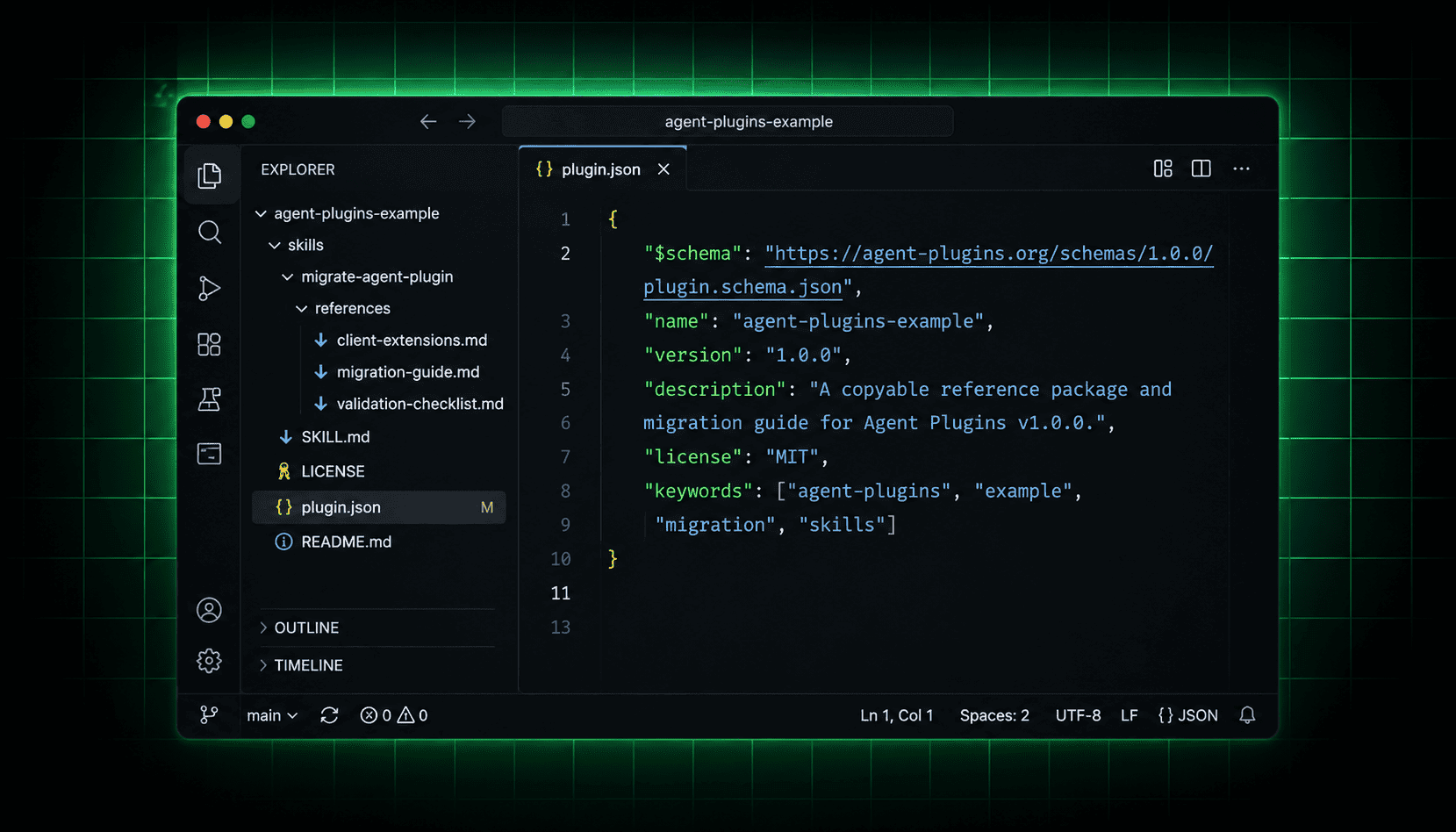
Agent Plugins 1.0 turns a recurring integration headache into a single portable package: ship a skill and its MCP server configuration once, and compatible agents can discover and run it without bespoke wrappers. GitHub has shipped general availability support across VS Code, Copilot CLI, the Copilot SDK, and the Copilot app, while the specification itself landed with backing from AWS, Anysphere, Microsoft, OpenAI, and Vercel, with Google joining as a core maintainer. That coalition matters—standards rise when both client distribution and vendor governance line up. The result is a plausible common format for coding agents that reduces fragmentation and speeds how quickly capabilities reach end users.
Practically, the spec enforces a predictable layout: skills live under a dedicated directory, MCP configuration sits in a manifest, and vendor-specific enhancements move into a namespaced folder that other clients safely ignore. This balances portability with room for differentiated features. For developers, it slashes the overhead of maintaining parallel manifests and directory structures; for platforms, it enables marketplace distribution and consistent discovery. Expect a broader catalog of high-quality, testable plugins that can be upgraded as cohesive units, with semantic versioning and CI verification across clients replacing one-off packaging scripts and brittle install guides.
Enterprises get a governance story that fits their existing controls: managed settings to enable or block plugins at scale, the ability to constrain marketplaces, and MCP allowlists to approve specific servers, commands, or endpoints. That makes portable plugins viable in regulated environments, where network egress, secrets handling, and auditability are non-negotiable. The near-term work is operational: define trust boundaries per plugin, map MCP servers to data classifications, and add multi-client plugin tests to release gates. The risk is spec drift or uneven client parity; the countermeasure is adopting the 1.0 schema today while instrumenting telemetry to watch behavior changes as clients iterate.