

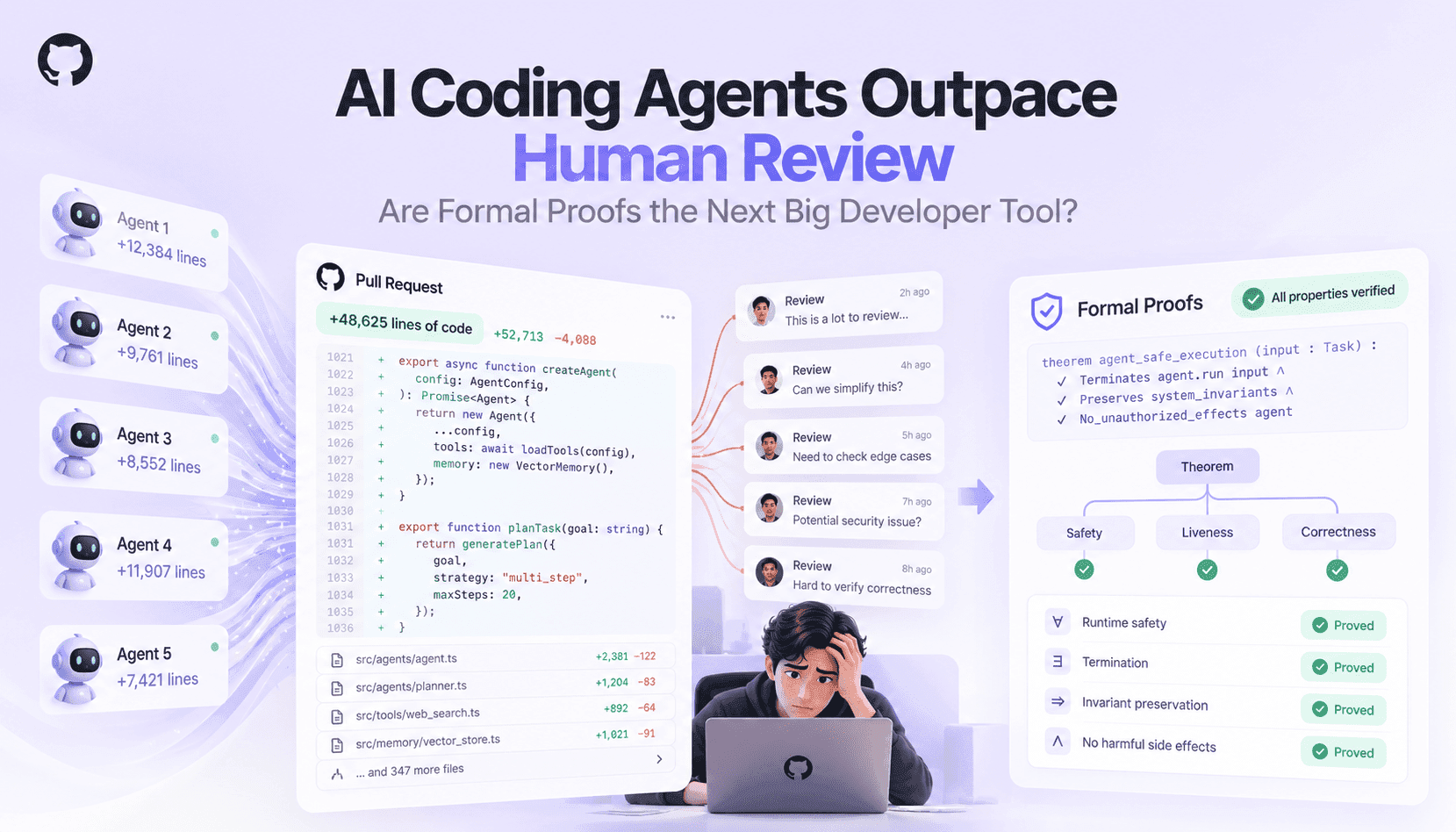
The rise of code-writing agents — from Copilot derivatives to autonomous agent workflows — has changed the cadence of engineering. Where a team once balanced a handful of human-authored PRs per day, many teams now receive streams of generator-produced patches, scaffolds and new modules. That volume improves feature velocity, but it also creates a verification backlog: human reviewers are a finite resource, and lightweight checks (formatting, linters, shallow review) won’t scale. This gap is the operational problem behind rising incidents, configuration regressions, and security misconfigurations in agent-augmented pipelines.
Different verification techniques catch different failure modes. Unit and integration tests validate behavior for specified inputs; static analysis finds type, flow, and certain API misuse issues; AI-assisted code review flags style and probable bugs; formal verification proves properties about all possible inputs when you can write a precise spec. None is a panacea. Tests miss corner cases outside the chosen inputs. Static analysis produces false positives and struggles with dynamic patterns. AI review can be pressured by model hallucination. Formal proofs have upfront cost and require clear specifications and often constrained code structure.
Microsoft’s Proof‑Driven Development research shows how formal methods can be pragmatically integrated into developer flows: by targeting critical modules and by deriving proofs from executable specifications, teams can eliminate whole classes of logic and concurrency errors that evade tests. GitHub AI Scan and similar scanning platforms provide scalable, continuous detection for known vulnerability patterns and risky dependencies. Together they imply a hybrid approach: use automated, probabilistic, and deterministic tools where they fit best, and reserve the expensive but decisive formal methods for the highest-risk code.
For teams using Claude Code, Codex, GitHub Copilot or agentic workflows, the practical question is how to combine these tools into an operational pipeline that retains agent productivity while keeping defects and vulnerabilities manageable. The remainder of this article compares verification methods side-by-side, lays out targeted recommendations for when to apply formal proofs, and presents a stepwise workflow that pairs automated generation with sandboxed testing, incremental proofs, and human judgment, so verification scales more like the code output than the reviewer headcount.