

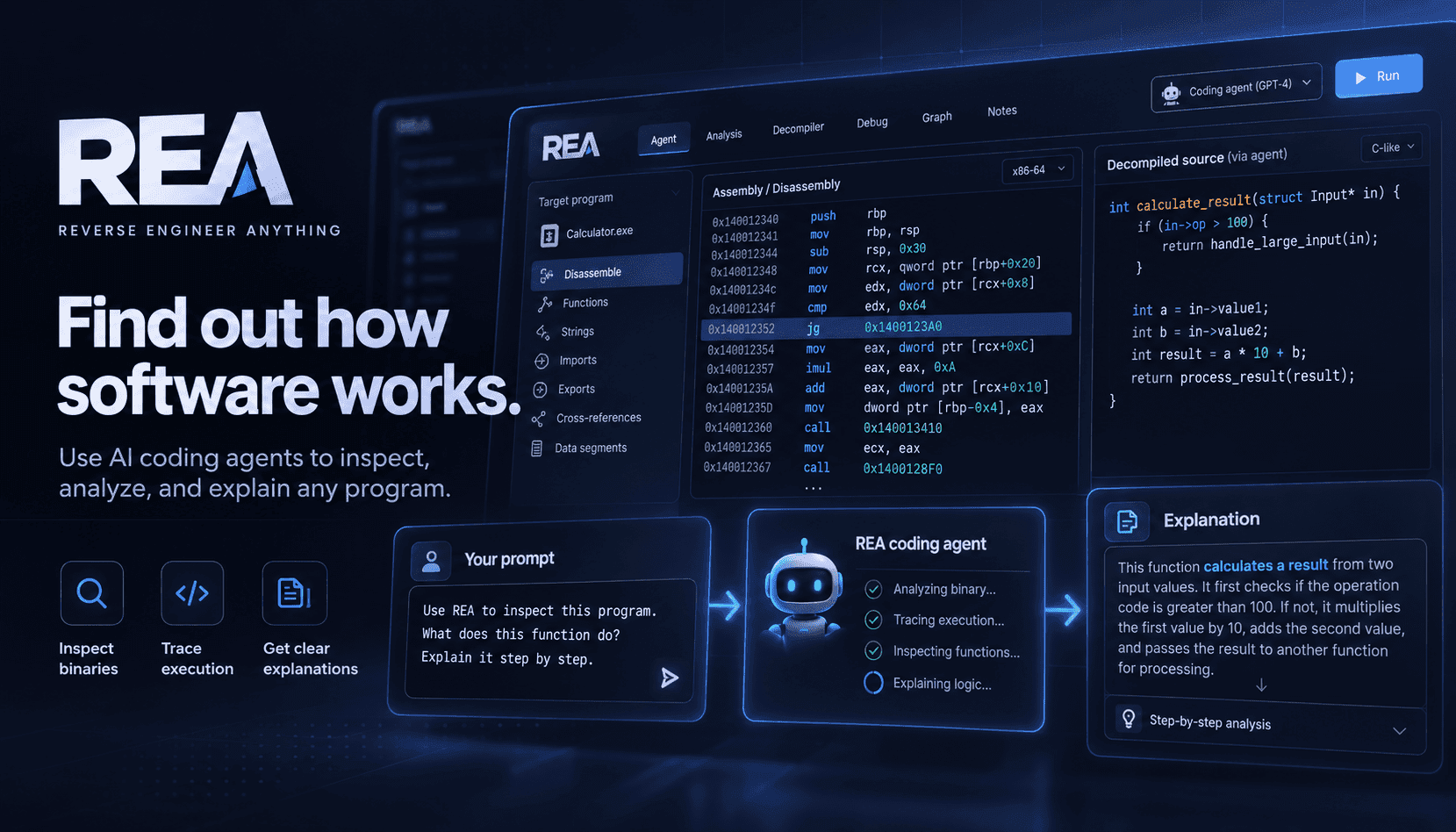
REA (Reverse Engineer Anything) reframes reverse engineering as a toolchain that an AI agent can orchestrate through a local MCP (Model Context Protocol) server. Instead of a human manually wiring static and dynamic analyzers, REA provides workflows, evidence contracts and provider adapters that let agents call into native analysis engines (Ghidra, Hopper, IDA), JavaScript/Electron parsers, .NET inspectors, APK decompilers and runtime capture tools. The result is a structured investigation: the agent issues steps, REA returns findings with traceable evidence, and the agent synthesizes conclusions and reconstruction guidance.
Practically, that pipeline changes how teams investigate features they don’t control. An agent can begin with a recorded UI interaction, follow network traces and IPC boundaries, extract relevant strings and resource references, and escalate a hit into a targeted binary trace. REA maps those artifacts to decompiled pseudocode and assembly views from the configured native provider, attaches call/reference graphs, and packages the evidence so the agent can justify each inference. This combination of automation and evidence is what makes reconstructions reproducible and reviewable.
For teams building integrations, migration tools or compatibility layers, REA’s local-first design is important: analysis runs on the investigator’s machine or infrastructure, not a third-party cloud service. That lowers data-exfiltration risk and preserves legal control over analyzed artifacts. REA also supports diverse targets—websites, Electron apps, .NET assemblies, Android APKs, firmware and raw packet captures—so a single agent setup can standardize investigations across an estate of legacy and proprietary software.
Adoption depends on operator discipline. Deep native analysis still requires licensed binaries for IDA or Hopper when used, and teams must document authorization, licensing status and reconstruction scope before starting. REA includes evidence and limitation fields precisely to surface what was observed and what remained ambiguous, but organizations must pair that transparency with legal review and internal guardrails to ensure reverse engineering is limited to permitted uses such as interoperability, security research or maintenance of owned software.