

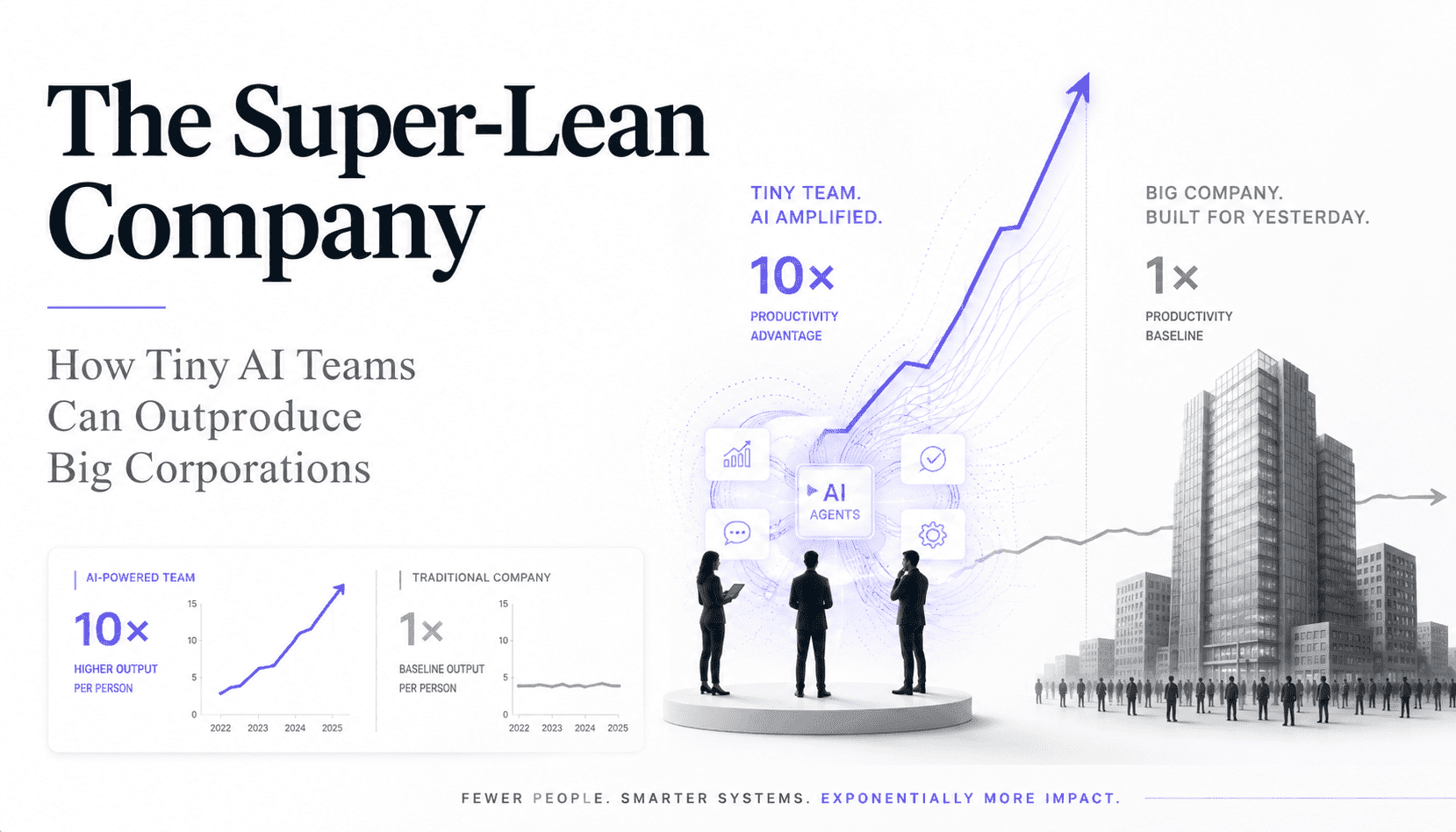
Most firms have treated AI as a speed boost inside the task “inner loop”—drafting, coding, summarizing. That helps, but bottlenecks quickly shift to the outer loop: review, integration, testing, release, and adoption. The super‑lean company flips this. It standardizes the outer loop with AI‑assisted gates, telemetry, and agents that move work items forward without waiting on people. When output is paced by release and quality assurance, not by writing or coding, compressing these gates unlocks step‑function throughput for small teams.
A parallel shift is happening in capital utilization. Instead of immediately buying more compute or capacity, lean teams orchestrate longer runs on what already exists: GPU pools scheduled around the clock, CI/CD pipelines with auto‑triage and revert, and content or customer workflows queued to run when capacity is available. This raises realized output per dollar of fixed assets and brings the productivity headline without expanding headcount. In effect, AI choreography—not sheer model horsepower—becomes the multiplier.
Designing for super‑lean requires new staffing ratios. Keep durable owners few—product, reliability, compliance—and let AI agents and automation cover elasticity. Replace role specialization with pattern libraries: prompt templates, eval suites, red‑team playbooks, and governance flows that any contributor can reuse. Measure the system, not individuals: track cycle time to safe release, change failure rate, time to restore, and revenue per employee. If these move in the right direction, smaller teams can credibly manage larger product surfaces.
The risk is fragility—thin headcount means single points of failure if automation misfires. Counter this with layered safeguards: offline evals before promotion to live, policy engines that gate actions, progressive rollout with guardrails, and post‑incident learning captured as machine‑readable rules. Treated as an operating model, not a tool pilot, the super‑lean company can scale output while preserving resilience and trust.