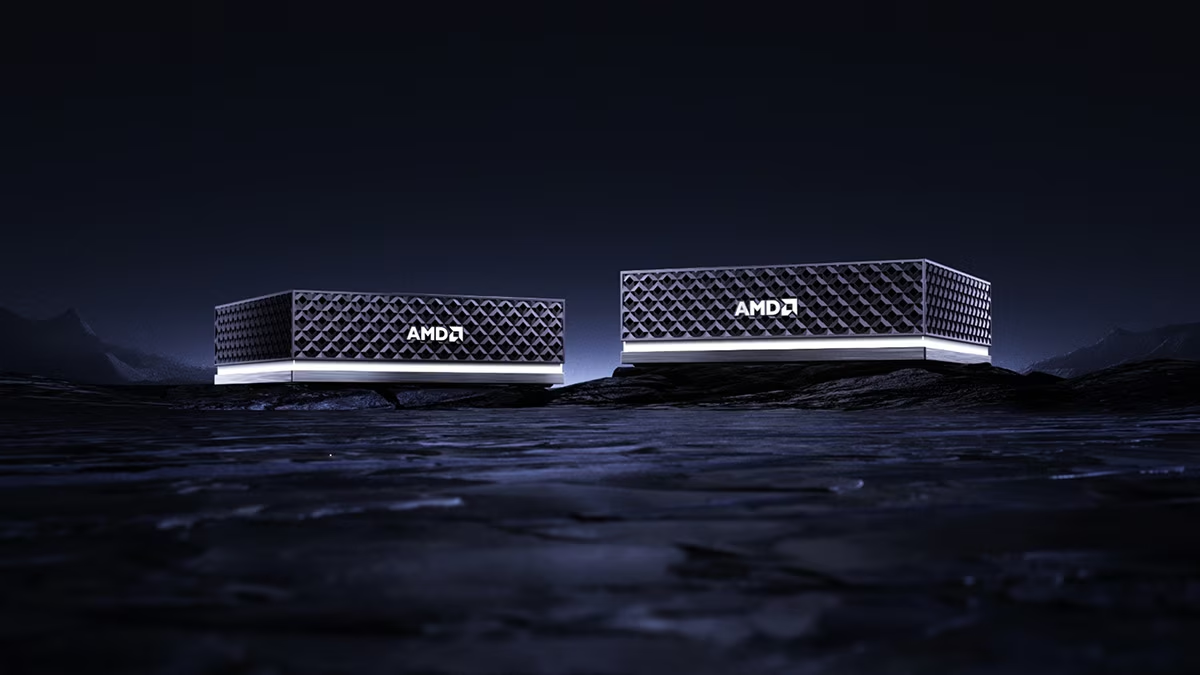
AMD’s Ryzen AI Halo Developer Platform shows how local AI workstations are becoming a serious alternative to cloud GPUs for developers, small teams and agent builders.
AMD Ryzen AI Halo is entering the AI workstation conversation at a moment when local development is becoming more important. Developers, AI builders and small teams increasingly want to run models, test agents, prototype apps and experiment with private data without sending every workflow to remote GPUs. That makes compact high-memory AI workstations a serious new category.
The comparison with NVIDIA DGX Spark is important because both systems represent a move away from traditional cloud-only AI development. NVIDIA’s Spark platform focuses on a dedicated personal AI supercomputer experience, while AMD’s Ryzen AI Halo Developer Platform leans into a more familiar PC-style environment with Windows and Linux relevance, integrated Radeon graphics, a 50 TOPS NPU and large unified memory.
For AI users, this is not only a processor story. It is a workflow story. The more models, coding agents, creative tools and private automation systems can run on a personal workstation, the more control users gain over cost, latency, experimentation speed and data handling. Ryzen AI Halo shows that the AI PC race is becoming a local AI development race.
Why Ryzen AI Halo matters for local AI development
Most AI development still depends heavily on cloud infrastructure. That works well for large-scale training, frontier models and managed production services, but it can be expensive or inconvenient for everyday experimentation. Local workstations give developers a different option: run smaller or quantized models, test agent workflows, build prototypes and inspect private data on hardware they control.
Ryzen AI Halo is designed for that middle ground. It is not trying to replace giant data-center clusters. Instead, it gives individual builders and small teams a compact local machine for inference, AI app development, agent testing, creative workloads and experimentation. That makes it relevant for the growing number of users who want practical AI development without renting cloud GPUs for every task.
AMD’s advantage is mainstream PC flexibility
AMD’s strongest angle is flexibility. A Ryzen AI Halo workstation is closer to a familiar developer PC than a closed appliance. Windows support matters because many developers, creators and small teams already build on Windows, while Linux support keeps the platform relevant for AI engineers using open-source model tooling, containers, local inference servers and development frameworks.
The Ryzen AI Max+ 395 configuration also gives the platform a strong local AI profile: 16 CPU cores, integrated Radeon graphics, 128GB memory support and a 50 TOPS NPU. For users who want one compact workstation that can run code, serve local models, test agents and support creative workflows, this combination is more accessible than a traditional multi-GPU workstation.
How it compares with NVIDIA DGX Spark
NVIDIA DGX Spark remains strategically important because NVIDIA owns a powerful AI software ecosystem around CUDA, optimized inference stacks, model tooling and developer mindshare. For many AI developers, NVIDIA compatibility still reduces friction because so much open-source AI tooling is built or optimized with NVIDIA GPUs in mind.
AMD’s challenge is different. It competes on accessibility, PC compatibility, price pressure and open development flexibility. Ryzen AI Halo may not beat NVIDIA in every optimized AI workload, but it can still be attractive if developers value Windows support, x86 familiarity, large unified memory, compact design and a lower barrier to local experimentation.
The real use case is agent computers, not benchmark bragging
The most interesting use case is the personal agent computer. A local AI workstation can run coding agents, file-aware assistants, research tools, local RAG pipelines, creative generators and private automation workflows directly on the user’s machine. That turns the PC into a development environment for AI agents, not only a place to call cloud APIs.
This matters because local agents need access to sensitive context: code repositories, internal documents, design files, customer notes, logs, datasets and unfinished product ideas. Running more of that workflow locally can improve control and reduce dependency on external services. The best AI workstation may be the one that makes local agent workflows reliable enough for daily use.
What NexusAI users should watch next
NexusAI users should watch real-world software support more than headline specs. The key questions are which models run smoothly, how well ROCm and Windows tooling mature, whether common local AI frameworks support the platform cleanly, and how Ryzen AI Halo performs in practical workloads such as coding agents, local RAG, multimodal inference and creative pipelines.
The broader lesson is that AI tool selection is becoming hardware-aware. In 2026, choosing an AI stack may involve comparing cloud models, local models, coding agents, workflow tools and the physical workstation that runs them. Ryzen AI Halo and NVIDIA DGX Spark show that the local AI workstation race is now part of the AI platform race.