Best AI Coding Tools in 2026: Claude Code vs Codex vs Cursor vs Windsurf
Compare Claude Code, OpenAI Codex, Cursor, Windsurf, Qoder and OpenHands to find the best coding agent for terminal development, parallel delegation, AI-first editing, enterprise workflows and self-hosted automation.
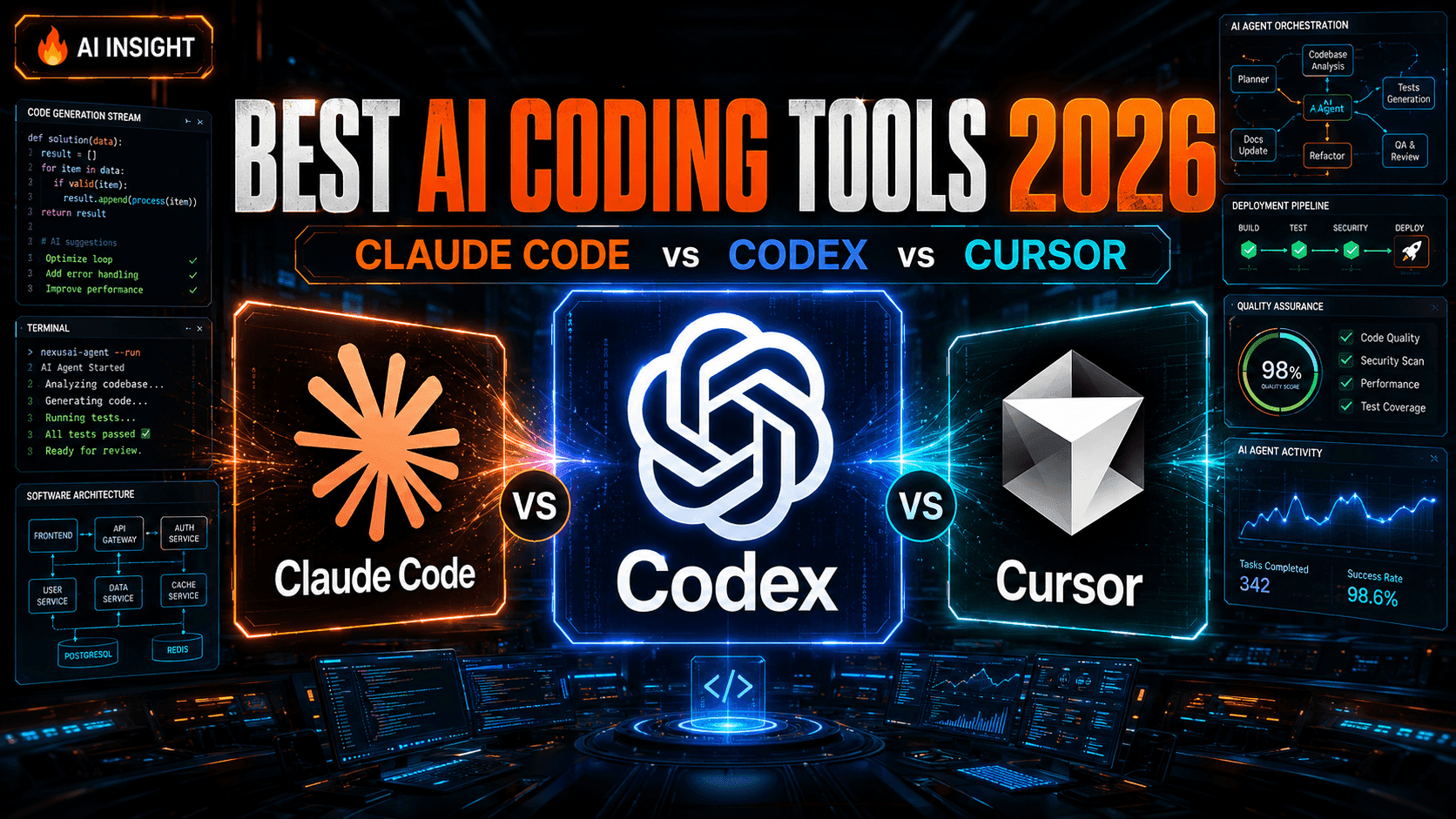
AI BriefAI coding tools have moved beyond autocomplete into autonomous engineering systems that can inspect repositories, edit multiple files, run tests, review changes and complete delegated tasks. Claude Code, Codex, Cursor, Windsurf, Qoder and OpenHands approach that work through different combinations of terminals, cloud environments, intelligent editors and open agent infrastructure. The best choice in 2026 depends less on a single benchmark and more on where developers want agents to run, how much control teams require and how work moves from specification to reviewed code.
AI coding is one of the fastest-moving software categories in 2026. Leading tools are no longer limited to suggesting the next line of code. They can investigate unfamiliar repositories, create implementation plans, edit connected files, execute commands, run tests and prepare changes for review.
The category has also divided into several operating models. Claude Code works naturally from the terminal, Codex supports parallel agents across local and cloud environments, Cursor embeds agents inside an AI-first editor, and the product previously known as Windsurf is evolving into Devin Desktop as a command centre for multiple coding agents.
This ranking evaluates the tools by repository understanding, autonomous execution, reviewability, environment flexibility, team adoption and suitability for real development work. It does not assume that one agent is best for every developer. The practical winner depends on whether the priority is deep terminal work, parallel delegation, editor integration, specification-driven development or infrastructure control.
Key Takeaways
Claude Code leads for terminal-native development
Its combination of repository understanding, command execution and multi-file implementation makes it the strongest overall choice for developers who want an agent inside their existing terminal workflow.
Codex is built for parallel delegation
Codex becomes most valuable when developers can dispatch clearly defined tasks across worktrees and cloud environments, then review the resulting changes.
Control and workflow fit matter more than one benchmark
Cursor, Devin Desktop, Qoder and OpenHands serve different needs across editor integration, multi-agent coordination, repository knowledge and self-hosted infrastructure.
How the leading AI coding tools rank in 2026
Claude Code ranks first for developers who want a capable terminal-native agent with direct access to repository files, commands and test workflows. Codex ranks second for parallel delegation and cloud-assisted engineering. Cursor ranks third as the strongest everyday AI-first editor, while Windsurf, now transitioning into Devin Desktop, ranks fourth for coordinating multiple local and cloud agents.
Qoder ranks fifth for its repository knowledge engine, codebase wikis and specification-driven workflow. OpenHands ranks sixth overall but becomes the leading option for teams prioritizing open infrastructure, model flexibility, transparency and self-hosted customization. These positions reflect general workflow value rather than a permanent capability hierarchy.
1. Claude Code: best for deep terminal and repository work
Claude Code is the strongest overall choice for experienced developers who already work comfortably in terminals, repositories and command-line tools. It can read a codebase, modify files, run commands, execute tests and continue through multi-step implementation work without forcing the developer into a separate editor.
Its advantage is the combination of strong coding reasoning and a workflow that remains close to the developer's existing environment. Claude Code is particularly suitable for debugging, architectural investigation, migrations and connected changes across large repositories. Teams should still define permissions, repository instructions, testing requirements and review gates because capable terminal access increases both usefulness and operational risk.
2. OpenAI Codex: best for parallel delegated engineering
Codex is designed around delegating substantial engineering tasks rather than maintaining only one continuous pair-programming conversation. Its app combines worktrees and cloud environments so multiple agents can investigate issues, build features, complete refactors or prepare pull requests across separate tasks.
This makes Codex especially attractive to developers managing backlogs, migrations and parallel workstreams. Its value increases when tasks have clear acceptance criteria and reliable automated tests. Claude Code remains the stronger choice for developers who prefer an intensive terminal session, while Codex is better suited to dispatching work and reviewing completed results across several agents.
3. Cursor and Windsurf: the AI-first editor battle is changing
Cursor remains a strong daily development environment for users who want codebase indexing, model choice, agent planning, editing and review inside one familiar IDE. It provides a smoother transition for developers who want more autonomy than conventional autocomplete without moving their entire workflow into a terminal or external agent dashboard.
Windsurf has entered a significant transition after becoming Devin Desktop. The underlying IDE experience remains, but the product is being repositioned as a command centre for managing fleets of local and cloud agents, including different agent providers through a shared protocol. This gives it ambitious multi-agent potential, although teams evaluating Windsurf should now consider the Devin Desktop roadmap, migration experience and broader Cognition platform strategy.
4. Qoder and OpenHands: knowledge-driven versus open agent infrastructure
Qoder differentiates itself through context engineering and specification-driven development. Its knowledge engine, repository wiki capabilities and autonomous Quest workflow are designed to make architecture and requirements visible before implementation begins. It is a compelling option for teams working with large repositories, inherited systems or projects where undocumented knowledge creates repeated mistakes.
OpenHands takes a different approach. It provides an open, model-agnostic foundation for cloud coding agents and gives platform teams greater control over models, environments and internal integrations. It may require more setup than a polished commercial editor, but it is the strongest option in this ranking for organizations building customized coding automation or keeping agent infrastructure under their own governance.
5. Choose the workflow before choosing the agent
Choose Claude Code for deep terminal work, Codex for parallel delegated tasks, Cursor for an AI-first daily editor, Devin Desktop for managing multiple agent systems, Qoder for specification and repository knowledge, and OpenHands for open infrastructure and customization. Many professional teams will use more than one because interactive implementation and asynchronous delegation are different workflows.
Before standardizing on a product, test it against a real repository and measure accepted changes, review time, test reliability, security controls and total task cost. Generated code volume is a weak success metric. The useful result is reviewed software that satisfies requirements without shifting hidden debugging and maintenance work onto human developers.
Frequently Asked Questions
What is the best AI coding tool in 2026?
Claude Code is the strongest overall choice for deep terminal and repository work, while Codex is better for parallel delegated tasks. Cursor is the most natural choice for developers who want an AI-first IDE rather than a terminal-focused agent.
Is Windsurf still available in 2026?
Windsurf has been renamed Devin Desktop. Its IDE capabilities remain, but the product is expanding into a command centre for managing multiple local and cloud coding agents.
Should a development team use more than one coding agent?
Often, yes. A team might use Claude Code or Cursor for interactive development, Codex for asynchronous delegated tasks and OpenHands for customized internal automation. The tools should share clear repository instructions, testing standards and human review requirements.