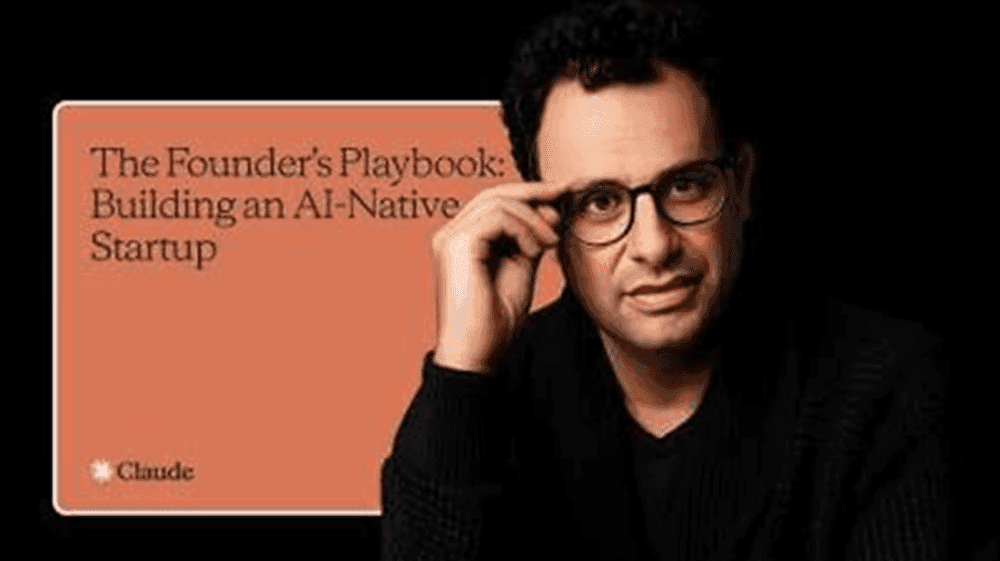
Anthropic’s Founder’s Playbook turns Claude into a startup operating system for idea validation, MVP building, launch execution and scale-stage agent workflows.
Anthropic’s Founder’s Playbook is a useful signal for how AI-native startups are being built in 2026. The core idea is simple: founders can now use AI across every stage of the company journey, from problem discovery to MVP development, launch operations and scale-stage workflow automation.
The playbook matters because it moves beyond generic advice like using AI to write copy or summarize meetings. Anthropic organizes the startup lifecycle into practical stages with goals, exit criteria, failure modes and AI-powered exercises. That makes it closer to an operating manual than a simple prompt collection.
For founders, the strongest takeaway is that AI should not be treated as a side tool. In an AI-native startup, AI becomes part of customer discovery, product design, code generation, research, launch planning, content production, internal operations and decision support.
The startup lifecycle is being rebuilt around AI
Anthropic structures the playbook around four startup stages: Idea, MVP, Launch and Scale. That framing is useful because founders need different AI workflows at different points. Early-stage teams need sharper problem validation and customer discovery. Later-stage teams need launch systems, workflow automation, operating cadence and reliable delegation.
This matters because many founders misuse AI by applying the same prompt style everywhere. The playbook suggests a better approach: match the AI workflow to the company stage. Use AI to clarify uncertainty early, generate and test product direction during MVP work, coordinate execution during launch, and delegate repeatable systems during scale.
Idea stage: AI should sharpen the problem, not just brainstorm features
The most useful AI work at the idea stage is not producing a long list of startup concepts. It is pressure-testing the problem. Founders can use AI to map customer segments, identify pain points, compare competitors, draft interview questions and summarize patterns from discovery conversations.
This is where AI can reduce founder self-deception. A model can help expose weak assumptions, missing competitors, unclear users and vague value propositions. But founders still need real customer contact. AI can structure discovery, but it cannot replace the signal that comes from people who are willing to pay, switch, complain or commit.
MVP stage: Claude Code changes what non-technical founders can ship
One of the biggest shifts is that founders who have never been traditional software engineers can now ship working prototypes faster. Claude Code and similar coding agents can help scope an MVP, plan architecture, generate components, explain implementation choices and refactor early code.
The risk is that speed can create technical debt. AI-generated MVPs still need clear requirements, security review, data-model discipline, test coverage and maintainable architecture. The best founder workflow is not vibe-coding everything blindly, but using AI to move faster while keeping a human product and engineering judgment layer in place.
Launch stage: founders need operating systems, not random AI tasks
At launch, the bottleneck shifts from building to learning. Founders need to manage messaging, onboarding, feedback, support, analytics, customer calls, content, outreach and rapid iteration. This is where AI can become a launch operating system rather than a collection of isolated prompts.
A strong launch workflow might use Claude to synthesize feedback, Claude Code to update product surfaces, Claude Cowork or agents to monitor tasks, and structured documents to keep positioning, objections, metrics and next actions in sync. The goal is to make founder attention more focused, not more scattered.
Scale stage: agentic workflows need controls
At scale, AI-native companies need more than faster content or code. They need repeatable agent workflows for operations, research, engineering, sales support, internal documentation and customer success. This is where Claude Cowork-style collaboration becomes relevant because AI has to work with teams, not only individual founders.
But agentic scale also needs governance. Founders should define what agents can access, what they can change, when humans approve decisions, how outputs are reviewed, and how costs are monitored. The best AI-native startups will not be the ones that automate everything immediately, but the ones that build safe systems for compounding execution.