

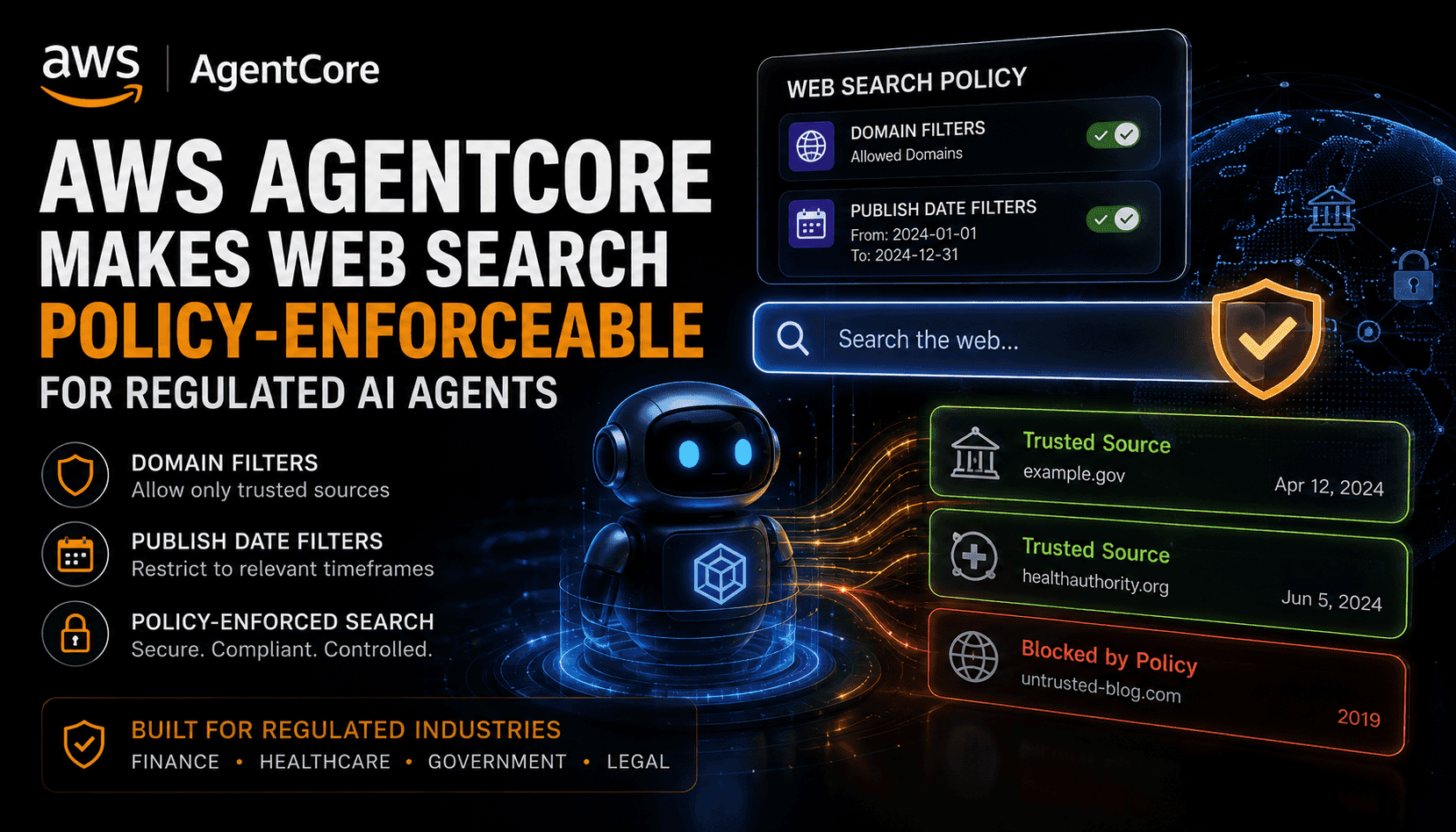
AWS is formalizing a core pain point in agentic systems: how to let AI search the web without abandoning governance. AgentCore’s web-search update applies admin-defined domain policies at the infrastructure layer, then lets each call further narrow sources and time windows. The key: this control sits behind the endpoint, not in client-side prompt logic or brittle post-processing. Requests that attempt to widen scope are silently constrained, and results missing a verified publication date are excluded whenever date filters are active. For organizations with board-level scrutiny, this shifts web grounding from a heuristic into an enforceable control plane.
The merge semantics are deliberately conservative. Effective allowlists are the intersection of admin and runtime inputs, while effective denylists are their union. That means developers cannot unblock a site the administrator has banned, and they cannot add a new site unless it already lives in the approved inventory. This design reduces the surface area for jailbreaks, prompt leakage, and multi-tenant cross-talk. Precision beats recall: hits without a canonical domain or recognizable publish date are filtered out under active constraints, improving auditability, repeatability, and the odds that citations survive legal review.
Practically, the model encourages teams to treat source policy as product infrastructure: curate an allowlist that mirrors your regulator’s expectations, instrument logs for effective filter sets per call, and label responses with compliance metadata (domain and timestamp). Finance teams can confine earnings-call summaries to approved investor relations domains and the current quarter. Healthcare assistants can cite FDA, NIH, or ClinicalTrials.gov only. Legal teams can restrict to .gov and official rulemaking portals with a rolling time window for freshness guarantees. The net effect is controlled breadth with measurable currency of information.
Strategically, this turns web search into a policy surface akin to network egress rules or DLP. It narrows the difference between in-house corpora and the open web by imposing the same governance vocabulary on both. Buyers should evaluate it like infrastructure: confirm merge behavior under adversarial prompts, validate how many results survive strict filters in your domain, and benchmark latency from regional endpoints. The win is not just safer answers—it’s a cleaner SLA: which sources are permitted, how recent the content must be, and what gets dropped when evidence is ambiguous.