

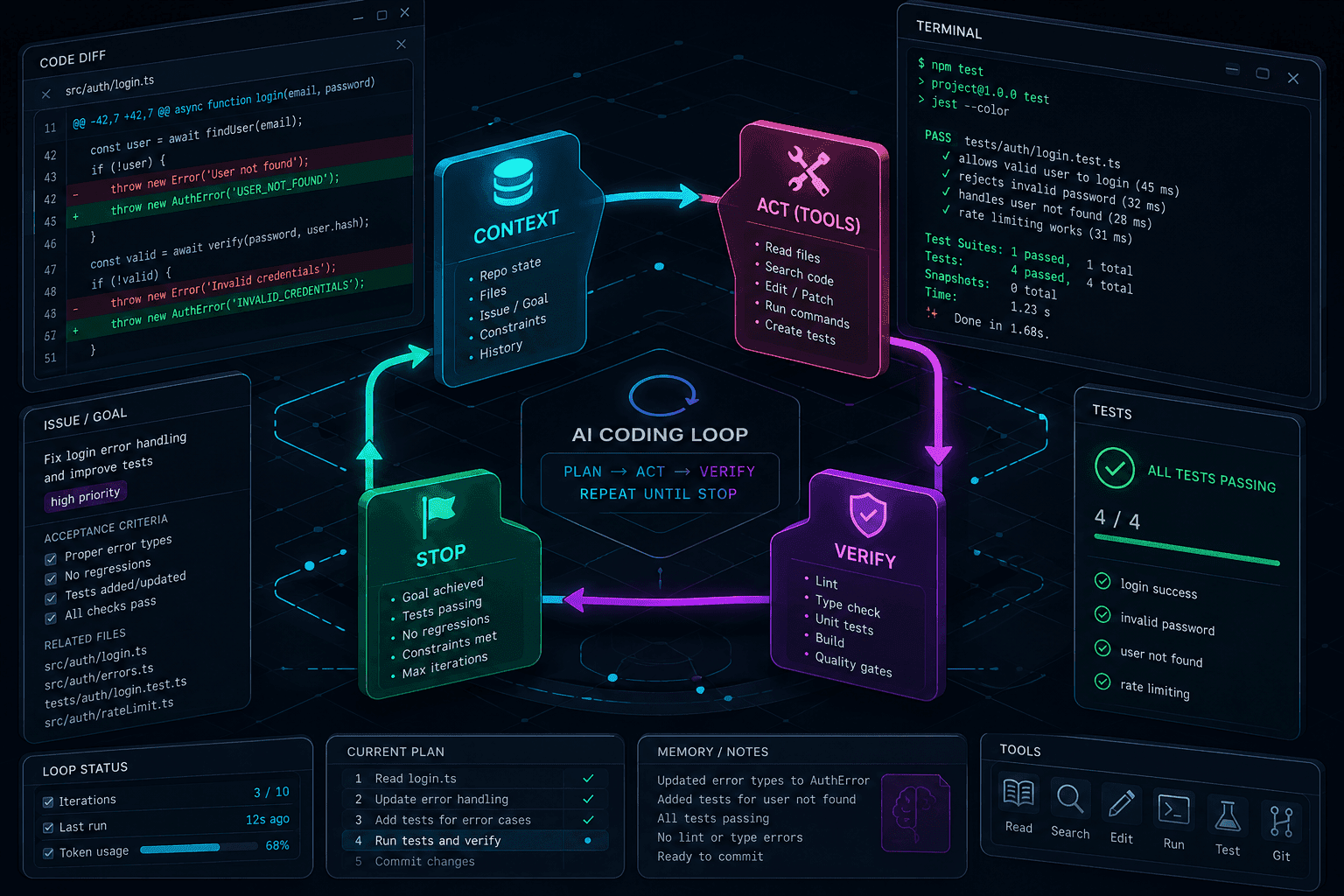
The promise of coding agents has often stalled on reliability: a great demo doesn’t translate into a stable workflow you can ship. Claude Loop pushes teams to engineer for repeatability, not one-off cleverness. Instead of sequentially prompting for each step, a loop specifies how the agent gathers context, decides which tools to use, verifies its own output, and halts on explicit success or failure criteria. This design-first approach turns ad hoc prompting into an operational workflow that survives handoffs, scale, and audits.
In practice, loop engineering shines on recurring repo tasks where the signal for “done” can be codified. Think triaging a failing test, proposing a minimal code diff, running a targeted test suite, and attaching a structured report to a PR. Or orchestrating documentation updates: collect API changes, generate draft edits, run a style linter, and request a maintainer review only when policy checks pass. The value unlock is consistent throughput and lower human context-switching, not full autonomy. Well-designed loops make AI assistance predictable and observable.
The hard part isn’t tool use—it’s verification. A useful loop encodes its own guardrails: unit or contract tests for correctness, static analysis and policy-as-code for safety, and side-effect scoping to prevent broad writes or data exfiltration. Loops should degrade gracefully: fail closed when a check is inconclusive, surface traceable artifacts, and request human input for edge cases. Teams that rush to expand agent permissions before they mature their evaluation harness end up firefighting regressions and losing trust with maintainers.
A pragmatic rollout starts small. Choose a single, noisy bottleneck with measurable outcomes—like PR hygiene or flaky test diagnostics—and define a loop with strict boundaries, narrow tool access, and clear stop conditions. Instrument everything: success rates, diff size, revert rate, time-to-merge, and compute cost. Iterate weekly on prompts, tools, and verifiers, then expand scope only when the loop’s evaluation signals stabilize. Over time, adjacent loops can compose into a resilient agentic pipeline that accelerates releases without eroding quality.