The 11 Best AI Generative Media Tools in 2026: A Buyer’s Guide to Images, Video, Music, and Brand Assets
A practical buyer’s guide to the 11 leading AI generative media platforms—Midjourney, Replicate, KLING AI, Magnific, Nano Banana 2, RunwayML, Suno, LogoFast, Luma AI, Photoroom, and Sivi AI—mapped to real workflows across images, video, audio, editing, upscaling, branding, product photos, APIs, and creative automation.
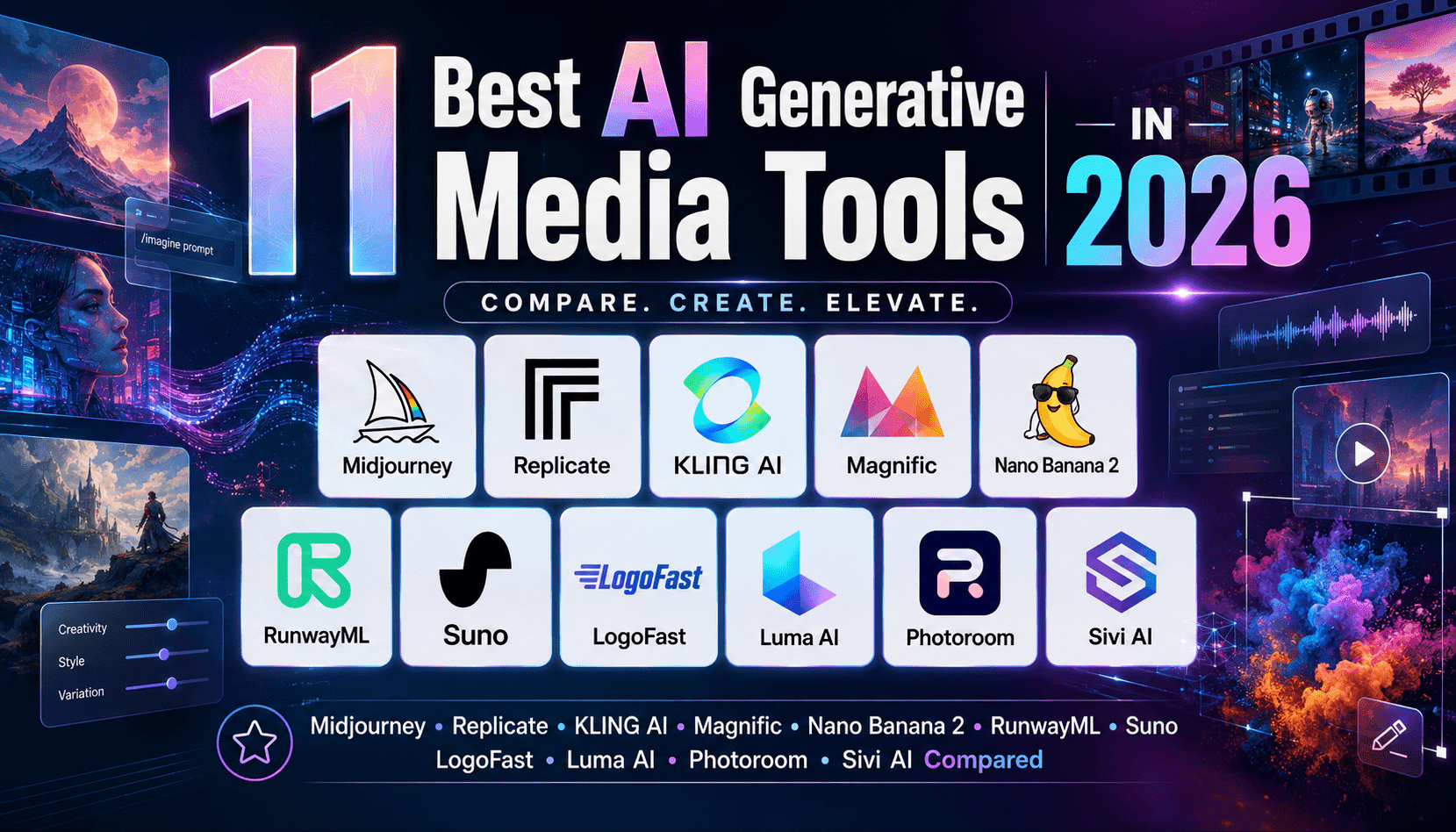
AI BriefGenerative media in 2026 is no longer a single-tool decision. Teams now assemble focused stacks: artistic image ideation, production-grade video, product-ready photo cleanup, real-time upscaling, rapid branding, music cues, and developer-accessible APIs. This guide positions eleven widely adopted tools by outcome and buyer type: Midjourney for high-aesthetic visuals, RunwayML and KLING AI for video, Luma AI for 3D-leaning workflows, Magnific for enhancement, Nano Banana 2 for Gemini-powered image/editing, Photoroom for commerce imagery, Suno for music, LogoFast for logos, Sivi AI for automated marketing visuals, and Replicate for model hosting via API. Use this to shorten pilots, control costs, and choose the right path to quality, speed, and creative control.
Generative media purchasing has matured from single-model bets to outcome-first stacks. The right choice tracks the work product: concept art, brand assets, UGC ads, ecommerce imagery, cinematic shorts, or soundtrack cues. Equally important are operational fit and guardrails—API access, throughput and latency targets, rights and consent controls, and cost predictability. This guide maps eleven standout platforms to real production needs, highlighting where they excel, where they compromise, and how to combine them into dependable workflows. If you’re a creator, marketer, designer, developer, or product lead, use the comparisons here to decide when to rely on UI-first tools, when to automate via APIs, and when to run hybrid pipelines.
For images, Midjourney remains the reference for high-quality, painterly art direction and fast style exploration. Nano Banana 2 brings Gemini-powered prompting and editing agility, while Magnific specializes in enhancement and upscaling without plasticky artifacts. Photoroom targets commerce: background removal, staging, and bulk-ready product images. On video, RunwayML offers accessible timelines and masking; KLING AI pushes toward cinematic motion and consistency; Luma AI leans into 3D-aware scenes and camera moves. Suno covers music and songs for quick cues. LogoFast spins up logos and variants rapidly, while Sivi AI automates channel-ready ads and marketing visuals. Replicate then ties it together for developers: hosted models, version pinning, and pipelines at scale.
Procurement-wise, evaluate by the quality–time–cost triangle and downstream editability. Run a two-week pilot: define 5–10 representative prompts or briefs per use case, measure first-pass acceptance rate, edit minutes per asset, rendering latency, and per-deliverable cost. For enterprise, confirm commercial terms, likeness/voice policies, watermarking, audit logs, model versioning, and SLAs. Validate temporal consistency for video (faces, logos, lighting), text legibility for ads, and artifact behavior under aggressive upscaling. For APIs, test concurrency, backoff strategies, and queueing. When outputs impact brand equity or legal exposure, implement review gates and store prompts, seeds, and parameters as evidence to support compliance and repeatability.
Key Takeaways
Stack by Deliverable
Pair an ideation tool (Midjourney/Nano Banana 2) with a finishing tool (Magnific/Photoroom) and, if needed, a video or 3D engine (RunwayML/KLING AI/Luma AI), then automate with Replicate where scale matters.
Measure Quality–Time–Cost
Run a two-week pilot with representative briefs and track first-pass acceptance, edit minutes per asset, per-deliverable cost, and 95th percentile latency before committing budget.
Governance Before Scale
Lock licenses, likeness/voice consent, watermark policy, model versioning, and audit logging early—especially for brand campaigns and enterprise data flows.
Choose by Outcome, Not by Model Name
Start by classifying deliverables: concept art, social ads, product photos, cinematic shorts, 3D scenes, logos, and soundtrack cues. For aesthetics-first exploration, Midjourney sets the bar; for editable production assets, prioritize tools with masks, layers, or API-based control. If speed and volume drive your ROI, Sivi AI and Photoroom streamline repetitive design and product imagery at scale. For teams integrating across microservices, Replicate’s stateless API and versioned models reduce integration friction and simplify observability. Align selection to your bottleneck: creative iteration time, rendering latency, brand governance, or unit economics. The best stack usually pairs one ideation tool, one production workhorse, and one API layer for automation.
Images and Editing: Midjourney, Nano Banana 2, Magnific, Photoroom
Midjourney excels at moodboards and art direction with rich lighting and texture; use it to converge on look-and-feel before committing to production. Nano Banana 2’s Gemini-driven editing shines when you need iterative refinements from the same prompt context, improving continuity across variants. Magnific earns its keep late in the pipeline: denoising, deblurring, and upscaling while keeping edges, hair, and micro-contrast intact—critical for print and high-DPI ecommerce. Photoroom is purpose-built for catalog work: background removal, shadow realism, templated staging, and bulk operations. Practical tip: pair Midjourney or Nano Banana 2 for creation with Magnific for finishing, then pass to Photoroom for channel-specific crops and compliant backgrounds.
Video and 3D: RunwayML, KLING AI, Luma AI
RunwayML delivers approachable video generation and editing with timelines, masks, and text-to-video, making it suitable for marketing teams and editors who need control without heavy engineering. KLING AI targets cinematic motion, character consistency, and more coherent scene dynamics, useful for narrative shorts and hero shots. Luma AI bridges video and 3D reasoning: stronger camera moves, scene geometry awareness, and useful outputs when you need parallax and spatial continuity. During trials, score models on identity stability, motion coherence, letterforms and signage, and edit survivability after color, crop, or conform. Budget for render retries: plan 20–30% extra time for prompt tuning and late-stage continuity fixes.
Audio, Branding, and Creative Automation: Suno, LogoFast, Sivi AI
Suno is ideal for generating music cues, jingles, and song drafts that match tempo and mood briefs; keep a library of stems to adapt for cutdowns. LogoFast gets you to a credible logo concept pack fast—use it for greenfield startups, hackathons, or rapid rebrands, then hand selected marks to a designer for polish. Sivi AI automates marketing visuals: ad variations, size adaptations, and brand-safe layouts across platforms. Combine them to compress production cycles: draft logo and palette in LogoFast, produce ad sets in Sivi AI, and layer Suno cues for motion spots. Governance tip: lock a lightweight brand kit and require AI outputs to inherit fonts, safe colors, and exclusion zones.
APIs, Governance, and Deployment: Replicate’s Role
Replicate is the developer linchpin: a stateless API for model inference, version pinning, and queue-friendly operation. For production, enforce request idempotency, exponential backoff, and structured logging of prompts, seeds, and model versions. Confirm content and likeness policies; some vendors limit human faces, custom voices, or brand marks without consent. Ask for VPC or private deployments if you handle PII or embargoed assets. Operational checks: concurrency ceilings, cold-start behavior, watermark handling, and SLAs for 95th/99th percentile latency. Legal checks: explicit commercial-use terms, indemnity scope, takedown process, and audit trails. Bake these into your SOW to avoid rework when campaigns hit scale.
Frequently Asked Questions
How should I combine these tools into a single production workflow?
Use a three-stage pipeline: ideation (Midjourney or Nano Banana 2) to explore style; production (RunwayML/KLING AI/Luma AI for video, Photoroom for product shots, Magnific for finishing); automation (Replicate) to batch, version, and monitor at scale. Store prompts, seeds, and outputs for QA and reuse.
What metrics best compare video generators for marketing work?
Score temporal consistency (faces, typography, lighting), motion coherence, edit survivability (after color/crop), render latency at target resolution, retry rate to hit brief, and cost per usable second of footage. Validate export formats and timeline controls if you finish in NLEs.
Are generative outputs safe for commercial use out of the box?
Policies vary. Confirm each tool’s commercial terms, restrictions on likeness/voice/logo use, and watermarking. For sensitive campaigns, require consent workflows, brand safety filters, and audit logs. Keep a license record per asset and apply internal review gates before distribution.