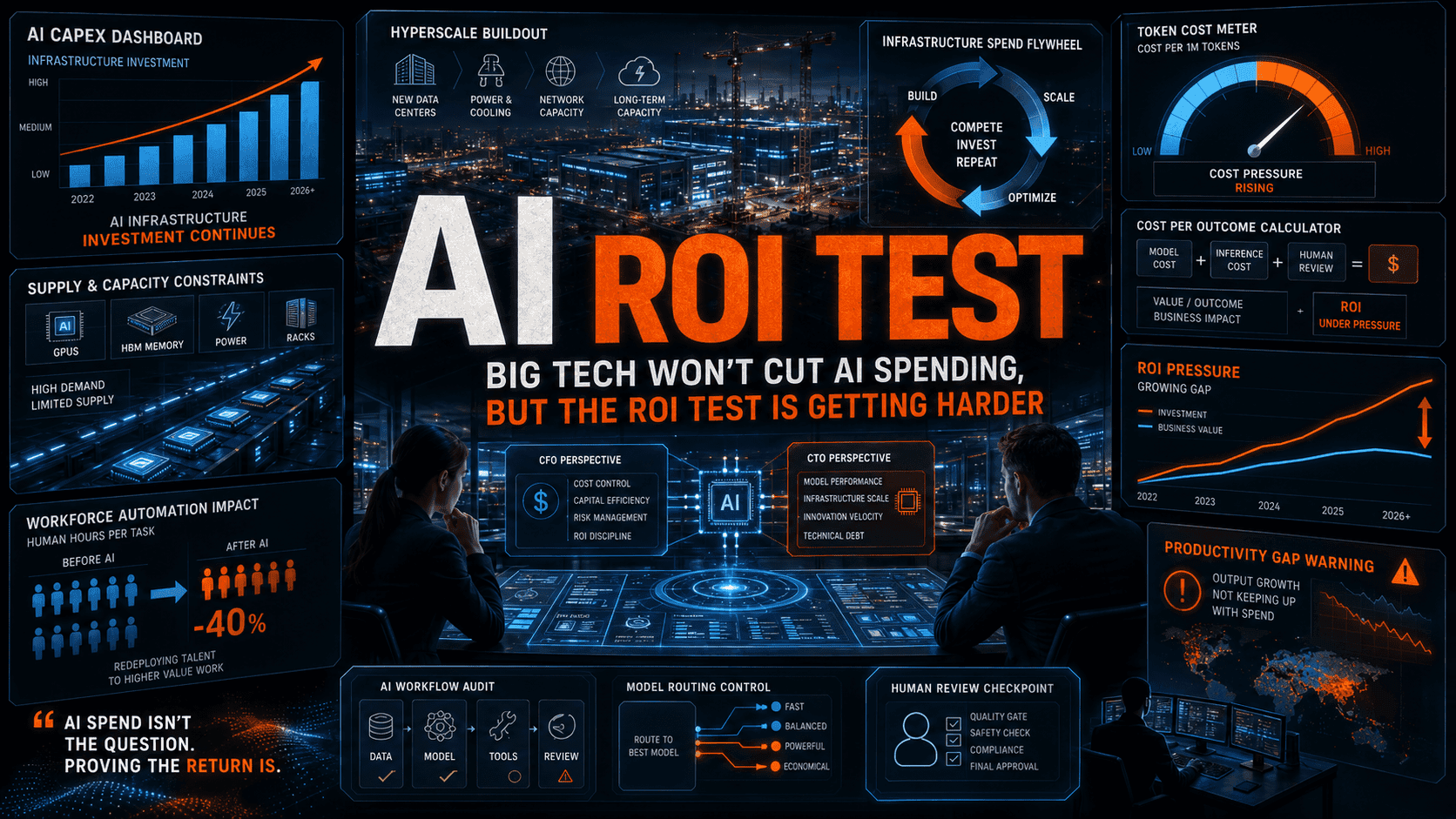
AI infrastructure spending is still accelerating, but enterprises are learning that replacing people with AI does not automatically lower costs unless workflows, tokens and outcomes are managed carefully.
The AI market is entering a more disciplined phase. Tech giants are still spending aggressively on data centers, GPUs, memory, networking and AI platforms, but investors and enterprise customers are becoming less patient with vague productivity promises.
The tension is simple: AI infrastructure looks strategically necessary, but AI adoption can be more expensive than expected. Companies may reduce headcount, automate tasks or deploy copilots, only to discover that model usage, integration work, human review, compliance and failed automation attempts create new costs.
That does not mean AI spending will collapse. It means the market is shifting from enthusiasm to measurement. The winners will be companies that can turn AI infrastructure into repeatable, profitable and trusted workflows rather than simply buying more compute and hoping productivity appears.
Why Big Tech is unlikely to cut AI capex quickly
For hyperscalers, AI spending is defensive as well as offensive. Cloud providers need capacity for enterprise customers, internal products, model training, inference workloads and developer platforms. Falling behind on infrastructure could mean losing the next generation of cloud demand.
This is why AI capex can remain high even when investors are nervous. Microsoft, Amazon, Google and Meta are not only chasing speculative AI upside; they are building the physical layer for search, cloud, productivity software, advertising, assistants, agents and developer ecosystems.
The cost problem is moving from chips to workflows
At the company level, AI cost is no longer just the price of a model API. It includes tokens, seats, tools, cloud infrastructure, data preparation, security controls, training, governance, integration work and the human time required to check AI outputs.
This is why some AI deployments can cost more than the people they were supposed to replace. If a company automates a role without redesigning the workflow, it may create a more complex system where employees spend time supervising, correcting and routing AI outputs instead of doing simpler work directly.
Headcount replacement is the wrong ROI model
The weakest AI business case is direct replacement: remove people, add AI, expect costs to fall. That model often misses the real economics. AI works best when it compresses cycle time, improves throughput, reduces errors, increases quality or lets smaller teams handle more valuable work.
A better ROI model asks what outcome changed. Did customer tickets close faster? Did analysts process more documents? Did developers ship accepted code with less review? Did sales teams qualify better leads? Did finance teams reduce reconciliation work? These are the measures that matter.
Why hardware suppliers may keep winning first
The AI spending boom creates a near-term advantage for companies that sell the infrastructure: GPUs, accelerators, memory, networking, data center equipment, power systems and cooling. These suppliers can benefit even before AI applications fully prove their revenue models.
That creates a split in the AI market. The companies spending on AI must eventually show returns, while the companies selling into the buildout can capture revenue earlier. For AI users, this means tool pricing may remain sensitive to infrastructure costs, especially compute, memory and energy.
How AI buyers should control the cost curve
NexusAI users should evaluate AI tools by cost per completed outcome, not by excitement or model ranking alone. The right tool should reduce friction in a specific workflow and make the cost of each task more predictable over time.
Good AI cost discipline includes token budgets, model routing, human review thresholds, automation boundaries, error tracking, usage dashboards and clear before-and-after workflow metrics. The goal is not to use less AI; it is to use AI where it compounds value.