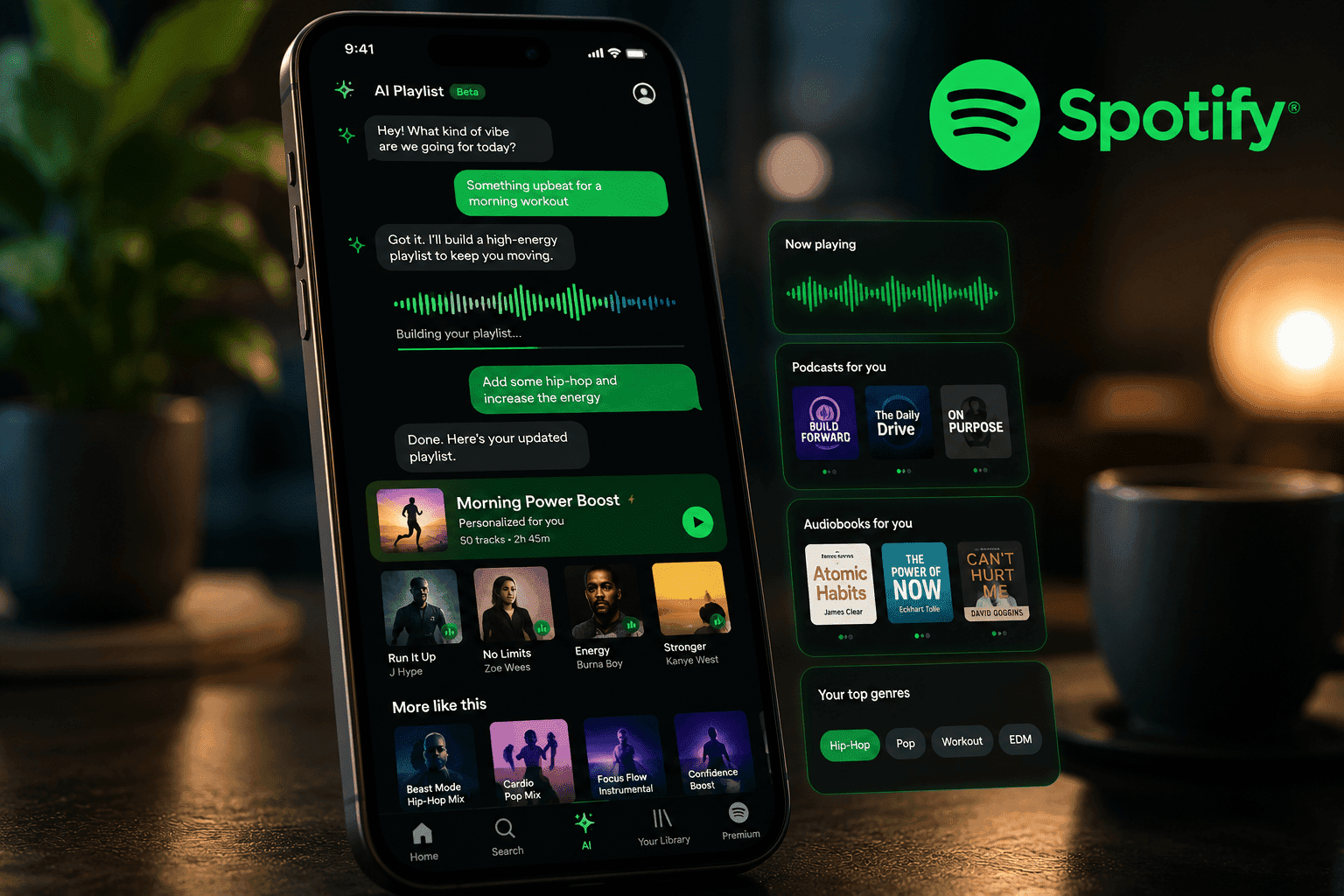
Spotify is rolling out a chat-style assistant that lets listeners talk through what to play next—across music, podcasts, and audiobooks—while grounding responses in the user’s history and Spotify’s catalog. The move shows why domain-anchored, action-capable AI can outperform generic chat for real discovery and retention.
Spotify is introducing a chat-style assistant that lets users ask for what they want in plain language—“something upbeat for a 30‑minute run,” “new indie artists like last week’s finds,” or “episodes that summarize this topic”—and then refine the results in real time. It operates across Home and Now Playing, accepts typed or spoken prompts, and taps your listening history to personalize suggestions. Crucially, it can also act: add to queue, save, follow, and pivot to adjacent content. This is a step beyond voice-only DJs or prompt-based playlist builders; it’s a conversational layer spanning music, podcasts, and audiobooks that is grounded in a closed, well-instrumented catalog.
Why it matters: domain grounding plus personal history turns a general LLM into a high-precision recommender interface. Instead of free-form generation, the assistant retrieves candidates from Spotify’s catalog and your embeddings, then re-ranks with intent gleaned from the dialogue. The result: fewer hallucinations, clearer intent capture, and a tight feedback loop where every follow-up improves relevance. It also shortens the path from desire to action—queue, save, follow—converting conversational intent into measurable platform events that compound over time and lift retention.
For product teams, this is the emerging blueprint for consumer AI: retrieval-grounded conversation sitting atop a well-labeled content graph, governed by policies and latency budgets, and evaluated with both offline ranking metrics and online causal lift. For investors, it’s a wedge that can expand average session length, increase new-artist exposure, and grow catalog utilization—signals correlated with subscription durability. For creators and rights holders, it introduces new paths to discovery and context—“what inspired this track,” “what to play next after this episode”—with potential for transparent attribution and creator-to-fan funnels if instrumentation is done well.
Execution challenges remain. Conversational state and real-time context must be fused with long-term profiles without amplifying filter bubbles. Safety, labeling, and age gating need to be reliable across modalities. Latency must stay under perceptual thresholds even when retrieval and re-ranking span millions of items. And evaluation must separate entertainment drift (“keep playing”) from genuine discovery lift (“new artists saved, catalogs explored”), or teams may overfit to chat engagement while missing durable value. Still, the product signal is clear: when an LLM is bound to a trusted catalog and empowered to act, discovery becomes a guided, two-way journey.
What Changed: Chat-Led Discovery Grounded in Catalog and History
The assistant moves Spotify from static rows and one-shot prompts to a live conversation that refines intent. Users can type or speak requests, review suggestions, and steer the system—“more recent,” “fewer explicit tracks,” “like this, but acoustic.” Unlike open-domain chat, responses are grounded in Spotify’s catalog and your listening footprint, which constrains outputs to playable items and reduces failure modes.
Beyond recommendations, the assistant executes platform actions—adding to the queue, saving tracks, following artists, or surfacing episode chapters. This turns dialogue into a control plane for the player and library, collapsing intent capture and fulfillment into a single flow and generating clean telemetry for ranking models and evaluation.
Why Grounded Conversation Beats Generic Chatbots
Generic assistants struggle with music rights, availability, and evolving catalogs. By anchoring to a known item graph and user embeddings, Spotify can retrieve candidates deterministically and let the LLM focus on interpreting intent, sequencing, and explanation. The conversation creates labeled preferences (“upbeat,” “studio version,” “similar to X but newer”) that re-rank results without free-form guessing.
Because every suggestion is playable and trackable, conversion signals—playthrough, skips, saves, follows—feed back into models. That closes the loop for experimentation (intent resolution rate, discovery lift, catalog diversity) and drives a compounding improvement that standalone chat apps can’t easily replicate.
Product and Architecture Pattern for Builders
Reference design: a) candidate generation via user and item embeddings (session-based + long-term), b) retrieval against a policy-filtered index, c) LLM for intent parsing and explanation, d) re-ranking with constraints (recency, safety, rights), e) action execution (queue, save, follow), and f) real-time telemetry for learning. Maintain a short-term session memory separate from durable profiles to avoid overfitting transient moods.
Operational tips: enforce latency budgets (<150–250 ms retrieval, <700 ms overall for snappy feel), localize safety filters, and expose user-controllable levers (energy level, familiarity, language). Evaluate with offline metrics (NDCG, recall@K, diversity@K) and online lift (new-artist saves, first-time plays, follow rate). Instrument conversation resolution rate—the share of sessions that end with a satisfying play.
Risk, Safety, and Privacy Limits to Watch
Conversational systems can amplify biases and create taste tunnels if they only reinforce recent behavior. Mitigate with diversity constraints, serendipity budgets, and periodic exploration. Age gating and content labeling must work consistently across music, podcasts, and audiobooks, especially when the assistant explains topics or recommends deep-dive episodes that may be sensitive.
Privacy considerations include minimizing raw text storage, separating analytics from identifiable data, and offering controls to clear conversational history. Provide clear attribution when the assistant references creator context, and allow opt-outs from certain personalization signals to maintain user trust without degrading baseline quality.
Measuring ROI and Operating the Assistant
Anchor KPI trees around discovery and retention: conversation resolution rate, add-to-queue/save/follow per session, new-artist exposure rate, first-time play conversions, catalog diversity, and downstream subscription durability. Watch latency percentiles, content policy violations, and abandonment after assistant prompts as leading indicators of UX quality.
Operationalize with an experimentation backlog: prompt templates, grounding sources, exploration ratios, and explanation styles. Maintain a safety review for new content types and languages. Treat the assistant as a continuously learning surface: harvest high-signal phrases to improve retrieval schemas and adjust re-ranking to seasonal and context signals (time of day, device, activity).