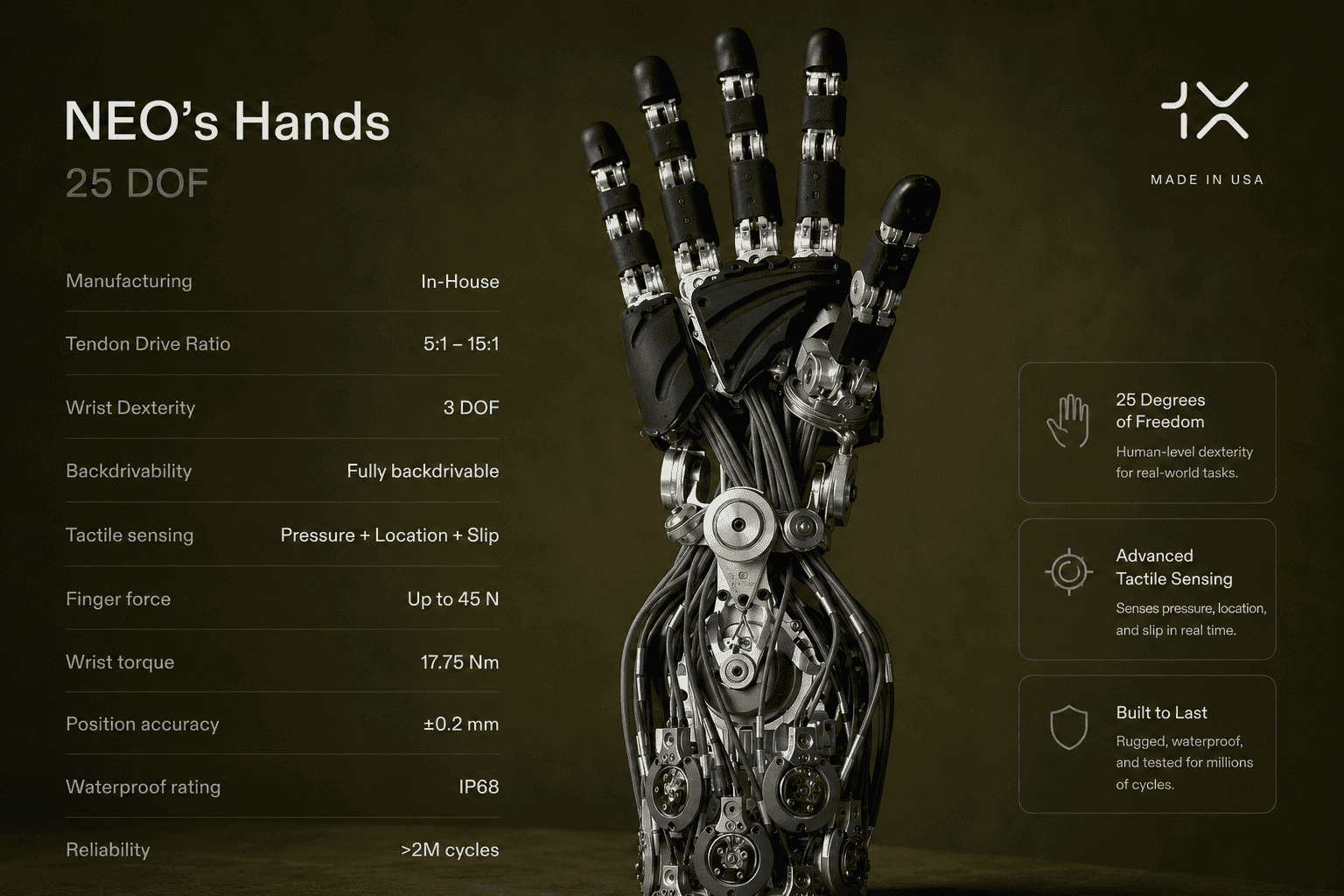
1X’s NEO debuts 25‑DoF, tendon‑driven hands with force transparency, full backdrivability, high‑resolution tactile skin, and IP68 sealing—shifting humanoids from "write‑only" grippers to read‑write manipulators. The result: near human‑level dexterity, safer interaction, and a data flywheel that advances embodied AI beyond demo‑ware.
Most robot hands are write‑only: they execute positions but feel little through their own joints. NEO’s 25‑DoF tendon hands flip that paradigm, exposing a read‑write surface where force flows out and information flows back. Low gear ratios (≈5:1–15:1) make all joints fully backdrivable, so contact forces aren’t lost in friction. Combined with native force control and high‑resolution tactile skin, the platform promotes manipulation from pre‑scripted moves to experiment: probe, feel, adapt. Practically, that expands task coverage from pick‑place to fine in‑hand operations, tool use, and compliant interaction—without bolting on external sensors that complicate reliability and latency.
The allocation of those 25 DoF matters more than the count. Anatomy‑inspired distribution—especially a genuinely opposing thumb—unlocks stable precision grasps and dynamic regrips. Peak torques near 3.5 Nm at the thumb CMC, 2.6 Nm at finger MCPs, and up to 45 N distal flexion deliver useful strength, while a 17.75 Nm wrist supports tool forces and load transfer. ±0.2 mm positioning accuracy keeps the platform effective in the small‑object regime where most human work lives. IP68 sealing and food‑safe materials broaden environments, from sinks to light food handling, while millions‑cycle validation and low distal inertia reinforce uptime and safety in contact‑rich workcells.
Tactile and proprioceptive streams are the foundation for policy learning and rapid recovery. Slip detection through shear channels triggers sub‑second regrips; full‑loop proprioception keeps the controller aware of pose and effort at all times. That means every grasp becomes training signal—self‑labeled by the physics of interaction—shrinking reliance on brittle visual heuristics for transparent, deformable, or occluded objects. The upshot for deployments is fewer handcrafted edge cases, faster iteration, and a clearer path to generalization provided operators can capture, version, and replay high‑bandwidth contact traces and reward functions tied to throughput, damage rate, and cycle‑time variance.
For buyers, the question shifts from “Can a gripper do this?” to “What’s our manipulation envelope, data pipeline, and maintenance plan?” Evaluate by structured tasks—threading, in‑hand rotation, tool engagement, and liquid handling—under timing and safety constraints. Map torque and bandwidth requirements to your SKUs and fixtures, and pressure‑test recovery from slips and collisions. Plan for tendon service intervals, skin replacement, and end‑to‑end telemetry: if you can capture millions of contact‑rich episodes, you are compounding capabilities. If not, you risk an expensive demo. The strategic value is the read‑write loop—and your ability to scale it.
What Changed: From Gripper Verbs to Read‑Write Manipulation
NEO’s hands move beyond the three‑verb ceiling (pick, place, push) by combining tendon drives at low ratios with 25 force‑transparent DoF. Every joint both acts and senses, allowing precise force control and backdrivability across the hand and wrist. Dense tactile skin adds normal and shear channels across surfaces, not just the fingertips. The integration enables fine probing, in‑hand rotation, dynamic regrips, and tool coupling that typical high‑ratio, high‑friction geartrains can’t achieve without external fixtures.
For operators, this translates to higher task breadth without swapping end effectors, better robustness when parts vary, and safer human‑robot interaction thanks to compliance and low distal inertia. The hand functions as an instrument—measuring as it manipulates—so policies can adapt online and improve offline using rich contact histories.
Why It Matters: Data Flywheel for Embodied AI
The bottleneck in embodied AI is not only model size; it’s the quality and volume of labeled interaction data. A read‑write hand closes the loop: every grasp yields pose, joint effort, contact maps, and slip events—precise signals that train manipulation policies without expensive human labeling. With IP68, robust tendons, and validated cycle life, the platform can accumulate millions of episodes in messy, real environments where generalization pressure is highest.
Expect faster learning on transparent, deformable, and occluded objects; tighter control over damage rates; and improved cycle‑time consistency. Organizations that stand up capture, storage, and evaluation for contact traces will compound advantages, while those limited to vision‑only pipelines will stall on hard manipulation edges.
Systems Integration: Control, Bandwidth, and Safety
To exploit force transparency and tactile skin, your stack must sustain high‑rate control (≥500–1,000 Hz local loops) with low jitter, along with synchronized logging of tactile, proprioceptive, and vision streams. Latency budgets should prioritize reflexes—e.g., sub‑50 ms slip detection to regrip before failure—while higher‑level policies schedule exploration vs. throughput. Tool usage benefits from calibrated torque limits and guarded motions layered with vision to manage alignment and occlusion.
On safety, low gear ratios and backdrivability reduce impact energies, but you still need zone monitoring, pinch‑point analysis, and risk assessments for human‑robot collaboration. IP68 extends cleaning options and wet tasks; verify chemical compatibility for sanitizers and plan inspection intervals for skins, tendons, and cable routings.
Buyer Playbook: Proving Utility Beyond Demos
Run a 6–8 week pilot with a target bundle of tasks: (1) precision pick of small parts (≤10 mm features), (2) in‑hand reorientation and threaded engagement, (3) compliant wipe and pour, (4) tool use under load (screwdriver/light bulb). Track cycle time p50/p95, damage rate, regrip success after slip, recovery time from disturbances, and cumulative maintenance minutes per 1,000 cycles. Require ±0.2 mm placement accuracy and demonstrate wrist torque sufficiency for your torque profile.
For ROI, model labor offset plus quality uplift: fewer damaged items, reduced fixturing costs, and changeover time savings. For TCO, factor tendon/skin consumables, spare assemblies, and downtime for IP68 cleaning. Favor configurations that expose raw tactile and effort streams for your MLOps stack.