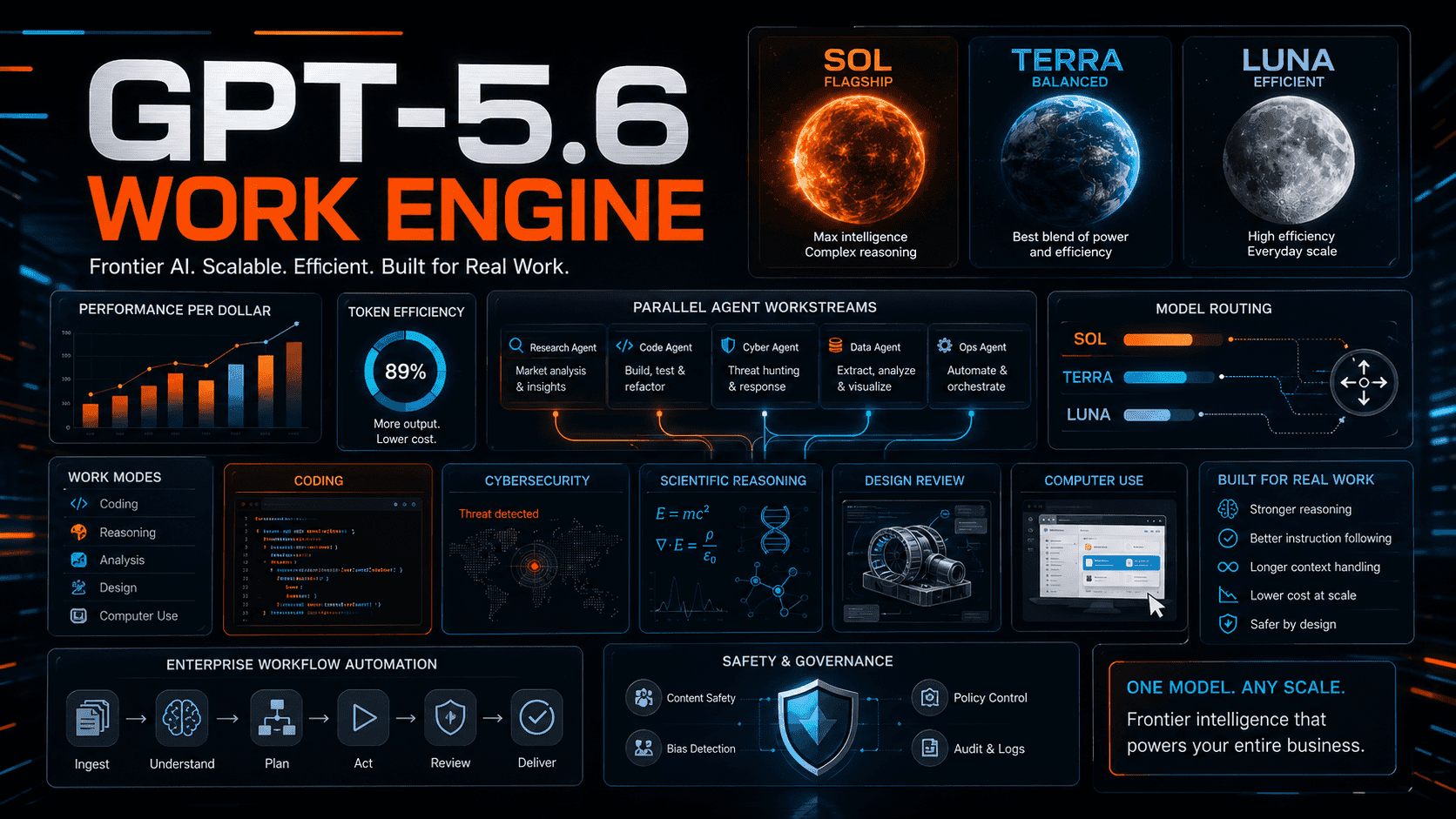
OpenAI’s GPT-5.6 family shifts the frontier model race toward performance per dollar, parallel agents, stronger computer use and practical knowledge-work execution.
OpenAI’s GPT-5.6 release marks a new phase in the frontier model race. Instead of presenting one model as the answer to every task, OpenAI is offering a family of models designed around different cost, capability and workflow needs.
The headline model is GPT-5.6 Sol, but Terra and Luna may be just as important for everyday adoption. Businesses do not only need the most powerful model; they need reliable intelligence at a cost that can scale across teams, automations, agents and customer-facing workflows.
The most important shift is that GPT-5.6 is being framed around successful work, not just benchmark scores. Better computer use, stronger design judgment, improved knowledge work and parallel agent execution point toward a future where frontier AI is judged by how much useful work it can complete per dollar.
GPT-5.6 Sol is the flagship for hard work
GPT-5.6 Sol is positioned as OpenAI’s highest-capability model in the family. Its role is to handle difficult work where accuracy, reasoning depth, tool use, coding strength and expert-level judgment matter more than raw speed or low cost.
For NexusAI users, Sol is best understood as the model tier for complex tasks: agentic coding, cybersecurity analysis, scientific reasoning, deep research, product design review, long workflow planning and high-stakes enterprise tasks where mistakes are expensive.
Terra and Luna make frontier AI more affordable
The broader GPT-5.6 story is not only Sol. Terra and Luna show how frontier AI is becoming a tiered system. Terra is suited for balanced everyday work, while Luna is designed for cost-efficient usage where scale and affordability matter.
This matters because most business AI workflows cannot run only on the most expensive model. Customer support, summarization, internal search, document drafting, translation, data cleanup and lightweight automation often need high reliability at predictable cost. A strong model family lets teams route work intelligently instead of overpaying for every task.
Ultra mode points to parallel agent execution
The new ultra setting is one of the most important signals in the release. Instead of treating a difficult task as one long model response, ultra coordinates multiple agents across parallel workstreams to complete complex work faster.
That changes how users should think about frontier models. The future is not only a smarter chatbot. It is a system that can divide work, inspect results, combine outputs, use tools and move toward a finished deliverable. This is especially relevant for coding, research, product analysis, security review and complex business planning.
Computer use and design judgment make GPT-5.6 more practical
OpenAI’s emphasis on stronger computer use and design judgment suggests GPT-5.6 is built for more than text generation. A model that can inspect, refine and deliver ready-to-use outputs becomes more useful in real workflows because it can work closer to the actual interface, file, codebase or deliverable.
For developers and operators, this means GPT-5.6 may be strongest when paired with tools such as Codex, browser control, document generation, spreadsheets, design systems and workflow automation. The model becomes the reasoning layer, while tools become the execution layer.
Safety and controlled rollout are now part of model value
Frontier model releases are increasingly judged not only by capability, but by how safely and responsibly they are deployed. As models become stronger in coding, cybersecurity, science and autonomous work, governments, enterprises and users will pay closer attention to release controls, safeguards and trust signals.
For AI buyers, this means safety is no longer a separate compliance topic. It is part of product selection. Teams should evaluate access controls, auditability, model-routing options, data handling, tool permissions, cybersecurity policies and whether a model can be deployed inside a governed workflow.