

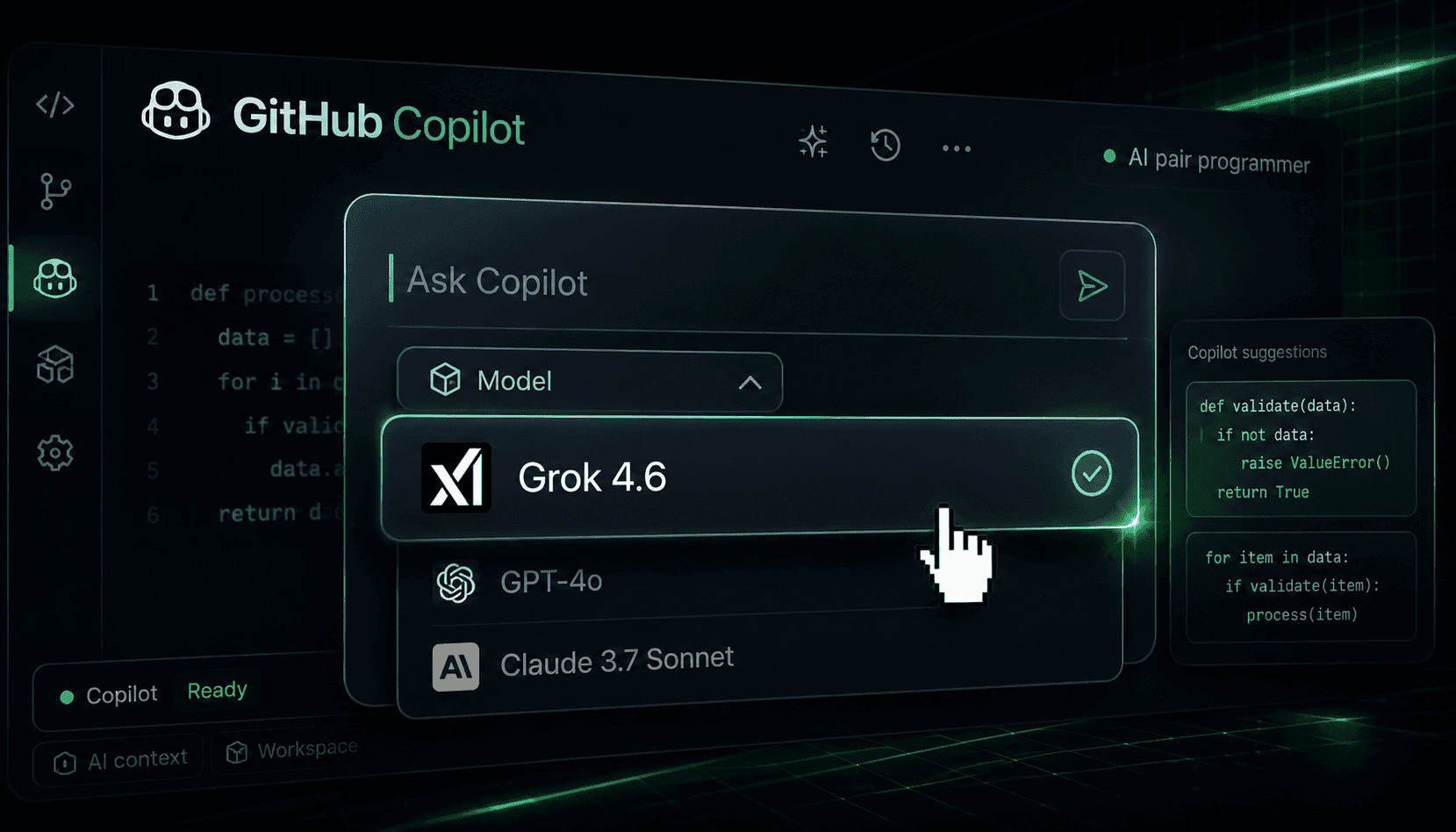
GitHub is adding Grok 4.6 to the Copilot model picker across VS Code, Visual Studio, JetBrains IDEs, Xcode, Eclipse, the Copilot CLI, and cloud agents. Framed as a frontier reasoning upgrade, Grok 4.6 targets long-horizon, multi-step tasks where the assistant sequences edits, shell commands, and tool invocations. Internal testing emphasized strong terminal performance and sustained reasoning—an angle that moves the model war from benchmarks into the IDE, where reliability over dozens of steps matters more than single-turn completion quality.
Why this is consequential: IDE-native agent behavior collapses context switching and lets developers keep the entire workflow—plan, code, run, debug, package—inside one orchestrated loop. Unlike chat-first coding models optimized for short snippets, Grok 4.6 is pitched at chaining tools, persisting intent, and recovering from errors in terminal-driven flows. That’s relevant to CI/CD scripting, data and infra tasks, containerization, and refactors that span services or repos. As Copilot integrates agents, the battleground shifts from raw token-level quality to end-to-end task completion speed and failure containment.
Access and operations will drive near-term outcomes. Grok 4.6 is rolling out gradually and is available across Pro, Pro+, Max, Business, and Enterprise plans, but many orgs will need admins to enable a Grok 4.6 policy flag. Pricing follows usage-based provider rates, raising two imperatives: model governance (who can run long agent sessions with shell access) and telemetry (tracking session duration, cost per completed task, and rollback rates). Smart teams will A/B Grok 4.6 against their current Copilot model on repeatable tasks—release scripts, infra migrations, multi-file refactors—to validate throughput, reliability, and cost-per-merge.