

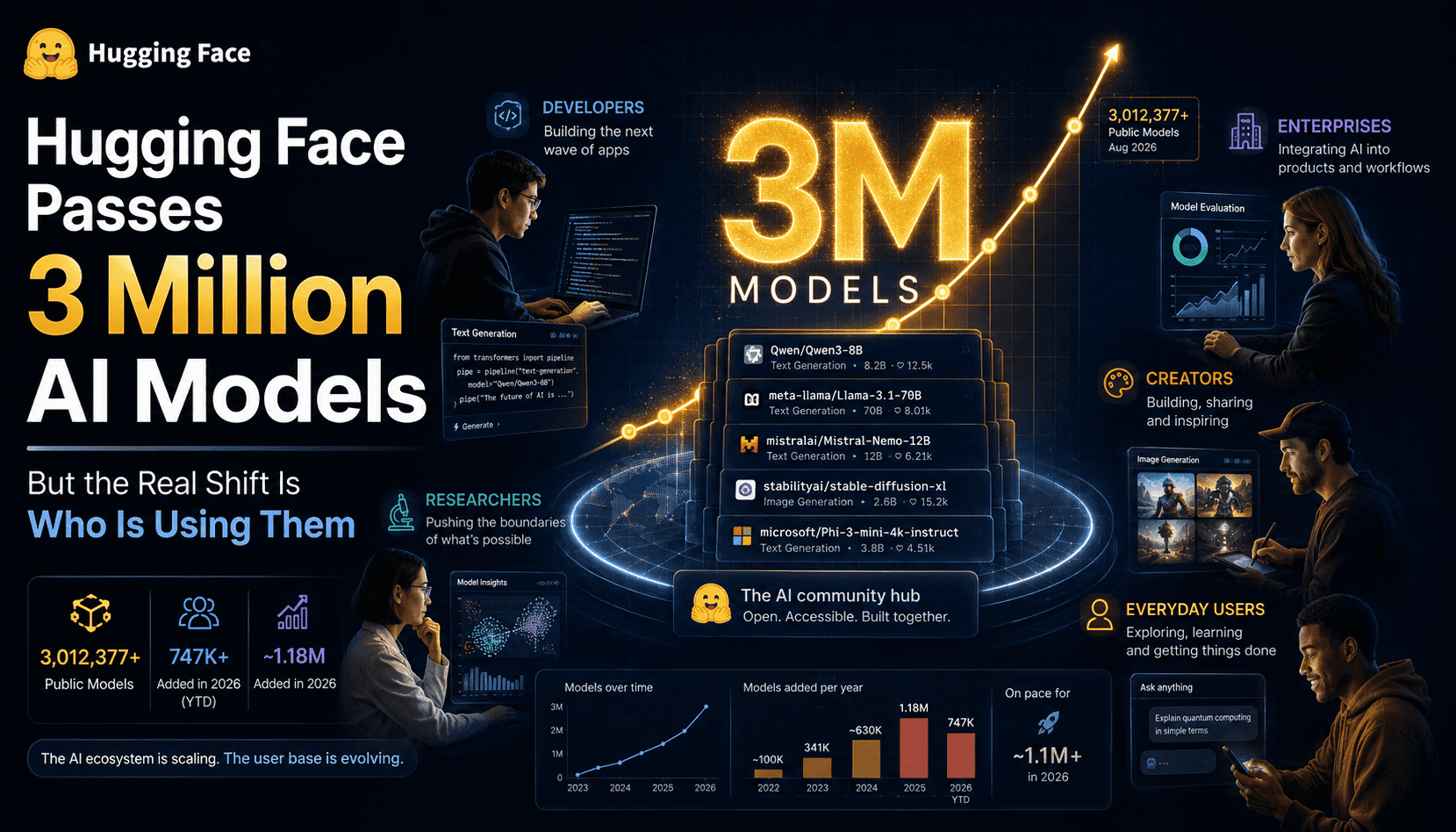
Hugging Face just cleared three million public models, a leap from roughly 2.26 million at the end of 2025. The raw number is striking, but the pattern behind it matters more: agents are now the top consumers of the Hub. In other words, repositories that once served human developers browsing and forking are being pulled into automated pipelines where software—planners, routers, and task-specific workers—selects, evaluates, and hot-swaps models on the fly.
The growth curve remains relentless, with several thousand new models appearing daily. Abundant supply is meeting increasingly agentic demand: retrieval-augmented generation, tool-using LLMs, and orchestrators that test candidates at runtime. Meanwhile, usage concentrates: a small share of models hoovers up nearly half of downloads, while the long tail sees sparse traction. That asymmetry rewards stable, well-documented, and tool-integrated releases, and it pressures teams to standardize evaluation and compatibility rather than chase every headline checkpoint.
For engineering leaders, the implication is operational. If agents choose models, the Hub becomes a live dependency graph, not a static catalog. You’ll need a private registry mirror, deterministic version pinning, input-output compatibility contracts, and automated regressions as models update. Cost physics also shift: agent throughput turns model I/O, inference endpoints, and egress into real line items. Treating models as ephemeral, interchangeable components only works if evaluation harnesses, caching, and fallbacks are built in from the start.
Geography and modality are changing the center of gravity too. Robotics has surged as a dataset category, reflecting the migration of models into embodied and industrial settings where agents must make decisions, not just draft text. Download share is tilting toward regions investing aggressively in open weights, and derivative families are compounding, creating dense ecosystems around a handful of base models. The result: faster iteration, but also new supply-chain and compliance exposure if provenance and licenses aren’t tracked end-to-end.