

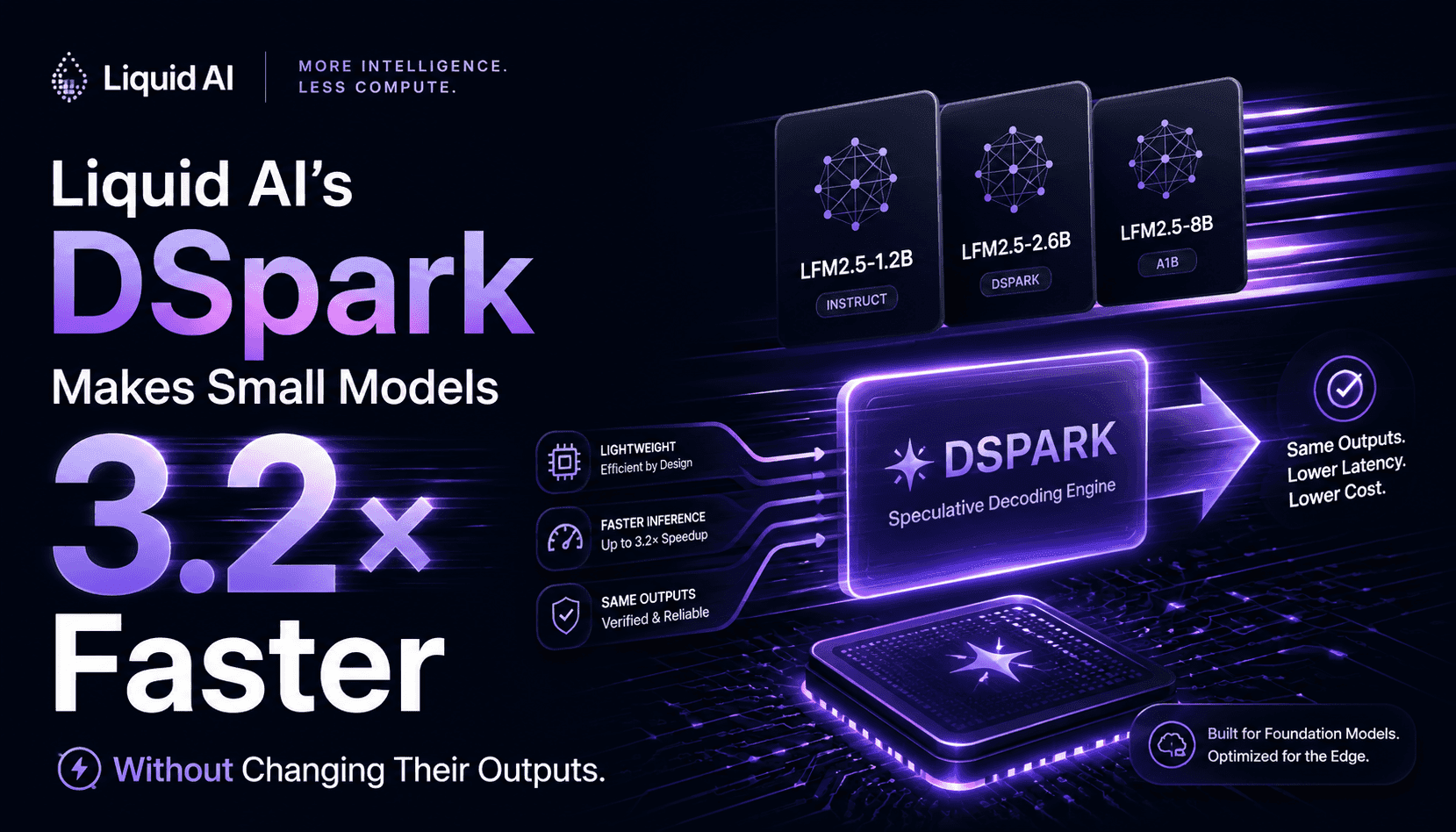
Liquid AI is shipping DSpark draft checkpoints for LFM2.5-1.2B-Instruct, 2.6B, and 8B-A1B that add speculative decoding to the decode path. The claim is straightforward: up to 3.18× throughput on a single H100 and up to 2.87× on-device, while keeping greedy outputs identical to baseline. That parity matters—DSpark verifies every proposed token—so teams can adopt the speedup without compromising established evaluation baselines. With day-one support in SGLang and llama.cpp, the rollout isn’t just a lab demo; it’s immediately runnable in common inference stacks. The impact is most visible where small models must feel instant: local chat, coding assistants, and agentic function-calling, where DSpark also cuts latency materially.
Why does this work now? LLM decoding is often memory-bound: repeatedly pulling large weights from DRAM dominates latency. DSpark tackles this by using a compact drafter that proposes multiple tokens, then having the target model verify them in a single pass—amortizing the weight traffic. Its recipe pairs a DFlash-style parallel backbone with a lightweight Markov head to add inter-token dependency, and a confidence-scheduled verifier that prunes low-confidence suffixes. Liquid AI’s drafters are ~300M parameters and trained for acceptance rather than pure loss, pushing more verified tokens per pass. The result: fewer round trips through memory per emitted token, which translates into higher throughput without changing greedy outputs.
Performance isn’t flat across contexts. For small dense models (1.2B–2.6B), DSpark delivers consistent 2–3× gains on GPUs and strong on-device speedups that cross the “feels instant” threshold for interactive use. The 8B-A1B MoE model shows robust GPU gains but thinner on-device improvements due to current Metal MoE efficiency and the cost of verifying multiple tokens across more experts. Still, DSpark’s ability to raise tokens-per-second on laptops makes local assistants and agents meaningfully more useful, and in agentic flows Liquid AI reports average function-calling latency dropping by more than half—an outsized win for tools-heavy scenarios where turn-time is the bottleneck.
Operationally, DSpark is a low-friction upgrade: attach the draft to the target model in SGLang or use a DSpark-enabled llama.cpp build, then monitor acceptance rate and draft_n/draft_n_accepted to validate benefit. Start with the drafter that matches your LFM2.5 target and a moderate block size; tune for your domain text to stabilize acceptance. Because speculative decoding is exact under greedy, your evaluation harnesses and benchmarks remain apples-to-apples. For production, validate agentic performance end-to-end—especially tool latency and function-calling cadence—since DSpark’s practical ROI appears largest where multi-step tool calls dominate response time.