Loop Engineering Could Replace Prompt Engineering for AI Coding Agents
Loop Engineering shifts AI coding work from writing better prompts to designing systems that continuously guide, test, evaluate and improve agents until the goal is reached.
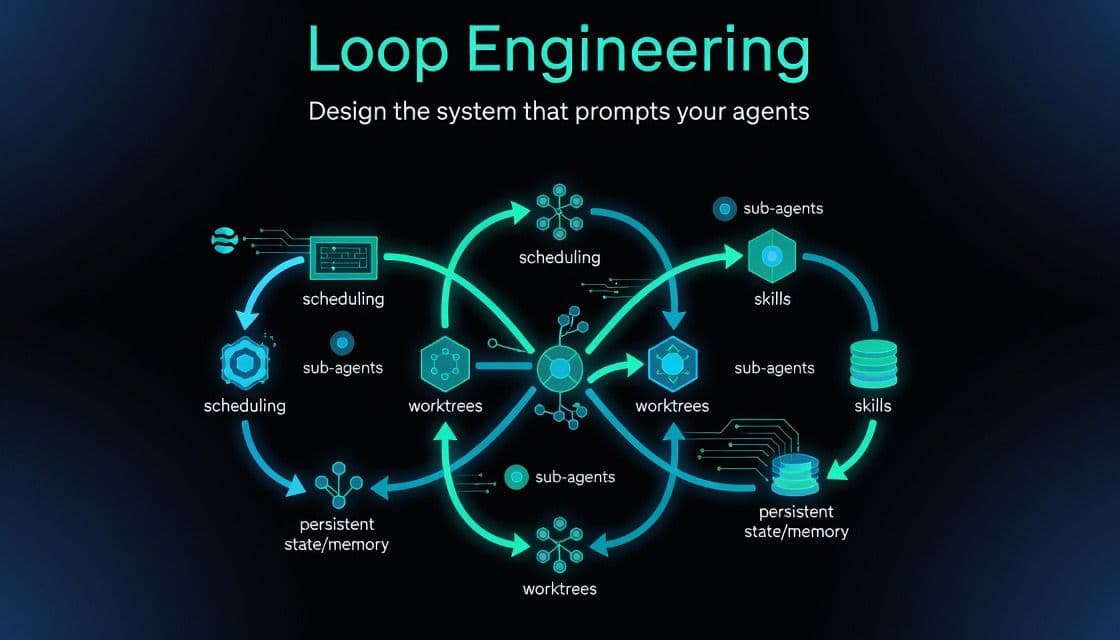
AI BriefLoop Engineering is emerging as a new discipline for working with autonomous AI coding agents. Instead of manually crafting one perfect prompt, engineers design iterative systems where agents act, observe results, evaluate progress, refine their approach and continue until the objective is achieved. For NexusAI users, this matters because the future of AI development may depend less on prompt wording and more on agent loops, evaluation design, guardrails, tests and feedback systems.
Prompt engineering helped users learn how to get better answers from AI models. But as coding agents become more autonomous, a single prompt is no longer enough. Modern agents can inspect codebases, edit files, run commands, read errors, update plans and retry. That means the important skill is shifting from writing better instructions to designing better feedback loops.
Loop Engineering describes this shift. Instead of acting as the person who repeatedly prompts the AI agent, the engineer builds the system that does the repeated prompting, testing, evaluation and correction. The agent does not simply answer once; it cycles through action, observation, evaluation and refinement until the task reaches an acceptable result.
For developers and AI tool users, this changes how coding agents should be evaluated. The question is no longer only which model writes the best code from one prompt. The better question is which agent system can reliably close the loop: understand the goal, make changes, check its work, recover from errors, avoid unsafe behavior and produce production-ready output.
Key Takeaways
Loop Engineering shifts the skill from prompts to systems
The core job is no longer writing one perfect prompt, but designing an iterative agent workflow with goals, tools, feedback, evaluation and stopping conditions.
Evaluation is the heart of reliable agent loops
Tests, linting, security checks, acceptance criteria and human review turn agent iteration from blind retrying into measurable improvement.
AI coding tools should be judged by their loops
When comparing coding agents, users should look at planning, execution, observation, recovery, tool safety and validation—not only model quality.
Why prompt engineering is no longer enough
Prompt engineering works well when the AI interaction is simple: ask a question, get an answer, refine manually. Coding agents are different. They operate across files, commands, tests, dependencies, logs, project constraints and user requirements. A single prompt cannot predict every failure mode or guide every decision inside a long-running task.
That is why developers are moving toward loop-based systems. A loop gives the agent a process: attempt the task, observe what happened, evaluate whether the result is good enough, decide what to change, and continue. This makes the workflow more like engineering an autonomous system than writing a clever instruction.
The core loop: act, observe, evaluate, improve
A practical loop engineering workflow starts with a clear objective and success criteria. The agent then takes an action such as editing code, writing tests, creating a file, running a command or summarizing a system. After that, it observes the result through test output, runtime errors, linting feedback, user review, logs or evaluation scores.
The most important step is evaluation. Without evaluation, the loop becomes blind repetition. Good loops include automated tests, acceptance checks, static analysis, security rules, performance thresholds, style guidelines and human approval points for risky changes. The agent improves because it has structured feedback, not because it is prompted harder.
Loop Engineering turns agents into systems, not chat sessions
The biggest mindset shift is that the agent becomes part of a system. A developer is no longer only chatting with a model; they are designing a workflow with memory, tools, constraints, tests, retries and stopping conditions. That workflow can run longer, recover from mistakes and handle larger tasks than a normal prompt-response pattern.
This is especially relevant for coding agents because software engineering already depends on loops: write code, run tests, inspect errors, refactor, review, deploy and monitor. Loop Engineering adapts that discipline to AI agents so they follow more of the same engineering rhythm that experienced developers already use.
Where loop design can go wrong
Loop Engineering can create powerful workflows, but it also introduces new risks. A poorly designed loop can waste tokens, repeat bad assumptions, over-edit working code, chase irrelevant errors, ignore business context or continue running after it should stop. More autonomy does not automatically mean more reliability.
The best loops include guardrails. Developers should define budget limits, rollback points, safe tool permissions, human approval for destructive actions, clear completion criteria and separate evaluation steps. A loop should make the agent more disciplined, not simply more persistent.
How NexusAI users should apply Loop Engineering
NexusAI users should think of Loop Engineering as a framework for choosing and using AI coding tools. The best agent is not only the one with the strongest model, but the one that supports structured workflows: planning, tool use, test execution, evaluation, memory, review and safe iteration.
For developers, the practical starting point is simple: define a task, define success checks, allow the agent to attempt the task, run automated validation, let it fix failures, and require human review before merging. Over time, this can evolve into reusable agent workflows for bug fixing, refactoring, documentation, test generation, dependency upgrades and product feature implementation.
Frequently Asked Questions
What is Loop Engineering in AI coding?
Loop Engineering is the practice of designing AI agent workflows that repeatedly act, observe results, evaluate progress and improve until a goal is achieved. It is especially useful for coding agents that need to run tests, fix errors and refine work over multiple steps.
How is Loop Engineering different from prompt engineering?
Prompt engineering focuses on writing better instructions for a model. Loop Engineering focuses on building the system around the agent: objectives, feedback, tool access, evaluation checks, retries, safety controls and completion criteria.
Who should care about Loop Engineering?
Developers, AI product builders, technical founders and teams using coding agents should care because loop design can determine whether an agent produces reliable work or simply repeats mistakes. It is most useful for complex tasks such as refactoring, testing, debugging and feature implementation.