

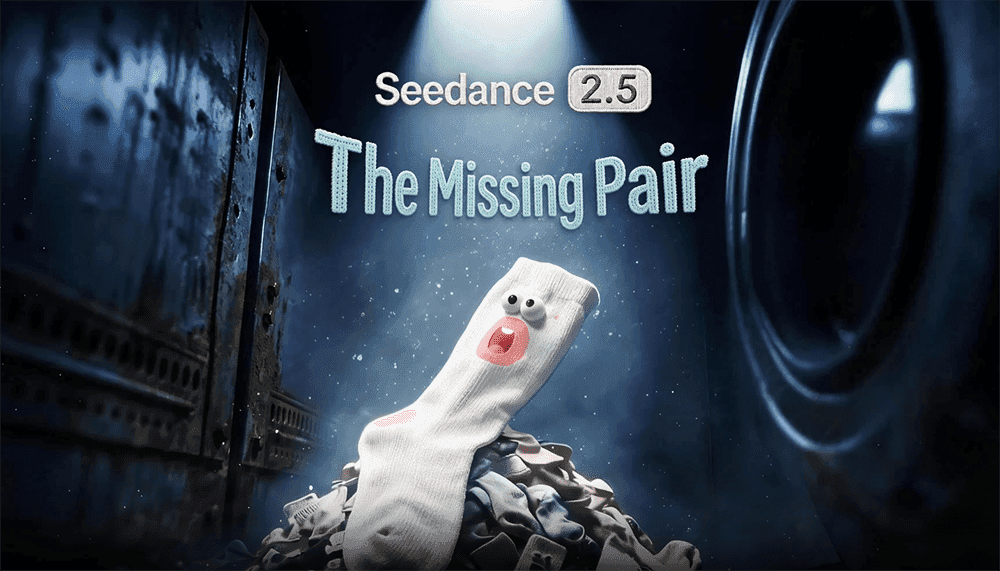
Seedance 2.5 marks a turn from short novelty clips to controlled, storyboard-length sequences. The model generates up to 30 seconds in one pass and can extend twice, keeping motion consistent while honoring the creative intent embedded in references. Crucially, it interprets framing and cinematic language rather than simply copying movement, which makes edits—camera moves, timing, and performance blocking—respond more predictably. Combined with white-model control for look-dev, and native green-screen support for downstream compositing, Seedance 2.5 starts to look like an early pre-visualization and fast content tool rather than a toy. For production teams, this means fewer dead-ends and more reusable shots across versions.
What materially changes in workflows is continuity. Thirty seconds is enough to stage a beat: establish, push in, reveal, and resolve. With stronger reference adherence, characters, props, and blocking survive shot-to-shot evolution, making it practical to extend a scene or re-time action without losing identity. Editors can plan A/B variations on camera paths and performance, then composite foregrounds over branded sets or product plates via green-screen. Marketers get faster iteration on social cuts and explainers, while studios can build mood films and previz reels that inform lighting, set design, and story pacing before committing to live action or 3D-heavy pipelines.
This maturity brings new buyer criteria. Rather than judging single-shot wow moments, evaluate storyboard fidelity across an entire 30-second arc: temporal coherence, character consistency under lighting changes, lip-sync and audio beat matching, and the reliability of edit instructions. Check how well green-screen plates key, whether color management plays nicely with your grading pipeline, and how white-model outputs accelerate look-dev. Operationally, plan for higher compute needs and organize references like an asset library—pose turnarounds, style bibles, camera diagrams—so prompts remain repeatable. Finally, address rights management for references and institute QA for safety, likeness use, and brand controls before scaling output.
For decision-makers, the near-term ROI is time saved in previsualization, rapid social content, and iterative product storytelling. Small creative teams can prototype multi-beat sequences, test multiple blocking options, and hand NLE/VFX teams cleaner building blocks. Agencies and in-house studios should create preset shot libraries—establishers, dolly-ins, reveals—paired with reference packs to standardize outputs. Track measurable deltas: fewer reshoots in live action, reduced 3D keyframeing for blocking, and faster approval cycles. When piloting, cap scope to a two-extend narrative, define pass/fail metrics per shot list, and lock down a handoff format (EDL/markers, plate exports, LUTs) so the AI output slots cleanly into editing and finishing.